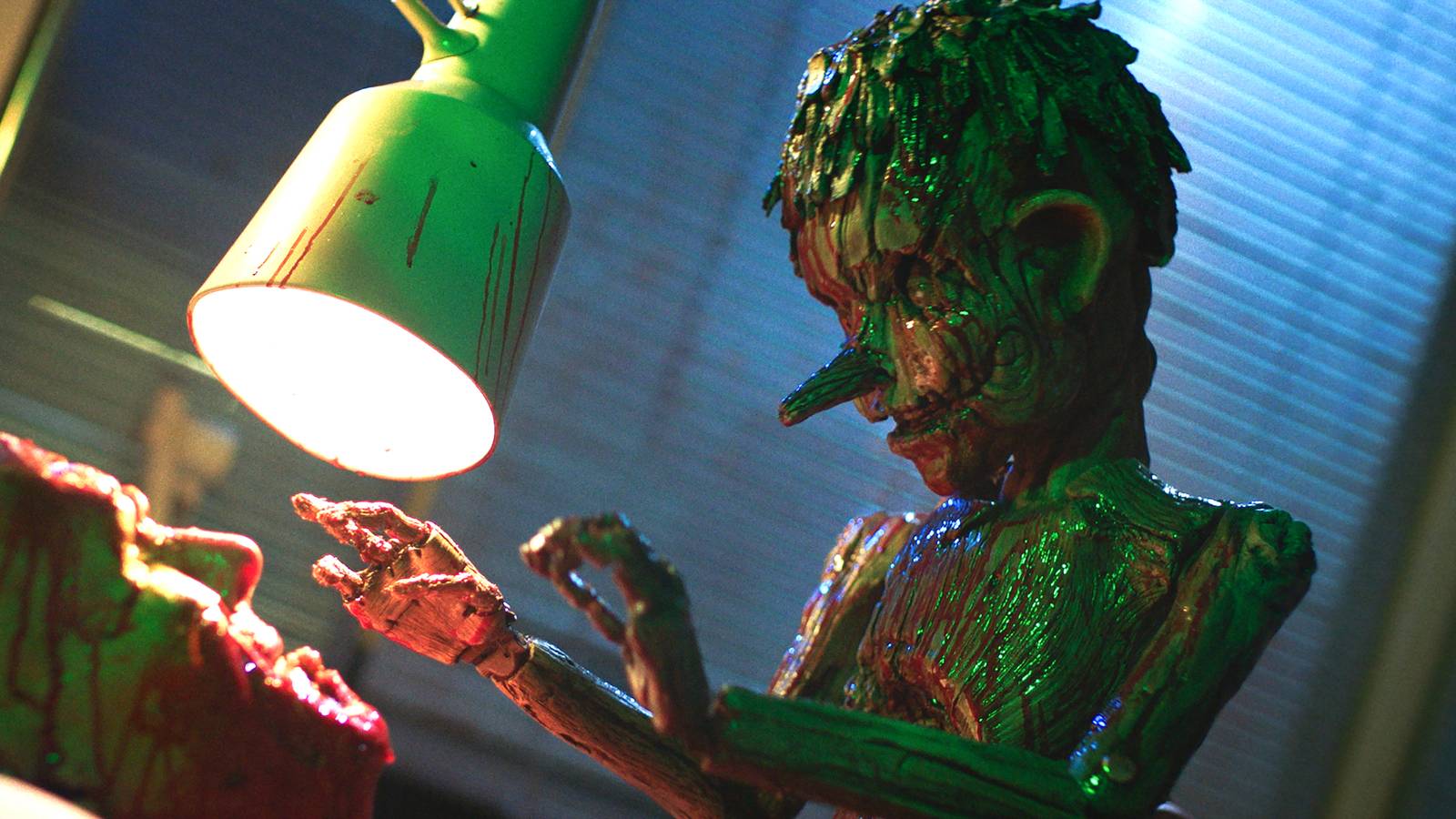
Published Jul 24, 2026, 2:00 PM EDT Grant Hermanns is a TV News Editor, Interview Host and Reviewer for ScreenRant, having joined the team in early 2021. He got his start in the industry with Moviepilot, followed by working at ComingSoon.net. When not indulging in his love of film/TV, Grant is making his way through his gaming backlog and exploring the world of Dungeons & Dragons with friends. Sign in to your ScreenRant account Warning: Some SPOILERS lie ahead for Pinocchio Unstrung!Carlo Collodi's iconic wooden boy has gotten a wild R-rated twist in Pinocchio Unstrung. Written and directed by Rhys Frake-Waterfield as part of his Twisted Childhood Universe, the new film stars Mayor of Kingstown's Richard Brake as Geppetto, who creates the eponymous magical puppet in the hopes of becoming a friend to his grandson, James. However, when James takes Pinocchio out into the world, the puppet learns of the dirty and dangerous nature of humanity, looking to kill anything bad and become a real boy. Alongside Brake, the Pinocchio Unstrung cast includes Silo's Cameron Bell as James, Nandor Fodor and the Talking Mongoose's Jessica Balmer, debuting star Jude Evan Lloyd as the voice of Pinocchio, horror icon Robert Englund as the voice of The Cricket, and Peter DeSouza-Feighoney and Scott Chambers reprising their TCU roles of Michael Darling and Christopher Robin. Frake-Waterfield has also enlisted Emmy winner Todd Masters, known for everything from James Gunn's Slither to the Child's Play reboot, for the creation of the eponymous puppet. Ahead of the film's July 24 release, ScreenRant's Grant Hermanns interviewed Rhys Frake-Waterfield, Scott Chambers, Robert Englund, Richard Brake and Todd Masters to discuss Pinocchio Unstrung. When asked about his approach to adapting the iconic tale into an unhinged R-rated story, Frake-Waterfield began by recalling that one of the first big questions he had during the writing and pre-production process was "where do I go" with creating the puppet, debating between going "practically" versus a "more digital, VFX-y route": Rhys Frake-Waterfield: You can see, people have wrestled with that in the past. You look at Guillermo del Toro's, he went fully practical with stop-motion. You look at Disney, they went more VFX. For me, I wanted to go down that practical route again, just because craftsmanship is inherently so fundamental to the Pinocchio story. Geppetto literally makes him, so we wanted to literally make him, as well. And because he is the hero of our film, he's both the victim and the villain, in a sense of what's happening. Frake-Waterfield went on to explain that, with this dedication to practical effects, it was important to bring someone onboard who "could really nail the design and make sure he actually worked well," while also "looking good on set," leading him to collaborate with Masters. Part of the reason he turned to the Emmy winner was having enjoyed his work on Child's Play and the 2019 horror sequel Brahms: The Boy II, praising Masters and his team at MastersFX as being "masters of puppets." Once he came onboard, Frake-Waterfield and Masters went through "multiple iterations" of Pinocchio's design, with the main discussion being about "how scary and demented should we go" with the character. Part of this challenge was because the movie had "moments where you actually want to connect with him" and brings an "innocent vibe" to the proceedings: Rhys Frake-Waterfield: But then there are other moments where you want to embrace the kind of sinisterness to him. And something which really lent itself to that was 1) the body horror aspect in terms of, as he was collecting parts and becoming more and more human, that inherently made him scarier. But also, a very underrated element was his nose. When he's got a little button nose, he's a bit more cute, and he's a bit more innocent. But when he's got that big fat, ol' long nose, it's like a knife coming out of his face. [Laughs] So he looks a lot more demented and a lot scarier. The writer/director expounded on the puppet's evolution in Pinocchio Unstrung by sharing that he "tried to play with that in the sound design," particularly when it came to the character's nose growing, in which Frake-Waterfield incorporated a "subtle" note of "his voice deepening," much like "an element of puberty." He also connected it to Pinocchio's journey of "getting a bit more corrupted" as the horror reimagining goes on. Another element that Frake-Waterfield and Masters really focused on with Pinocchio's design for the TCU movie was his overall size, as he "had to be a size which would work for various scripted elements," such as James bringing the puppet to school in his backpack, and therefore he "can't be too big." However, with him also needing to go down a murderous route, they couldn't "make him too small either": Rhys Frake-Waterfield: I think those guys have absolutely smashed it. A lot of people are very surprised when they see the test footage of all of the animatronics, and you can see his mouth moving, his eyebrows going, and they're convinced it's VFX, and it's digital, but it's not. It's fully practical. For Chambers, in reflecting on the early reception of Winnie-the-Pooh: Blood and Honey and his and Frake-Waterfield's efforts to continually improve the TCU, he explained that one of the biggest focuses of Pinocchio Unstrung's development was determining the way to "make it whatever suited it the best." More importantly, this led down the road of determining the "tone [that] is going to suit this the absolute best." The producer denoted taking a similar approach to previous TCU entry, Peter Pan's Neverland Nightmare — which he wrote and directed — in which they "couldn't afford the pirate ships" necessary for such a film, having only made the 2025 movie on an "incredibly low budget" of £250,000. Subsequently, he decided to take the film "down the dark route" for his reimagining of J. M. Barrie's fantasy classic and wanted to "go dark as f--k" with it: Scott Chambers: Also, we're all leading towards Poohniverse: Monsters Assemble, so we're trying to set up characters that you don't like as you get to that, because when you get there, you need to kind of instantly have a feeling about each character. So when we were looking at this one, I think a big lesson was like, "What tone is going to suit this the absolute best?" When it came to Pinocchio Unstrung, Chambers acknowledged that early conversations had him and Frake-Waterfield discuss the possibility of going with a "Conjuring/Annabelle vibe," but ultimately, because they were "massive fans of Chucky" and felt there "hasn't been anything like that in so long," they decided to go a similar route for their new film: Scott Chambers: We were like, "What if we could do something similar, reinvent it a little bit and make it this cute little boy doll instead of this?" Because we could have still gone down the route of a serial killer vibe or whatever, but we were like, "No, let's do something really fun and a bit charming, so that you actually end up kind of like loving him along the way." So that was something that we brought into it, just the tone. Richard Brake Was Ready To Turn Down Pinocchio Unstrung Until He Read The Script ScreenRant: I absolutely had a blast with Pinocchio Unstrung. There was a lot of heart to it, as much as there was the unhinged chaos that comes from The Twisted Childhood Universe. I'd love to hear, first and foremost, what it was like getting to be part of this unique new horror franchise coming into this film. Richard Brake: I'd heard about Winnie-the-Pooh, the first one, because I obviously read all the hype and stuff. I hadn't seen it, and my agent called me up and said, "Oh, they want you to play Geppetto in Pinocchio Unstrung by the Winnie-the-Pooh guys." So, I was like, "Oh no, I think the reviews of the original one were not great." Then I read the script and loved it, and then most of all when I met the guys, Scott and Rhys, they're just incredible artists. Worked so hard at making movies, and they had so little money. Winnie-the-Pooh, they didn't expect anyone to see it, and it just blew up. And then, of course, everybody saw it. In fact, they didn't want everybody to see it, because they knew they made it for about $500, so they were not expecting it to be seen. But it obviously did incredibly well, and they pumped all that money back into making more films, and obviously with more money and [they can better get to] how they want to make them. I'm very honored, actually, to be a part of it, especially because those two guys are just incredibly driven to make films that they want to make. ScreenRant: Their passion and their growing strength in their artistry really can be felt with each new film, and I do think that Pinocchio might be my favorite one yet. As someone who's been a fan of yours going back to even the days of Doom and Batman Begins, I love getting to see a sort of softer side of you for much of this film when you're playing Geppetto, both with James and with Pinocchio. What was it like really getting to showcase that side and working with Rhys and Scott to really find those grounded moments in which he does want to show tenderness and care for those around him? Richard Brake: That was one of the things that appealed to me when I read it. It wasn't just some unhinged guy. It was a nice granddad. I've got three boys, and I actually get to be a decent guy. His motives are good, it just gets a little twisted by the end, shall we say? But it was fun to do that. I've had opportunities here and there in different films to showcase that, but in this one, that particular grandfatherly side was fun. It was really fun to be able to do that and to really pull it off, because you need to think he's a lovely guy before you see how he really is. ScreenRant: I'd also love to hear about working with Cameron and really fostering that grandfatherly relationship that Geppetto has with James throughout the film. Richard Brake: He does such a great job, Cameron. It was one of his very first, or maybe his first, feature film, and he came in so prepared and so keen to just learn and do a great job. He was so focused all the time, so it was really easy to work with him and create that relationship between the two of us. I can't sing his praises enough. All of the guys involved, all the younger actors, Jack [Art Gray], Jessica [Balmer]. They're all fantastic, they create such a nice bond between them, and then the bond between me and Cameron, it's important to the whole film that you have that. Otherwise, it kind of falls apart. ScreenRant: I couldn't agree more. Again, that emotional core, I think, is part of what makes this movie really sing. Richard Brake: Yeah, that's exactly why I liked it. It wasn't just some crazy slasher film with Pinocchio. It actually had a real heart to it, and real characters to it that you cared about. That was obvious from just reading the script. I was very surprised. I wasn't expecting it. I remember reading it, kind of expecting to turn it down, to be honest, because I thought it would just be some slasher movie with a crazy puppet, and it wasn't. It was much more than that, for sure. ScreenRant: When I spoke with Todd Masters last week about creating Pinocchio for the film, he talked about wanting to have a design that stood apart from previous ones, but still had this sense of innocence, in a way. I'd love to hear for you what was your first reaction when you saw the puppet Pinocchio on set? Richard Brake: It was shock, really. [Chuckles] I think the first time I saw him was when he's coming out of [the hole in the wall], the first time the audience sees him, and I remember just being blown away by him. The amount of work and detail that went into it, and then, of course, by the end, I felt like I was working with a real person, even though there's six people behind him doing different things, and the way they subtly change him. You'll know if you're watching, how there's a kind of good Pinocchio and a not-so-good Pinocchio, and there are subtle changes in the design, particularly around his nose, that kind of make him look a lot scarier. So, what Todd did was incredible. I remember when it first came, and they showed a bit of Pinocchio. I think they might have sent me a test of him, which I showed to a couple of close friends, and they just couldn't get over it. They're big horror fans, these friends I showed it to, and they were just blown away by the work that Todd had done. ScreenRant: The ending really has me intrigued about what the future might hold for you in this franchise, what with The Cricket trying to bring you back in the same way Pinocchio and the other puppets were brought back to life. How much have you talked with Rhys and Scott about what that ending post-credit scene entails for you going forward? Richard Brake: Not much. They know I'd love to work with them again. You know how much I enjoyed working with them, and I think they felt the same. So I'm sort of open to anything. I would more than happily work with those guys again in any capacity. And they're always kind of working out their next move with it. It's not like they plan certain things — obviously, with the universe that they've created — but at the same time, they're very open to changing things, so we'll see what they come up with. I know they've got a few ideas. We'll see. ScreenRant: We talk about fostering that grandfatherly relationship with Cameron and with the rest of the young actors. What was it like then flipping that switch and going full killer mode on all of them, as well as Pinocchio, towards the end. Richard Brake: That was a lot of fun because they kind of weren't expecting it. I was turning it on, full on, you know, mad-a-- Richard Brake doing it. [Chuckles] I had pretty much free rein at that point to do what I wanted, so it was quite fun, especially as the younger actors probably haven't had the experience to work with somebody who's [got] quite that kind of madness, playing that insane. So they were brilliant. In fact, they made it even easier to do, especially with Cameron in that scene down in the basement. It was hard, it was raining inside, so I'm absolutely soaking wet. Camera's running. It's freezing cold, and I'm losing my mind. So yeah, no, I had a lot of fun trying to scare them. Pinocchio Unstrug Closed A 66-Year Loop For Robert Englund ScreenRant: I had such a blast with this film. I keep telling it to everybody I've talked to, but it might be my favorite thus far in the franchise, so kudos to you and everyone else for your work on this one. Robert Englund: Well, I thought I needed to kind of do something real nasty and dark again. You know, I'd been playing around with classic stuff like Stranger Things, and retro stuff like Natty Knocks, and I did a kind of classic thing with The Midnight Man with Lin Shaye, the old, "games you shouldn't play" horror subset of film. But yeah, I think some of the fans were needing me to be nasty again, so at least with Cricket, I got to do at least a vocal equivalent of some good, scary dark crap. ScreenRant: What was sort of going through your head when Scott and Rhys first came to you with this idea of joining this growing franchise? Because when I spoke with Richard the other day, he chuckled as he admitted that he initially wasn't sure if he wanted to until he read the script. Robert Englund: Well, when I read the script, the one thing I liked was that it had that thing in the writing that I could see a filmmaker would exploit, where they would be on the same page, in terms of style and content and darkness and fun. So there was that, and I was aware of the great success of the Winnie-the-Pooh mutation, but I think for me, the strange connection — and this is so out of left field — it's kind of a full-circle thing. I'm getting old now, and my very first semi-professional experience and starring role was as Pinocchio, and it was an amazing experience for me. I had a prosthetic nose. I loved getting the laughs, I was addicted to the laughs. I was one of the youngest actors in a children's theater company that was all teenagers, the Teenage Drama Workshop, and most of the kids were 16, 17, and 18, and I was like 12 and a half, or 13. I was playing all these leads, and it was the first time in my life I had a little sense of power. I think I was Aladdin, Peter Pan, and Hansel in Hansel and Gretel, another dark fairy tale, and Pinocchio, and it was a real turning point in my life. I lost my virginity that summer, and I love that it was the first time I had that feeling of power. I hadn't hit my growth spurt yet, so I was short for my age at that point, and it was just this wonderful experience. It's when I truly got addicted to acting, and it was Pinocchio, so when this project came around, I think I had mentioned that, in some recent interviews for another publicity tour, it just seemed like the right thing to do, and I knew I was in good hands once I read the script. I could see where they were going with it. I could see what it was supposed to be, but yeah, it's a strange thing. Sometimes, we actors choose things, or in life we make those decisions because it's sort of a circle remaining unbroken, to quote a country Western song. ScreenRant: Well, I love that this gave you that opportunity to close that circle, because what a flip it is to then go from being Pinocchio to then being, not his conscious like we normally get to see of The Cricket in adaptations, but his unfiltered devil on his shoulder. Robert Englund: Well, that's exactly it. Listen, Grant, I'm so glad you said that, because that was an image I used, and I just told a previous journalist, because I hadn't remembered it until just then, but you're right, it's exactly what I was using. It was probably from an old Warner Bros. cartoon or something. But the devil whispering in his ear, instead of his good conscience, and instead of "When You Wish Upon a Star," I was doing the opposite of that. That evil whispering in the ear and manipulation, which I imagined him almost like a little devil epaulet. ScreenRant: And you have such a great vocal range in all the voice acting you've done throughout the years. I'd love to hear what it was like working with Rhys and Scott to figure out what that evil voice would sound like coming from The Cricket, given that, for the beginning of the film, we don't necessarily understand that he has that evil side to him. We see him still as that caring figure, but then as things progress, he then gets to flip the dial and get a little more malevolent. Robert Englund: I was thinking a little bit about the Edward G. Robinson, Don Rickles [range]. I know that's weird. Don, the famous insult comedian, but also Little Caesar [with] Edward G. Robinson is such a great film. Also, Key Largo and Double Indemnity, and that great Orson Welles film, The Stranger, with Loretta Young. But that kind of hard-boiled, "[Doing a specific voice] Yeah, yeah, yeah." It's almost that prodding nasal sound that Edward G. Robinson used to such great effect. I think that was probably in the back of my throat, or the back of my brain, somewhere in my chest cavity when I was doing it. I did see a little bit of Edward G. Robinson and a little bit of that Don Rickles attack that influenced what I did. Also, I was constantly worrying about — I have a muscle memory laugh that I got from an acting class years and years ago, that I used for Freddy, and it was literally a classroom exercise. If you could go back in time, there were probably three or four other actors in that class, because we were working with our diaphragms and sustaining our breath, doing the exact same laugh that I used for Freddy. But it's become a muscle memory laugh, because of that exercise, and because I've done it so much as Freddy, and it's requested so often when I do interviews and such, that I wanted to stay away from that with Cricket. I didn't want him to fall into it. I know some people will hear Freddy's voice a little bit in there, because it's Robert England's voice. But I was constantly and technically trying to avoid that laugh. ScreenRant: One thing I was also curious about was if you, Rhys and Scott ever discussed what the backstory of The Cricket was, because I love that in this version of Pinocchio, it feels like it has that Frankenstein-type core when it comes to Geppetto and the puppets, but then also has a genuine sense of magical fantasy. Robert Englund: Well, I'll be honest. I didn't. I rarely use backstory when I'm doing voice work, and I'll tell you why. Because there are so many possible alternatives with the line itself, or with a speech, especially if you're doing a long speech like I did in Stranger Things, or like the opening narration of Freddy Vs. Jason. You want to find, "This is the technical side of it," but you want to find those rhythms and cadences too, along with personality. I found the personality with a little sprinkling of, again, Don Rickles and Edward G. Robinson. But I didn't really build him a backstory. I didn't really need to because it's a fairy tale and surreal enough that I didn't really need to justify his motivations. Pinocchio Unstrung Has A Few Clues For The TCU's Epic Avengers-Like Crossover Jagged Edge Productions ScreenRant: I've been telling everyone that Pinocchio Unstrung might be my favorite yet. I do love the real emotional core of the story with Geppetto and James, as well as the unhinged fun of the slasher part of it all. I love how open and honest you've been about wanting to learn from the reception of each film going into each new film. What were some of the lessons you took from the previous TCU movies going into the creation and the production of Pinocchio, in particular? Rhys Frake-Waterfield: Yeah, so filmmaking is the same as any other job, really. When you first start it, you're never as good as you hope to be, and you're also kind of never really able to reach your full potential. It's only after doing it over and over do you become better and better at the job, especially if you can kind of absorb criticism, and see what's gone wrong, and what you need to work on and implement into future films. So, going into Pinocchio, something I learned from some of the other films I'd done, particularly because I directed Blood and Honey 1, and Blood and Honey 2. It wasn't just the fact that it was a bigger budget. Blood and Honey 2, the scope and the quantity of kills were just way too ambitious for the budget we had. I think I must have killed about 50 people on it. And something which resonated with me was that's very uncommon if you look at studio horror. So I thought about pulling it back a lot, and focusing more on individual death scenes and improving the quality of them, rather than just going for 20 headshot deaths in the film, which is kind of what happened at the end of Blood and Honey 2. That felt quite important with Pinocchio, because he's on a twisted journey to becoming real, and his journey to becoming real involves collecting individual body parts, so he can slowly make himself more and more human. So that's something I wanted to incorporate with each death and each kill in the film, is he's slowly building, and he's creating his final form and what he hopes to become. ScreenRant: So, you mentioned Geppetto, and this question's a bit of a spoiler-y one, so I'll save it for after the film's release. But I'm always fascinated by the way you're mixing science and fairy tale with these films, from Blood and Honey 2 to this, in terms of how he creates Pinocchio and the other puppets. I'd love to hear how much of that backstory you've really worked out, because apart from that little video showing how he actually creates the puppets, I feel like there's still so much to learn about how he learned about that, and the other things in his life that might tie into things. Rhys Frake-Waterfield: Yeah, so there was a reason behind that, and there is also a reason why it's so closely linked to Blood and Honey 2. Ultimately, all of these films are leading towards our Avengers-style culmination of all the heroes, so because of that, I wanted to try and tie the lore in how these creatures came to be fairly similar in a sense. They have this kind of, like you're saying, more science-y background linked to them rather than just saying they're cartoons and fairy tales, and that will give me a good grounding for them all to sensibly merge together, and see their joint origins, and where they've come from. So, there is a long-term plan with that, but I also think the story of Pinocchio is very closely linked to other stories of creation, like Frankenstein, as well, and Frankenstein is very science-based. So, yeah, I thought it'd be an interesting version to go down with Pinocchio, especially because my plan with the godmother character was to twist her and corrupt her down to a different root, so that supernatural element was kind of taking a bit of a backseat in this interpretation of it. ScreenRant: Since you mentioned Poohniverse, I did want to ask. I think I read that Blood and Honey 3 is looking to start filming this year. How is development on Poohniverse coming along? Rhys Frake-Waterfield: So, Blood and Honey 3, we've wrapped. We wrapped that back in about the first of June, so it's currently in the edit. It's nearly done, and then the next project for us is Poohniverse. So that's what we're in the process of writing now. That's why I've kind of had these ideas, which I wanted to ensure were in Pinocchio, so that they could all sensibly merge together and come together. And there are a few Easter eggs and moments, and I think in Pinocchio there's a particular line which kind of references how Geppetto came to learn about this whole process, and that links to the Blood and Honey world. So yeah, if you have a keen ear, you'll hear that bit, and it might kind of make sense how it's all going to come together. ScreenRant: I'm going to have to go back and rewatch now! So, is filming then probably gonna start next year, or do you think you'll be able to start it this year? Rhys Frake-Waterfield: I reckon next year, just because there's a lot of preparation which needs to go into that film. It has so many components. It was hard enough just preparing for Pinocchio, just the doll. But that one will involve all of the creatures. It will involve Pinocchio, all the Blood and Honey creatures, the Peter Pan character, Bambi, everything. So it takes a lot more preparation and planning. ScreenRant: I know I'm almost out of time, so very final question before I let you go. Obviously, Scott's been a part of this creative team the entire time, but I love that you're passing the directing reins on to him for Blood and Honey 3. I'd love to hear about that decision, and how it was to see him take that torch and run with it. Rhys Frake-Waterfield: Yeah, so we're being quite ambitious with how many films we're shooting, and it wouldn't have made sense for the films for me to try and be a bit greedy in wanting to direct them all. If I was saying, "I want to do Blood and Honey 3 and I want to do Pinocchio," the reality is probably neither film would have been good, because I'd be stretching myself too thin. So it made sense to hand the reins over from one of them onto someone else, and yeah, I wanted that to be Scott. So I focused primarily on the preparation stage and the writing stage on Pinocchio, whilst he was doing Blood and Honey 3 in the background. And the result of that is both films are way better than they would have been otherwise. But it is strange, because I was on set for Blood and Honey 3, as well. So there are moments where it's strange, as a director, seeing someone else direct the characters you've kind of created. So I kind of wanted to step in a few times and just like take over, but I had to hold myself back. [Laughs] Scott Chambers Had To Learn A New Skillset For Pinocchio Unstrung ScreenRant: Having just spoken with Rhys, he mentioned that he was busy developing this at the same time you were busy developing Blood and Honey 3. So apart from the cameo that Christopher Robin makes, what sort of involvement did you have on this one versus your normal TCU projects? Scott Chambers: Yeah, well, it's kind of normal in terms of it was the exact same work that I did in this one, because obviously I was used to doing like 44 films a year. So to me, just managing two was way easier. So yeah, in pre-production, it was just pretty much everything. On these types of low budgets, you're not just producing. I was the casting director, you're the locations manager. It's everything that goes into it, and then when you get to set, there were new hurdles on this one. I think we all had to have a go at puppeteering, which we'd never done because, obviously, with the unions and stuff, they couldn't come over and actually operate the puppet. So, that was a big task, because I really didn't have time to be doing stuff like this. They were like, "We just need people on set doing this." And then I was like reaching out to all kinds of actors, so you've actually got Peter Pan himself [Martin Portlock]. He came in and operated for the whole thing. He was amazing, actually. And then Tigger [Lewis Santer] came and did it. So yeah, that was all going on. There was quite a lot going on this shoot. There was a lot to juggle because there were a lot of locations, a lot of actors, extras, a lot of gore, then all the puppet stuff. And then we had to actually end up extending the shoot by a bunch of days, because we were meant to have, as we were going, a puppet B unit, but long story short, it didn't really work out, so we had to kind of extend the shoot. So the main crew kind of left, and then there was, yeah, a couple of actors from other films, and myself, Rhys, Vince [Knight], the DOP, his girlfriend, all just trying to work out how to do all the pickups to green screen them into the movie. But yeah, in the back room, I was definitely developing Winnie-the-Pooh: Blood and Honey 3. It was just chaotic, because we'd truly gone from one film to the next to the next to the next, and we had no breaks. But it was fun. ScreenRant: Since you talk about having been part of the casting process on this one, I love that you got both Richard Brake and Robert Englund, two icons in the genre. What was like going into those meetings, being like, "Okay, we've got two legends, we need to try and sell them on joining this growing franchise"? Scott Chambers: Well, both, obviously, I've been a fan of for ages. Richard Brake, that opening monologue in the film 31 stuck with me for years and years and years and years and years. It's such a memorable moment, the performance is insane. So when I got the first treatment, I'm already thinking about who could play the iconic role of Geppetto. And when I saw the arc he goes on, and what the actor needed to be able to bring to it, instantly, Richard Brake was in my head. I'd offered him a role years and years and years ago in another film called The Gardener, which didn't work out. But he's been in my head since then. I'd wanted to work with him, so it was quite a simple process. I emailed his agent. I know Richard wanted to talk to Rhys before signing on. Obviously, the hard thing is, is at the time of Pinocchio, I think all we had out was Winnie-the-Pooh 1, and maybe two — I think we were about to release 2 or something when we were on the lead up. And obviously, I get it. You're going to Google it, you're going to see all this hatred online, because that was a rough period going through all that. It was rough because it was a movie shot in six days on £20,000 pounds, and was never anticipated to be what it was. So I was very aware of, "People like Richard are going to see this, and we need to really explain to them what it is we're going to do different." And now, we've got more money and all this kind of stuff. I know Rhys wrote a big long email that I was able to attach to the offer to the agent, so Richard got that, and then they jumped on a Zoom together. And then luckily, Richard [and Rhys] just clicked so well. And truly, Richard is one of the best people to work with. So easy, he's just such a great person. And then the second part, obviously Robert England, we were actually filming, and because with voiceover, you can think about that a bit later, I was thinking in the back rooms, like, "Who could we get for the voice?" I was like, "I really, really want to tick off some of my favorite horror villains. Wouldn't it be so cool to get the iconic Robert Englund?" And then I talked to Rhys, and Rhys was like, "Yes, that would be so cool if you could make it happen." I emailed his agent, there was some back and forth, but not much. And then he just signed on, and I was like, "What the?" I remember going to Rhys on set, and I was like, "You've got f----ng Robert England!" And he was like, "Oh my god!" He was all excited. ScreenRant: So, coming back to the puppetry and the effects, by the way, I gotta ask, what was the toughest kill to have to pull off for you guys on this film? Scott Chambers: From what I remember, it was probably the stuff in the swimming pool. I remember even Rhys having to get into the pool and stuff. This was filming in November, so in the UK in November, it was ice-cold, it was so freezing. I think that pool one was hard, because you're getting the puppet in the pool, you've got to try to do the animatronics. There are certain bits where hand movements with Pinocchio — when you see the scene, you'll know what I'm on about — there are certain things he's doing before he gets in the pool. Then, when he gets in the pool, you've got Cricket up above doing all his shenanigans, so that was a lot. And then obviously having to send the actors off to SFX, which took hours, and we really didn't have long to film that. I remember feeling like that was a bit rough, but it was mostly because of the elements, and there was another element of the water. ScreenRant: I see I've got time for one more question, so I would love to ask, what is it like getting to take over the reins of Winnie-the-Pooh for Blood and Honey 3? Talking with Rhys, he was like, "It was surreal being on set and having to hold myself back from taking it from Scott." Scott Chambers: [Laughs] So yeah, when I approached it, it was always meant to be Rhys, and then long story, Reese was in development for something else at the time, and not only that, he was in final stages of post-production for Pinocchio, and Rhys did pretty much everything on Pinocchio. So much of VFX was him. It's truly been the film that has just gone on and on for over a year of him slogging away at it. So he didn't have time, and we had kind of. Certain deadlines and contracts that we had to meet. So anyway, it basically turned on me. I kind of had to do it out of the two of us, and I was like, "What do I do with this one?" The storyline was the hard part to crack, because I didn't want to continue it from Winnie 2. Because I didn't want to lead it, because I think directing something on this level and being in all the scenes, that would have been too much. Even on Winnie 2, that was quite rough. I remember the bit where I found my parents dead, we had the SFX people threatening to quit during me having to find my parents dead, and that was really rough, because obviously I'm the only producer on that set. I'm trying to focus on how you would react in that moment, versus people in the back, right behind me, when I'm about to go into this house and right behind me, I've got them throwing stuff out the back of a van. [Laughs] Todd Masters & His Team Developed A Wide Array Of Puppets For The Film ScreenRant: First and foremost, I'm a big fan of your body of work, it's truly outstanding what you have done in general, but I also really love what you've done on Pinocchio Unstrung. It fits perfectly into the film, but it's also great to see that extent of practical effects being utilized for the film. I'd love to hear when Rhys and Scott first approached you, what was sort of going through your head about the concept of a killer Pinocchio? Todd Masters: Well, I gotta say, working with those guys has been a lot of fun. When they first called us, I think they saw Child's Play or something like that, and really liked the puppet stuff, and they wanted a puppet that could be a character like that. So, more than just a thing that you consider an effect or wiggle through frame, it really needed to be a performer, and right off the bat, I was actually surprised Rhys had told me that he hadn't done a lot of puppet movies. The body of work that those guys have done, I was like, "Really, you've never really done puppet stuff?" I was over in Vancouver at the time, and they were over in London, and we actually had only met once at that point. Rhys was amazing about pre-planning puppet shots, and we got together storyboarding, drawing shots, sending them back and forth over the pond. It was a really exciting experience to kind of get in there and work with these guys to create this thing, because it's pretty cool. ScreenRant: And I love that this got to be Rhys' introduction to puppetry, because, with your help, he definitely killed it on this one. So, in talking about Pinocchio himself, then, and him needing to be a character, I'd love to start with the design of the character, and hear how much involvement you may have had in that, or maybe how you helped to tweak Rhys' original design for Pinocchio in order to better fit the animatronics and stuff that would be needed to bring Pinocchio to life. Todd Masters: Well, we started early with a general conversation about what the character should be. It should have a very tangible feeling and a believability to it. We looked at a lot of classic puppets, even from the 1800s. We have an amazing team at MastersFX, and Kiana Larson, one of our lead designers here, just right off the bat, brought in her own doll collection, her own puppet collection. We started kind of wondering, getting in the head space of Geppetto, so to speak, because we're all kind of mad scientists in a way. We started doing a few of these maquettes. Kiana is really fast, too, so she just kind of started sculpting. First, they were little apple-sized heads, just to kind of express, "Where are we going with this guy?" Because we didn't want him to look evil or demented. We wanted a little of that, but really we wanted first impressions to be like, "Oh, isn't it cute?" And then let it evolve. Josh Raymond, who's our animatronic supervisor, brought the facial features and all the puppeted parts to life with his animatronic skills. I know that all of us were sort of wondering at first, "How would a piece of wood look like if it were smiling?" Wood doesn't do that. [Chuckles] But we wanted to get the overall impression that he was solid wood. Kiana, at one point, brought up the idea of driftwood. We all love driftwood sculptures, so we collected a bunch of actual wood and molded it and turned that into his limbs. And the final head sculpture evolved out of one of Kiana's maquette sculptures. We just started sculpting them bigger, because they weren't that far off, and she really hit on a personality to them, but with a little bit of a s--t-kicker [grin], so that was really great. And Rhys and Scott were all over it, they loved it, and every week we would give them an update, so everybody was in on it. We're very proud of how he's turned out. We love him. ScreenRant: Now, obviously, as you mentioned there being multiple maquettes, with animatronics, sometimes they break down, and therefore you'll have multiple backups. How many Pinocchios did you actually have to create for the film? Todd Masters: We made two hero animatronic puppets, which, by the way, never broke down. We got physical with them, and broke a piece of them, just because it was a hard performance. But they were pretty damn good all the way through. Josh was over there with us for a portion of time, and he was able to keep things updated. Alex [Roseberry] and Kiana and our whole team over there were really great with the puppets, even though it was a fast and rough shoot with lots of travel. I think the humans ended up worse than the puppets. [Chuckles] ScreenRant: Especially when they're getting thrown down or chucked off of treadmills. Todd Masters: There were a couple of those. We made two heroes, but we also made a stunt puppet, which we called Stunty, and we also made one for Vince, our cinematographer, to light to line up shots with, and we called him Lighty. But we also had Sh---y and Crappy, which were puppets we made on the last day of prep, right before we threw everything into an airplane. I took all of the original maquettes, some of that we molded, and we just quickly made them into puppets that are on Geppetto's bench, so those were S----y and Crappy, and we had a bunch of other names like that. But it was still very limited. ScreenRant: That's awesome that you were able to find uses for even S----y and Crappy, because they definitely creeped me out when I saw them in Geppetto's workspace. Todd Masters: Yeah, they're weird, right? I love garbage sculptures, so some of those were mine. Kiana does beautiful sculptures, of course, but the rest of them were s--t we had lying around the shop. As long as we have something in there to express that he's done stuff before, that was important, that his bench felt very used. Because, again, Geppetto is a monster maker, he's like one of us. ScreenRant: You got a real sympathy for Geppetto there, don't you? Todd Masters: Absolutely, and Richard Brake and I would kind of commiserate a little on that too. He was so good playing Geppetto, that I almost believed him to be a monster maker at one point. We had a lot of late nights and cold haunted places that we would just have a moment to catch up with the actors, and we really got to know our team, and our family really well. It was a very family-like experience, because we all suffered together, and we all made art together. I met people on this show that I will know for the rest of my life, super talents. We brought our best people over, as well, but I was so impressed by the team that had come around with Jagged Edge's stuff, and the fact that they were still alive. [Chuckles] But also the puppeteers we met there were automatically perfect. It was really surreal. Everything just kind of clicked, and I really feel like we made a great movie. It's got a great story. The kid cast is really cool to see, all those locations that we dragged all over hell were definitely worth it. It's a one-of-a-kind, lightning-in-a-bottle kind of movie. ScreenRant: Did you also have involvement in the creation of the Wood Mother, because that felt like a great extension of the puppetry work that you did with Pinocchio? Todd Masters: Yeah, we did the Wood Mother, and we did that weird thing that he tests on the projector, and then the great prosthetic studios, they did all the gore and everything, so it was really cool to work with those folks. ScreenRant: I'd love to hear about the creation of the Wood Mother, because that's a character who feels evil from the jump, but yet for Pinocchio, there has to be something sympathetic for him to latch on to in order to be influenced by her. Todd Masters: We kind of scribbled her out after we got the design chores of Pinocchio done. So while Josh and Kiana barreled on to building that, me and a couple other of the artists, Maddi [Bisset] and Brad [Proctor], started working on things like the weird thing in the door. I think we called her Dory or Dorothy. At one point, we were like, "What the hell is this thing called?" [Chuckles] So we made it kind of within the chaos of building the hero puppets and the schedule. I think Maddie sculpted it — I'm trying to remember — but we all kind of designed it, and we made it as a hand puppet. We had no idea when we made it at first what it was going to be attached to it. So it just kind of emerged, and we love it. She's a great character. ScreenRant: Very final question before I let you go. I'd love to hear about doing Pinocchio's nose extension, the most iconic part of the character. It's such a small detail, but yet I do love that, again, it feels like solid wood in growing, and it looks genuine. Todd Masters: Sure. Well, real fast, we made several of them for truth, lie, so on, and they were all attached by magnets, so we could quickly change as needed per scene. When we did the scene where he shoved it up that guy's nose, I couldn't believe that actually happened. They actually really did it. The actor — it was really late, so maybe he was half awake, but yeah, he literally did that. [Chuckles] There's no camera trick there, it really happened. Be sure to check out our other Pinocchio Unstrung-related coverage with: Scott Chambers revealing the first plot details and franchise timeline setting for Winnie-the-Pooh: Blood and Honey 3 Robert Englund explaining the true source of Freddy's rage in the Nightmare on Elm Street franchise Richard Brake offering a disappointing update on The Munsters 2 at Netflix Release Date July 24, 2026 Runtime 80 Minutes Director Rhys Frake-Waterfield Cast Jude Evan Lloyd Pinocchio (voice) Geppetto introduces his grandson James to a magical doll named Pinocchio in this entry in the Twisted Childhood Universe. As James acquaints Pinocchio with the world, the naive doll embarks on a dangerous mission to eradicate anything deemed "bad." Writers Rhys Frake-Waterfield Producers Scott Chambers, Rhys Frake-Waterfield Main Genre Horror Executive Producer(s) Nicole Holland, Stuart Alson Studio(s) Jagged Edge Productions Distributor(s) ITN Studios, Premiere Entertainment Group
How Pinocchio Unstrung Brought Its Unhinged R-Rated Story To Life Explained By Director & Cast
Full Article
Original Source
Read the full article at Screenrant →KhanList aggregates and links to publicly available news content. We do not host full articles from third-party sources. Always verify important information with original sources.