
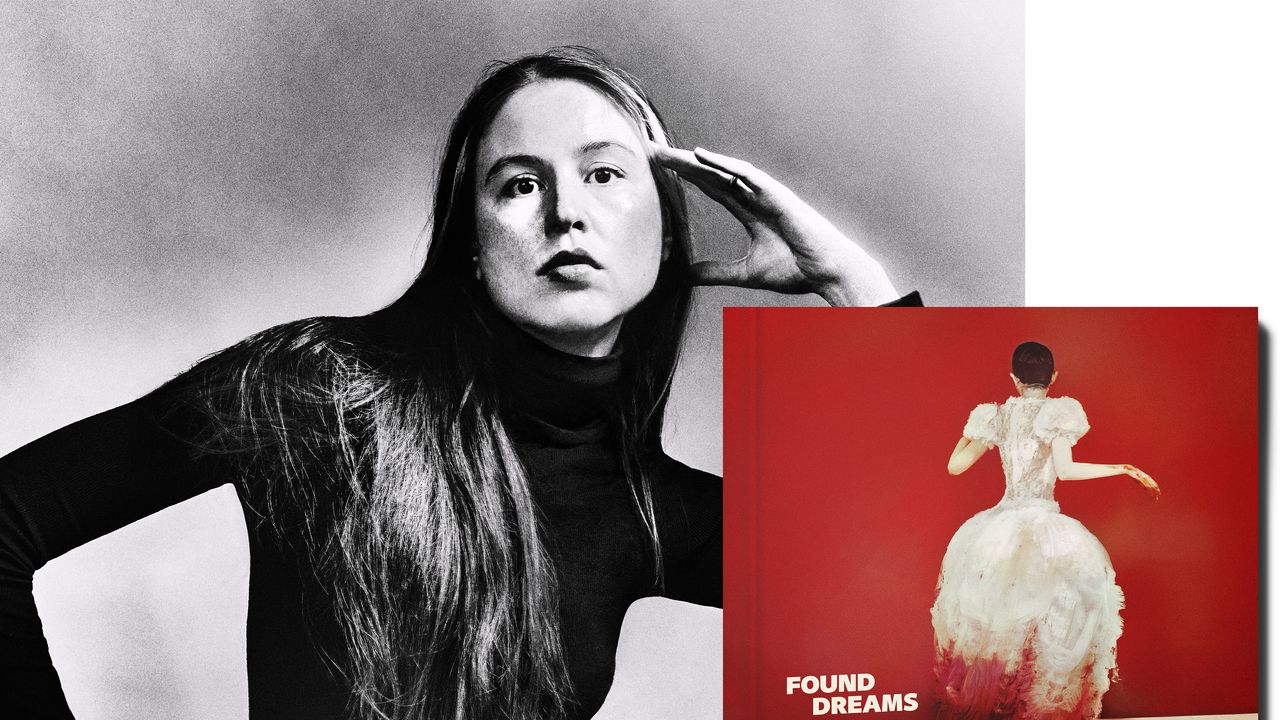
“I don't want people to whisper in front of my images,” says the Moscow-born artist, whose new book features portraits from several of her GQ photoshoots.GQ; Getty ImagesWhen the renowned psychologist-turned-photographer Elizaveta Porodina answered my call, she was not at her desk or even indoors. Instead, she appeared bathed in sunshine, walking the tree-lined streets of Munich, the city she calls home. I haven’t been to Munich, I told her. But our conversation, she offered, would double as a virtual tour. So, from my artificially-lit desk in New York, I was whisked away on an interview-length excursion into Porodina’s world—hardly the first time the artist has left an audience feeling transported.Porodina has the kind of one-line biography that holds a novel within itself. Trained as a clinical psychologist, the Moscow-born photographer is known for creating portraits that invite both her subjects and audiences into vivid, surrealist dreamscapes. What began as a hobby–taking portraits of her friends–quickly evolved into a passion and eventually a career, her work always augmented with and deepened by her studies in psychology. Porodina’s experiments with light and color, her strong use of allegory and narrative symbolism, coax the subconscious to the surface. “It’s almost like showing people a Rorschach test,” she explains, “and being like: what do you see?”Her unique, painterly style—applied to shoots with Zendaya, Brad Pitt, Ariana Grande and Paul Mescal in some of the world’s best-known magazines, including GQ—has made Porodina something of an editorial darling. Her just-released photography book, Elizaveta Porodina: Found Dreams, is a hardcover accumulation of her years exploring the bounds of reality and fantasy. As we toured Munich together through her iPhone screen, she told me how it came to be.The Dreaming BodyModel: Paul MescalFeatured in: British GQ, February 2026Elizaveta PorodinaGQ: Why did you decide to publish a book?Elizaveta Porodina: What it really is for me, and I'm realizing it now, is that this was the end of a phase as a creative, and I cannot really put in words what I mean by that. Or maybe it is not just the end but also the beginning of something bigger, something more expansive. When I started putting the book in place, I definitely wasn't viewing myself at the end of anything at all. But now it has happened, and I feel like it really was sort of the last line of a phase of seeing myself as this one thing—let's say, as mostly a photographer. Because during the phase of working on all these editorials, commissions, personal projects, there has been a huge throughline of writing narratives.Right. Your work is clearly a kind of storytelling.Storytelling, yes. And all of my stories in the last couple of months, years, maybe even longer were built upon a skeleton of a very specific narrative, and I was committed to a very specific narrative. So I guess [the book] really is an end and a beginning, and I wanted to celebrate it, to put a bow on it.There are so many ways of saying things. I read a quote by David Lynch who said, "Screenwriters are too worried that everything has been said. Yeah, everything has been said, but not by you.”It's your perspective. So, how do I do that? I approach it with the utmost sincerity and authenticity and I try to extract and excavate the visual metaphors that are true to my experience. Basically, I'm trying to look at something and say this feels like da da da da, and it only can be true to my experience. And at the same time, when it is so uniquely specific, it will be universal. I truly believe that. That is my philosophy. If I am honest and if I am vulnerable enough, and if I stand in the marketplace, shouting, "Here's my heart, fully open.” I do think that at least 20 people will gather and say, "That's exactly what I'm feeling.”How do you prepare for your shoots? Take me inside your creative process.Technically speaking, I sit down and I write a narrative and I commit to certain parts of it very specifically. Other parts I leave quite open, because there is another aspect that needs to be flexible, and by that I mean that there is a collaborative aspect with the subject that I'm photographing and their experience in that specific emotional situation could be different from mine, so I want them to be able to express that. I would never put my rigidity onto their expression.Do you share your writing with your subjects?Yeah, if they're interested, I do. There are situations where I'm lucky enough to be able to speak to [the subjects] beforehand, but sometimes it's just a last-minute decision when it comes to a model, or when it comes to talent, and you simply don't have the time.You didn’t include any of your writing in the book, did you?No, because in this specific medium, it's a little bit like the movies. When you go to the movies, you don't include the script on top of the movie. You're showing these things, and that's what I'm interested in as well. I do understand that some certain people, when they like a movie, they want to also read the script, but it's not for everyone. I think the GQ story, the latest one that we did—With Paul Mescal?Yeah, that's a really good one to share in terms of the storytelling because there was quite a narrative to it. There was a very strong idea that was weaving itself through the whole thing. There was not one image that was there because it was decorative.So what was the story here?Basically, when you're an artist at heart and this is how you express yourself and your inner world, you find that at the best of times, you're actually not just expressing yourself—you are in fact sort of channeling something different.You’re like a vessel.Yeah, you're a vessel. You sit down and suddenly the story writes itself, the picture takes itself. And even when you go through the pictures afterwards, you can almost see this like, fireball of concentrated energy around the moment where it worked, where the presence came upon you and you were blessed by its divine power. And you just feel invincible in these moments. It is basically heroin for an artist to feel that way.I wanted to tell a story about that, about the artist who is waiting to be crowned, to finally be blessed by the presence of the muse. It was such an amazing setup because Paul was so open to the idea, and at the same time he had a very beautifully intuitive approach: tiny movements of his body, little expressions within his face. And Lydia, [the Muse], she was pure energy. It was so fulfilling to see how they played against each other.The Threshold DreamsModel: Paul Mescal and Lydia ReidFeatured in: British GQ, February 2026Elizaveta PorodinaDo you prefer to work with actors because they're used to conveying a story visually?Well, I would say I like to work with people who can act and who can convey a story and who can hold this energy within them. Whether they are professional actors and have been doing it for a long while or their talent is yet undiscovered to themselves or others, that's irrelevant, right?On the topic of actors, though, I wanted to ask you about the Brad Pitt shoot you did for GQ. Can you tell me a little more about the experience of shooting this one?[Brad] was quite open to enter the world that I was building. Around that time, I was quite tired of the idea of a certain assertive male archetype. It's just not that interesting to me to fan people who have been seen in a certain way, especially when they're an insanely talented actor with a prolonged series of such interesting evocative roles that go completely against character.There are certain things that are ascribed typically to femininity—being hysterical, being eccentric, being too much, being too euphoric, being joyful, liking certain colors, being into flowers—and putting all of these things together with someone who, for many people, is a powerful archetype of calm, chill, stoic masculinity was interesting to me.I never go into a shoot knowing exactly what is going to happen. I always go into any shoot somewhat worried about at least one component because I'm trying it for the first time, either a movement or a combination of that specific idea with that subject, or a setup that I have never tried before, and it's always a bit of a leap of faith. When we were planning the shoot with Paul, for example, I remember that there was a lot of conversation beforehand about it. Me and Adam [Baidawi, then-editor of British GQ] had this grand idea because we both love magazines and picture-making so much, and we both grew up on strong visuals. So there was just this desire to make images than live because they are great images, not just because they are pictures of an actor looking good.I remember really going through it, really doubting my ability to capture this ambitious emotional intensity. I remember being in studio on the free lighting, and then coming into the studio on the next day mega early at around 6:30 and, like, euphorically jumping up and down to capture the exact moment and trying to understand what the exact position could be and just involving everyone on set. Around 10 AM, Paul came in, and I was already so in the zone. I think I forgot to even say hello. I just tore him by the hand and was like, "Here is some stuff that I was thinking about. Do you want to look at it?” And he was like, "Fuck yes, let's look at it.” We were immediately there. Artistically speaking, it felt like a roller coaster with no lows. It was just high, higher, really, really high, and then like a beautiful drop to silk height, and then he just left.What are some books or films or other references you find yourself returning to frequently as sources of inspiration?It's so eclectic. One of the most important pieces of literature that I keep returning to is Ursula Le Guin, specifically Left Hand of Darkness or The Dispossessed. This is something that unifies a lot of my passions for genres that kind of defy definition, because I don't necessarily feel very comfortable in just one. When I read something like Left Hand of Darkness, I see the science-fiction aspect, I see the nature aspect, I see the environmental aspect. I see the deep understanding and deep affection towards what a human is when they allow themselves to truly be any iteration of themselves and not just one.I'm also a huge fan of horror. I try to cover all my bases. I try to cover all the classics, but also watch anything that comes out now just to understand the zeitgeist. Since I was a kid, I always loved fairy tales and fables, and this love has never left me. There is something incredibly, vulnerably specific in a fairy tale, something very universal. And I find that horror is almost like a modern version of a fairy tale for people. It is something to project themselves into, something to feel cathartic. Someone like [David] Cronenberg, that is a really good example. You can watch a Cronenberg movie and just think about the cool effects, but you can watch it also with a full understanding coming from a Lacan perspective, a Jung perspective.You’ve exhibited your work before, and now you have this monograph in which your photographs exist on their own. What is the difference between something like this and your work as it’s presented in, say, a magazine profile?When I was a kid, I would collect books and postcards and I would look at magazines a lot, too—everything that is printed matter. And later, I would use tear pages from a magazine to hang on my walls, or I would go to magazines to find inspiration as well. It had a glamorous and mythical quality to it. You know, a magazine is somewhat very modern, but it has something very archetypical to it.In a way, it’s beautiful to do something in a medium that is quite approachable to a lot of people, and to lure people in, to let them step into your depth accidentally. I don't want people to whisper in front of my images. I want them to be able to maybe tear them from a magazine and just enjoy the aesthetic side at first, but to then be kind of lured into them as if they're like a secret siren singing to them specifically.The Threshold DreamsModel: HoyeonFeatured in: GQ, April/May 2023Elizaveta PorodinaSign up for Manual to receive useful advice on style, health, and more, six days a week.Sasha Mutchnik is the Senior Social Director at GQ, where she handles content strategy across the magazine’s social platforms. She also writes about style, culture, and nightlife in New York, and makes memes under the alias @starterpacksofnyc. ... Read More
How Photographer Elizaveta Porodina Sees the World
Full Article
Original Source
Read the full article at Gq →KhanList aggregates and links to publicly available news content. We do not host full articles from third-party sources. Always verify important information with original sources.