
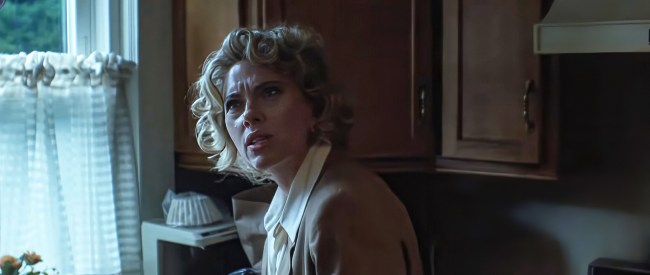
Editor’s Note: The following story contains spoilers for “Paper Tiger.” James Gray never hid that Jeremy Strong and Anne Hathaway were playing fictional versions of his real-life parents in his 2022 drama “Armageddon Time,” based on the writer/director’s experience as a sixth grader growing up in Queens in the 1980s. “Jeremy is doing my father to such a degree that it is disturbing. He sounds exactly like him, looks exactly like him; it’s bizarre. Annie, too, is uncanny about [playing my mother],” said Gray while a guest on this week’s episode of IndieWire’s Filmmaker Toolkit Podcast. “So I had had such a great time with them shooting ‘Armageddon Time,’ I said, ‘Well, why don’t we do this again?’” Gray knew his next film (what would become “Paper Tiger”) would be set in 1986 and once again focus on a Jewish family of four, with two sons, in Queens. In the project’s early stages, Hathaway and Strong were up for reprising their roles, but it soon became clear Gray would have to wait 18 months — after both “The Odyssey” (Hathaway) and “The Social Reckoning” (Strong) finished filming — to start production. Anne Hathaway, Jeremy Strong in ‘Armageddon Time’©Focus Features/Courtesy Everett Collection “You can’t wait a year and a half,” said Gray. “And then I started thinking, ‘Well, maybe this is a blessing in disguise.’ That the [film] could start to take on a new style, and so then I started to pursue it in a different way. So in the beginning, in its origin stages, it was [a sequel of sorts], but like any movie, it’s like a wild horse that’s going to get away from you.” While Scarlett Johansson and Miles Teller’s characters in “Paper Tiger” are inspired by Gray’s parents, they are not as deeply grounded as Hathaway and Strong were in “Armageddon Time” as facsimiles of Gray’s parents in how they talked, looked, dressed, and behaved. Through this lens, Gray began to see the film as less of a straight memoir, freeing him to embrace elements of the crime genre in his storytelling. Explained Gray, “What I tried to do was to make a film more in — for lack of a better way of really explaining — a bit more Hitchcockian in certain places. Almost — again, ‘pulpy’ is not quite the right word — a little bit more, how do I put this — more of an engagement directly with a tense idea of narrative, that it would be a driving, tense story.” What also changed is the sympathetic lens through which Gray now saw his father. In “Paper Tiger,” Irwin (Teller) puts his family in danger when he unwittingly gets entangled (pursuing environmental consulting work for businesses along the polluted Gowanus Canal) with the Russian mob. While Irwin is guilty of pride and naivety, it is (especially compared to Gray’s previous films) a positive portrayal of a hard-working and earnest father pursuing the American dream. In this sense, the shift from Strong to Teller was fortuitous. Strong had painted an unforgiving portrait of a miserable, strict father — tortured by generational trauma and unbending with his sons striving for upward mobility — whereas Gray saw something in Teller he could lean into for a different portrayal of his father. “Miles has a kind of — I can’t believe I’m going to say this, he might even resist this— a softness to him, which would probably offend him, but I think that’s a great thing,” said Gray. “He doesn’t have a softness in his persona. He doesn’t have it in physical terms. It’s actually a tenderness inside. You have to embrace [that] beauty in him and hope it works for the film.” Miles Teller in ‘Paper Tiger’Courtesy Everett Collection When it came to recasting Hathaway, Gray was more practical, saying he needed three characteristics: another bankable star, who was also Jewish, and a real New Yorker. He believed the way the city seeps itself into a person’s bones is not something that even the best actors can learn to portray. Those three unnotiables made Scarlett Johansson the clear number one choice. “I had met [Scarlett] years before on a project that never wound up happening, and quite liked her. She’s a total New Yorker through and through. Then when I found out that Annie [Hathaway] was going off to do Chris [Nolan’s] movie [‘The Odyssey’] for a thousand years, she was the first choice because you’re talking about one of the biggest stars in the world, and she’s also a Jewish woman from New York, checks the boxes,” said Gray. “When I sent [the script] to her, I sent her a note, ‘There’s probably no chance in hell you’re going to do this, but I love you, can you read this?’ And then she texted me back very, very quickly and was like, ‘Let’s go.’” While Hathaway’s portrayal of Gray’s mother was more open and loving than Strong’s version of his father — and therefore didn’t require as sharp a contrast in how the role was recast — Gray believed Johansson’s approach better fit the needs of “Paper Tiger.” “It’s a more operatic idea of character than Annie’s was in ‘Armageddon Time,’” said Gray. “It’s much more a kind of high emotion. And of course, because the situation is much more tragic, and she embraced it completely.” “Paper Tiger” opened last weekend in New York and Los Angeles, and expands on November 20. To hear James Gray‘s full interview, subscribe to the Filmmaker Toolkit podcast on Apple, Spotify, or your favorite podcast platform. You can also watch the full interview on YouTube.
How ‘Paper Tiger’ Evolved When Jeremy Strong and Anne Hathaway Couldn’t Reprise Their ‘Armageddon Time’ Roles
Full Article
Original Source
Read the full article at Indiewire →KhanList aggregates and links to publicly available news content. We do not host full articles from third-party sources. Always verify important information with original sources.