
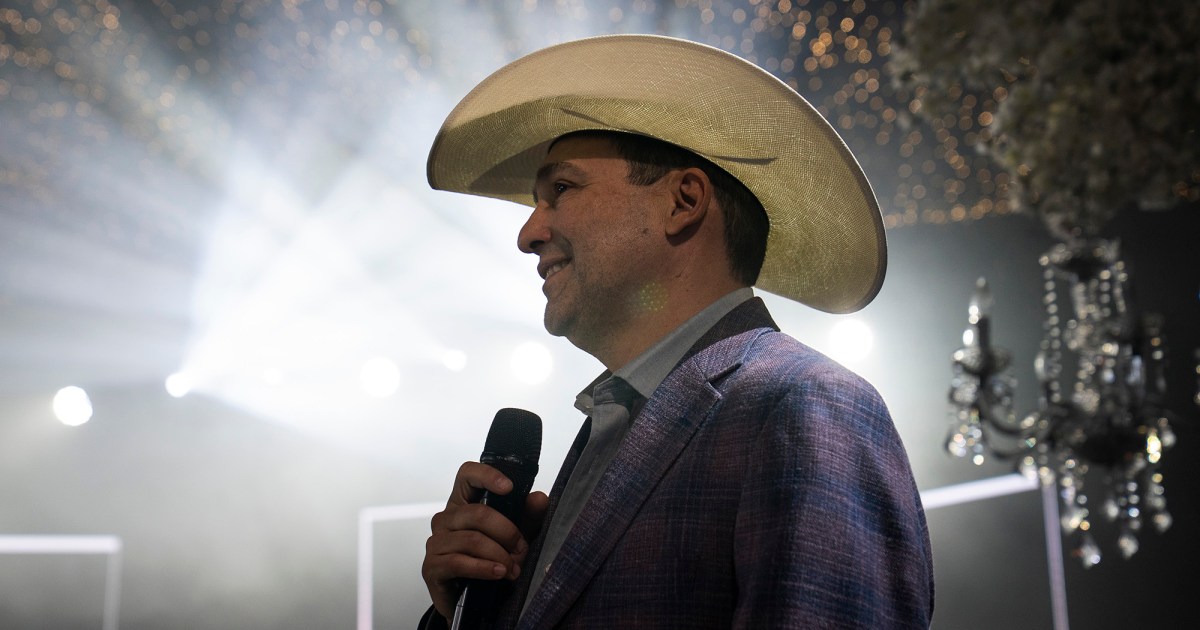
Bobby Pulido, a two-time Latin Grammy winner and democratic nominee for congressional district 15, sings at in Edinburg, Texas. Gabriel V. Cárdenas/For The Washington Post/Getty Get your news from a source that’s not owned and controlled by oligarchs. Sign up for the free Mother Jones Daily. Bobby Pulido played one of the final shows of his career on a Friday night in early October at a street festival in the South Texas town of Alice, a county seat near the King Ranch where LBJ’s allies stole the 1948 Senate election and generations of Tejano music stars got their start. The 53-year-old Pulido, who is both a Tejano music legend and the son of one, is the Democratic nominee in the state’s 15th congressional district, a freshly gerrymandered swath of Texas that starts on the border in Hidalgo and stretches north for about 300 miles. When he entered the race last year to unseat Republican Rep. Monica De La Cruz, it seemed like an uphill climb. Donald Trump would have carried the district by 18 points in 2024 and Republicans were so encouraged by recent swings in South Texas that they redrew the maps to secure a clean Republican sweep. But polls have shown the Democrat with a consistent lead in the race, and the Cook Political Report now considers it a “toss-up.” Pulido has been buoyed by both national and regional trends. One recent survey showed that Latino voters in Texas have swung 16 points away from Trump since 2024, raising the possibility of a Democratic sweep in South Texas instead. (I wrote about Democrats’ efforts to hold onto the new 35th district, outside San Antonio, last week.) But his success, for now, is also a feature of what Pulido specifically brings to the race—and how he’s gone about it. The performance in Alice was not, strictly speaking, a campaign event—Pulido was headlining a free show celebrating the legacy of the accordionist Ruben Naranjo Sr. People brought their own folding chairs and sat on the sidewalks and in the street under twinkling lights, while a few brave souls danced in front of the stage. When the Democrat was introduced, his candidacy was mentioned only in passing. It was billed as his last show in the area before he retires from his current profession; a little more than a week later, he played his official farewell concert before 3,000 people at an arena outside McAllen. “We would never have done a quinceañera—I promise that that was not in the plan,” he told me. But after the congresswoman’s jab, people began reaching out. “We didn’t think we’d get that kind of response. After one day we had a thousand invites. And we’ve done almost 80 of them.” But it was hard to avoid the context in which Pulido was performing. Behind the crowd, near the smoker and the truck selling pickles, a group of supporters in Pulido for Congress t-shirts was frying up chicharron. Everywhere I turned downtown, I could see his smiling face on signs, peering out from under his trademark cowboy hat. He arrived in a campaign van, and when he finished performing, after a spirited rendition of “Ojalá Te Animes,” Pulido descended the steps on the side into a mob of fans and photograph seekers. I followed the crush until we finally escaped into the nearest building to chat briefly about the race. We were in a dress shop. Pulido took in the racks of pastel quinceañera gowns and shrugged. After Pulido emerged from his primary runoff last May, De La Cruz, who handily defeated a serious Democratic challenger two years ago, seemed confident she could do it again. “This election isn’t about who you want performing at your niece’s quinceañera,” she said in a video message. “It’s about who you trust with your family’s future.” Pulido says now, “it could be one of the most costliest blunders anyone’s ever made.” “We would never have done a quinceañera—I promise that that was not in the plan,” he told me. But after the congresswoman’s jab, people began reaching out, seeing if he was available. “We didn’t think we’d get that kind of response. After one day we had a thousand invites. And we’ve done almost 80 of them. We’ve collected lots of data from people. Like, willingly, they give it to us. And we’re able to get in front of a different type of working-class voter that during the week they’re too busy working, you’re never gonna see them throughout the course of the campaign. For us to be able to get in front of them is truly a gift that she gave us.” “There’s a lot of people that voted for Trump that really, really overlooked a lot of the things they already knew in him. But they were willing to give him a chance because they thought he might make life better for them. They know now it was all a lie. There’s going to be a big backlash for sure.” The music, though, is just a hook. Pulido offers a glimpse of how Democrats aim to win back the kinds of voters who have recently been drifting away from them. He hammers the Iran war and talks about how the president’s tariffs and misleadership have crushed the regional economy, which is hugely dependent on agriculture and international trade. Trump promised to make things cheaper; gas in the district has hit $3.99 a gallon. Pulido is comfortable criticizing conditions on the border during the Biden administration but full of anger over the pervasive racial profiling and cruelty of Trump 2.0. When I was there in 2024, Democrats flooded the airwaves in De La Cruz’s district with ads about abortion; Pulido, who has said he is personally pro-life but that “it’s not my place to tell a woman what she can do with her body,” describes the voters of his district as “culturally very conservative, hard-working people that really want our elected officials to focus on pocketbook issues.” In battleground districts in 2026, populism plays too—lower drug prices, congressional stock trading, Citizens United, data centers, and the Epstein files. “People feel like they got lied to,” he says. “There’s a lot of people that voted for Trump that really, really overlooked a lot of the things they already knew in him. But they were willing to give him a chance because they thought he might make life better for them. They know now it was all a lie. There’s going to be a big backlash for sure. It’s not even political—they feel like they got conned.” If he were running in a different year, or in a bluer district, or did not sing “Desvelado,” Pulido’s candidacy would come not just with a fun story, but some caution flags. During the Democratic primary, his progressive opponent, Ada Cuellar, warned voters about crude sexual jokes he’d made in old social media posts. De la Cruz and her allies have now spent big to inform voters that Pulido spent years touring with a sex offender and had once boasted about bailing the man out of jail. (Pulido has since said that he was aware the man had gone to prison but never bailed him out and that he believed the man had served time for “harboring illegal aliens”— which is, in itself, a revealing alibi for a Democrat in the year 2026.) But in a district where most voters have backed Donald Trump at least once, the attacks haven’t hit the same way. Is Pulido a unique candidate or a stand-in for something bigger? Maybe it’s the former that makes him the latter. I keep thinking of 2026 as a generational reset. It has been two decades since Democrats had a clean slate, with no national figurehead, no next-in-line. And for most of that time, the geographic scope of the Democratic Party has been slowly shrinking. Save for overeducated suburbs and a few Sun Belt Senate races, the number of places where the party can realistically expect to compete has simply been smaller in recent years than it was when Barack Obama took office. (Don’t believe me? Go ahead, look at a House and Senate map from 2008 sometime.) But Pulido is one part of a broader story: Democrats have expanded the map by breaking out of their box. They are running candidates who can’t be easily defined or dragged down by the actions of previous campaigns or administrations, whose political identities are at least, for now, distinctly regional. In some states, they are backing candidates who aren’t even running as Democrats. That’s the flip side of losing everything, after all—you finally get to start back up from nothing.
How “One of the Most Costliest Blunders Anyone’s Ever Made” Helped Put a Republican Seat in Play
Full Article
Original Source
Read the full article at Motherjones →KhanList aggregates and links to publicly available news content. We do not host full articles from third-party sources. Always verify important information with original sources.