
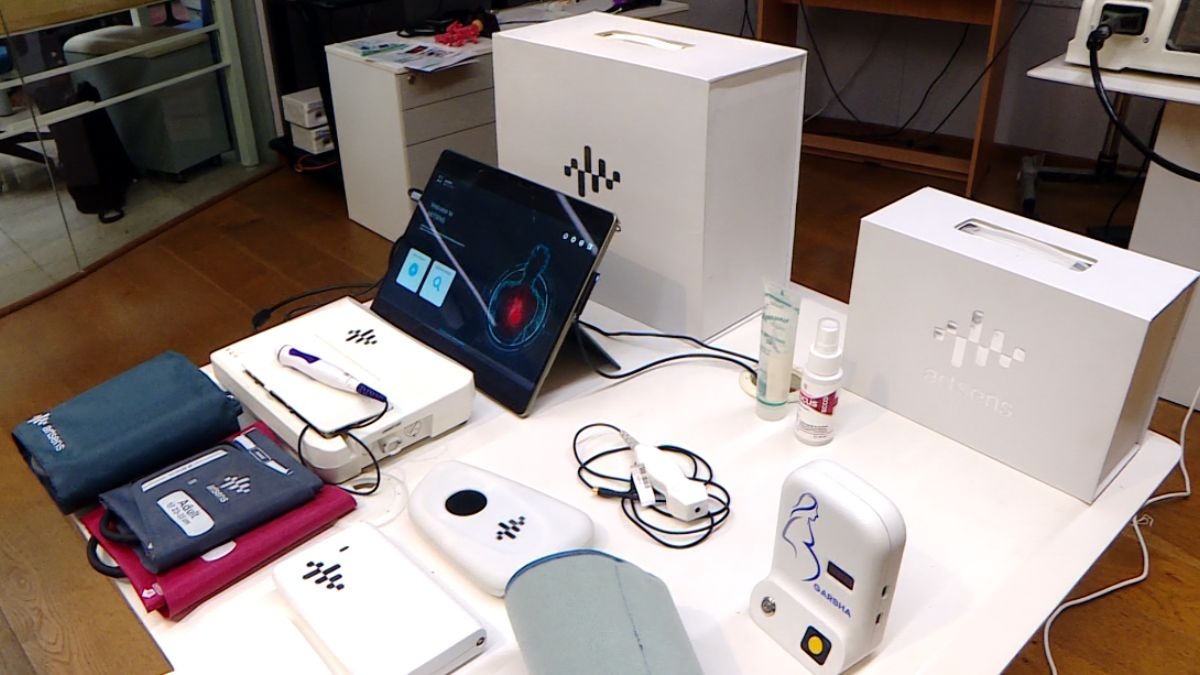
A team of young scientists at IIT Madras has built ARTSENS, a five-minute test that reveals the true age of your arteries, years before a heart attack shows any sign. Through a mission called VESPA, they are now mapping the vascular health of the whole country to build India's first early-warning guidelines.ARTSENS, built at IIT Madras, reads the true age of a person's arteries in about five minutes. (Photo: Radifah Kabir/India Today)You know your age. You have counted it at every birthday, candle by candle. But there is a second age you carry that no one has ever named for you, written not on your face but deep in the soft walls of the vessels that keep you alive. It is the age of your arteries, and it may be nothing like the number on your cake. A small team of young scientists at IIT Madras has found a way to read that hidden age in about five minutes, and has now set out to measure it for a whole country. Their mission is called VESPA, and it is quietly trying to move the moment at which India meets one of its deadliest diseases.VESPA, which stands for Vascular health based Early Screening for Public health Adoption, is being described as India's first and largest attempt to map the vascular health of its people. The mission is led by Dr Jayaraj Joseph, Assistant Professor at the Department of Electrical Engineering at IIT Madras, with Dr Raj Kiran, Principal Scientist, Cardiovascular Science and Technologies at the Healthcare Technology Innovation Centre (HTIC).They laid out their ambition in an exclusive conversation with India Today at the IIT Madras campus, where this reporter toured the laboratories and watched the ARTSENS test performed on the ground.HTIC, where the work is housed, was founded by Professor Mohanasankar Sivaprakasam, a recipient of the Rashtriya Vigyan Puraskar, one of India's highest scientific honours. The centre has built a long line of affordable, indigenous medical technologies, and VESPA, powered by a device Dr Joseph and Dr Kiran's work helped create, is among its most ambitious. CAN YOUR ARTERIES BE OLDER THAN YOU ARE?Picture the body's blood system as plumbing. The heart is the pump, the blood vessels are the pipes. But nature's pipes are cleverer than anything in your walls. Vascular simply means anything to do with these vessels, the arteries that carry blood outward, the veins that draw it home, the fine capillaries that bridge the two. And a healthy artery, unlike a rigid pipe, is springy. It breathes with every beat.That spring is the whole story. "If you are healthy, your arteries are supposed to be elastic," Professor Jayaraj tells India Today Digital. The elasticity is not an accident but a design, a way of catching the violent push of each heartbeat and softening it, so that blood reaches the body's most delicate tissues as a gentle tide instead of a hammer blow. The complete ARTSENS kit, a probe, arm and thigh cuffs and a tablet, folds into a case that can travel to any health camp. (Photo: Radifah Kabir/India Today) The trouble begins when the spring goes out of them. Deep in the artery wall lie fibres that lend it stretch, and they begin to stiffen and fray far earlier than most of us would ever guess. "The earliest signs of disease start to manifest by loss of arterial elasticity," he says. Those fibres, he adds, "start to degrade even in your 20s and 30s, way before you have a cholesterol problem, way before you have blood pressure, way before you have a heart attack."And so a person can carry two ages at once. "You may be 60," Professor Jayaraj says, "but if you don't take care of your health, your blood vessels will already be at 80." A stiff artery inside a young body is a letter posted years in advance, warning of what is coming. All this time, no one has been opening it.WHY IS HEART DISEASE CAUGHT TOO LATE IN INDIA?One question runs underneath the whole endeavour, and it is disarmingly plain. How early is early enough?Today, we tend to catch heart disease only once it has already announced itself, a chest pain, a cholesterol reading gone high, a blood pressure that has crept up over years. Doctors call these conventional risk markers, and by the time they sound, the harm is often long done. Stranger still, much of what we call prevention involves no measurement at all. "I ask you a bunch of questions and I fix a score for you," Professor Jayaraj says of the usual method. "That is all. I don't measure anything from you." VESPA India aims to screen 1,00,000 participants across the country to build India's first vascular-health reference values. (Photo: Radifah Kabir/India Today) The reward for looking earlier is not merely a longer warning. It is a gentler cure. Caught at the stage of a quietly stiffening artery, cardiovascular risk can often be coaxed back with lifestyle alone, before it sets hard into something that demands a surgeon or a lifetime of pills. For a nation, that is the whole distance between spending on prevention and spending on the operating table.And there is little time to lose. About a third of the Indians dying of heart disease, Professor Jayaraj notes, are only just touching 40 or 50. Not the old. People in the very middle of their lives, with children half-raised and work half-finished.WHAT IS ARTSENS, AND HOW DOES IT WORK?The reason a warning this early has never reached ordinary people is stubbornly practical. There was simply no easy way to measure it. To read the stiffness of an artery meant a costly hospital ultrasound and a trained specialist, the sort of apparatus you cannot fold into a bag and carry to a village.So the team built the thing that did not exist. They called it ARTSENS, short for ARTerial Stiffness Evaluation for Non-invasive Screening, and it performs in five minutes, in a field tent, what once needed a hospital wing. Non-invasive means it never breaks the skin. Nothing is injected, no blood drawn. A small probe rests against the neck to listen to the carotid artery, the great vessel that feeds the brain, while soft pressure cuffs sit on the arm and the thigh.From these gentle contacts, ARTSENS gathers the two readings that matter most. The first is carotid stiffness, how hard that neck artery has grown. The second is aortic pulse wave velocity, and it is a small marvel of physics. The aorta is the body's main artery, rising directly out of the heart, and every beat sends a pulse racing along it. ARTSENS watches the artery widen and narrow with every heartbeat, the raw signals from which arterial stiffness is measured. (Photo: Radifah Kabir/India Today) The stiffer the pipe, the faster that pulse flies. So by timing how quickly the wave travels from one point to the next, the device clocks the speed of your pulse and reads the stiffness of your aorta straight from it. Altogether it reports around ten measures, central blood pressure among them, and gathers them into one tender, legible number. Your vascular age.The device does not guess at any of this. "We are not estimating," Professor Jayaraj says. "We are actually measuring." It watches the artery widen and narrow in real time, beat by beat. And because it is image-free, leaning on a single ultrasound sensor rather than a full scanner, it slips past the cost and the imaging rules that keep hospital machines from ever reaching a health camp.Its accuracy has been validated against gold-standard clinical ultrasound and set down in peer-reviewed journals, including the Journal of Hypertension, across more than a hundred studies and a string of patents. At the demonstration on campus, it was Dr Jagadeesh who ran the live test, the probe at the throat, the cuffs in place, the arteries drawing their own quiet confession onto the screen.WHY DOES INDIA NEED ITS OWN VASCULAR DATA?Here lies the deeper puzzle, and the reason a clever device was never going to be enough on its own. Say ARTSENS tells you your pulse travels at a certain speed. Is that good, or is it grim? For blood pressure, every schoolchild half-knows the answer, 120 over 80. For arterial stiffness, India holds no such number. There is no Indian reference range at all.So the country borrows one. The only benchmarks that exist were drawn from European and American bodies, where a pulse wave velocity of roughly 10 metres per second marks a rough boundary. But an Indian is not a European. Dr Jayaraj Joseph, right, and Dr Jagadeesh at the Healthcare Technology Innovation Centre, IIT Madras, where ARTSENS was built. (Photo: Radifah Kabir/India Today) The immense variety of Indian bodies, diets and lives writes itself into very different vascular patterns, so that what is perfectly normal for someone in Kerala may be quietly dangerous for someone born elsewhere.There is even a riddle hidden in the figures. The highest rates of heart disease in India, Professor Jayaraj observes, often sit in the most prosperous and most health-aware states, Kerala among them. Awareness alone, then, is not the cure.You must also catch the disease early enough, and to do that you first have to know what early looks like inside an Indian artery. VESPA exists to draw that map, and from it to write India's first vascular screening guidelines.WHEN WILL THE ARTERY TEST REACH THE PUBLIC?A national standard demands national data, and the mission is now gathering it at scale. Deciding what counts as normal is statistically hungry work, roughly 10 people screened for every clean normal reading, which is why the target stretches to more than one lakh participants and some 90 lakh data points, drawn through around 800 camps across the length of the country.It has already begun. VESPA has so far screened more than 6,400 people at dozens of sites in ten states, working with a widening circle of partners that runs from AIIMS in Delhi and Patna to JIPMER in Puducherry, CMC Vellore, Manipal, and hospitals from Guwahati down to Kottakkal. Among its backers is the Indian Council of Medical Research, which has supported the underlying technology for years. The test is painless and non-invasive: a small probe rests on the neck to read the carotid artery, the vessel that feeds the brain. (Photo: Radifah Kabir/India Today) What the team is asking for now is not more scientists but more hands, the NGOs, hospitals and corporate partners who can carry the test out into the country. The aim is to bring ARTSENS to a commercial stage in India within the next two to three years, priced gently enough for a government to adopt, so that a measurement once sealed inside a laboratory might one day wait in an ordinary primary health centre.For all its ambition, the heart of VESPA is a small and tender idea. Two young engineers looked at the body's oldest quarrel, the slow hardening we all drift towards, and decided to measure it at its source, in the hush of a single blood vessel, long before it can break a heart. If they succeed, the question at your next check-up may no longer be only how many years you have lived. It may be, at last, how old you are within.- EndsPublished By: Radifah KabirPublished On: Aug 27, 2026 09:01 IST
How old are your arteries? An IIT Madras device knows decades before a heart attack
Full Article
Original Source
Read the full article at Indiatoday →KhanList aggregates and links to publicly available news content. We do not host full articles from third-party sources. Always verify important information with original sources.