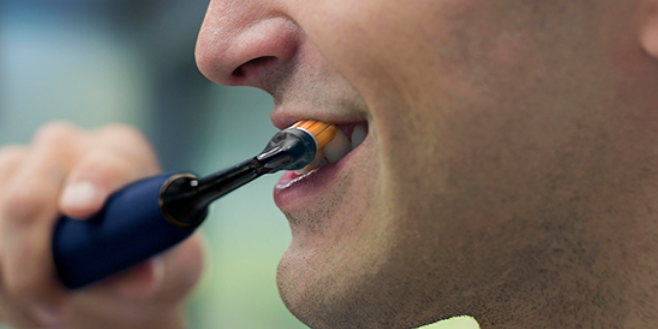
4 min readLOOK IN YOUR bathroom right now. That toothbrush sitting in the cup, probably the one with bristles splayed out like a busted broom: when did you buy it? If you have to think about it, you already know the answer is too long ago.Lots of guys treat their toothbrush like a casual household tool, using it till it breaks, then finally replacing it. If this is you, then you should know that the problem with this is that your toothbrush is probably living in a warm, damp room, collecting whatever's in the air, and going to work on gums that bleed if you look at them funny.So we asked two dentists to sort it out: how often our toothbrushes actually need swapping, whether electric is worth the money, and what a worn-out brush is quietly costing you.So, How Often Should You Change Your Toothbrush?Three to four months is the rule of thumb. That's what the American Dental Association (ADA) says, and both of our experts landed there organically as well. Manual brush or electric head, it doesn't matter; it’s the same clock.The calendar should just be your fallback, though. The better move takes about two seconds: flip the brush over and look at the bristles straight on. If they're still standing up in neat little rows, you're fine. If the outer ones have started fanning out sideways, you're done, because that flare means they've gone soft, and stiffness is the entire reason a toothbrush works. Stiff bristles flick plaque up out of the gumline. Soft ones just kind of slide over it.Dr. Craig Noblett, D.D.S., M.S., President of the American Association of Endodontists, sums it up: "The easiest indicator isn't the calendar—it's the bristles. If they no longer stand straight, they're no longer doing their job."A couple of things will kill a brush early. Brushing hard is the big one, and pretty much every guy brushes harder than he thinks he does. Getting sick is the other. Dr. Noblett is honest that the evidence a toothbrush actually reinfects you is pretty thin, but he still thinks it's worth swapping, mostly because if you've just spent two weeks with strep, that brush was probably already past due.Manual vs. Electric: What’s Better?Electric does win, but by less than the ads want you to believe, and not at all if you're brushing badly. The number everybody cites comes from a Cochrane review covering 56 trials and about 4,600 people.Dr. Pablo Atria, DDS, MSc, PhD, Program Director at NYU College of Dentistry, treats it as the benchmark, and what it found is that powered brushes remove roughly 11 percent more plaque in the short run and about 21 percent more over time.Worth knowing that those results are specific to oscillating-rotating heads, the small round ones that spin back and forth, not every powered brush on the shelf. It's also a bonus on top of decent brushing rather than a replacement for it.“It is important to highlight that technique and consistency are more important than hardware, so if you have a good manual brushing technique, you don't need an electric brush,” Dr. Atria says.There’s also the general tech specs of it all. An electric toothbrush can obviously do certain things a manual one can’t."The biggest advantage of many electric toothbrushes isn't necessarily the motor—it's the built-in timer and pressure sensor," Dr. Noblett says.Think about what those two things are doing for you. The timer keeps you brushing for the full two minutes, which is a lot longer than anybody goes when nobody's counting. And the pressure sensor starts buzzing the second you lean into it, which is genuinely the most common mistake guys make.What an Old Brush Is Doing to YouNothing you'd notice, which is exactly why it gets you. Bent bristles quit reaching the gumline, that tight seam where the tooth meets the tissue, and that's the spot that matters most. Plaque settles in there, hardens into tartar within a couple of days, and from there you're headed toward gingivitis (bleeding when you brush, gums that look a little puffy, breath that mouthwash doesn't fix).Dr. Noblett points to research showing worn brushes pull off significantly less plaque than new ones, and the difference shows up worst in those hard-to-reach spots that were already a challenge.Two More ThingsStore it right.Rinse it, shake it out, stand it upright, leave it uncovered. Dr. Noblett warns against closed containers, where trapped moisture encourages bacteria—those little travel caps are for travel, not your counter.Know when it's not a brushing problem.Lingering sensitivity, pain lasting more than a few days, swelling, or an ache when you bite down? Don't scrub harder. Dr. Noblett says those can signal the tissue inside the tooth is inflamed or infected, and getting ahead of it early is often the difference between saving the tooth and losing it.The Best Toothbrushes, According to Men’s Health EditorsOral-B iO Series 10 Electric ToothbrushNow 16% OffPhilips Sonicare DiamondClean Smart 9700 Electric ToothbrushQuip Rev 360 Oscillating ToothbrushNow 14% OffColgate Total Battery Powered ToothbrushMoon Electric ToothbrushWaterpik Sonic-Fusion 2.0 Professional Flossing ToothbrushSupersmile Zina45 DeluxeMore of Our Favorite Dental CareBest Electric Toothbrushes | Best Toothpastes | Best Water Flossers | Best Grooming Products | Best Teeth-Whitening Kits | Best Oral Hygiene Products | Best MouthwashesJosiah is the Digital Content Producer for the commerce team at Popular Mechanics, Best Products, Runner’s World, and Bicycling Magazine. He also writes for “BIO Buys”—a column on Biography.com—giving readers the lowdown on what products their favorite celebs are using. In another life, Josiah was an editor at ThePioneerWoman.com, where he sharpened his expertise on all things lifestyle, food-news, and entertainment. Outside work related matters, he’s a fan of Studio Ghibli films, unimportant reality TV drama, and melancholy Lorde songs. Sean Zucker is the Grooming and Reviews Editor at Men's Health. He brings over half a decade of experience covering health, wellness, and lifestyle. When Sean's not writing about hair products, you can find him running for exercise, or toward the nearest food truck.
How Often Should You Replace Your Toothbrush?
Full Article
Original Source
Read the full article at Menshealth →KhanList aggregates and links to publicly available news content. We do not host full articles from third-party sources. Always verify important information with original sources.