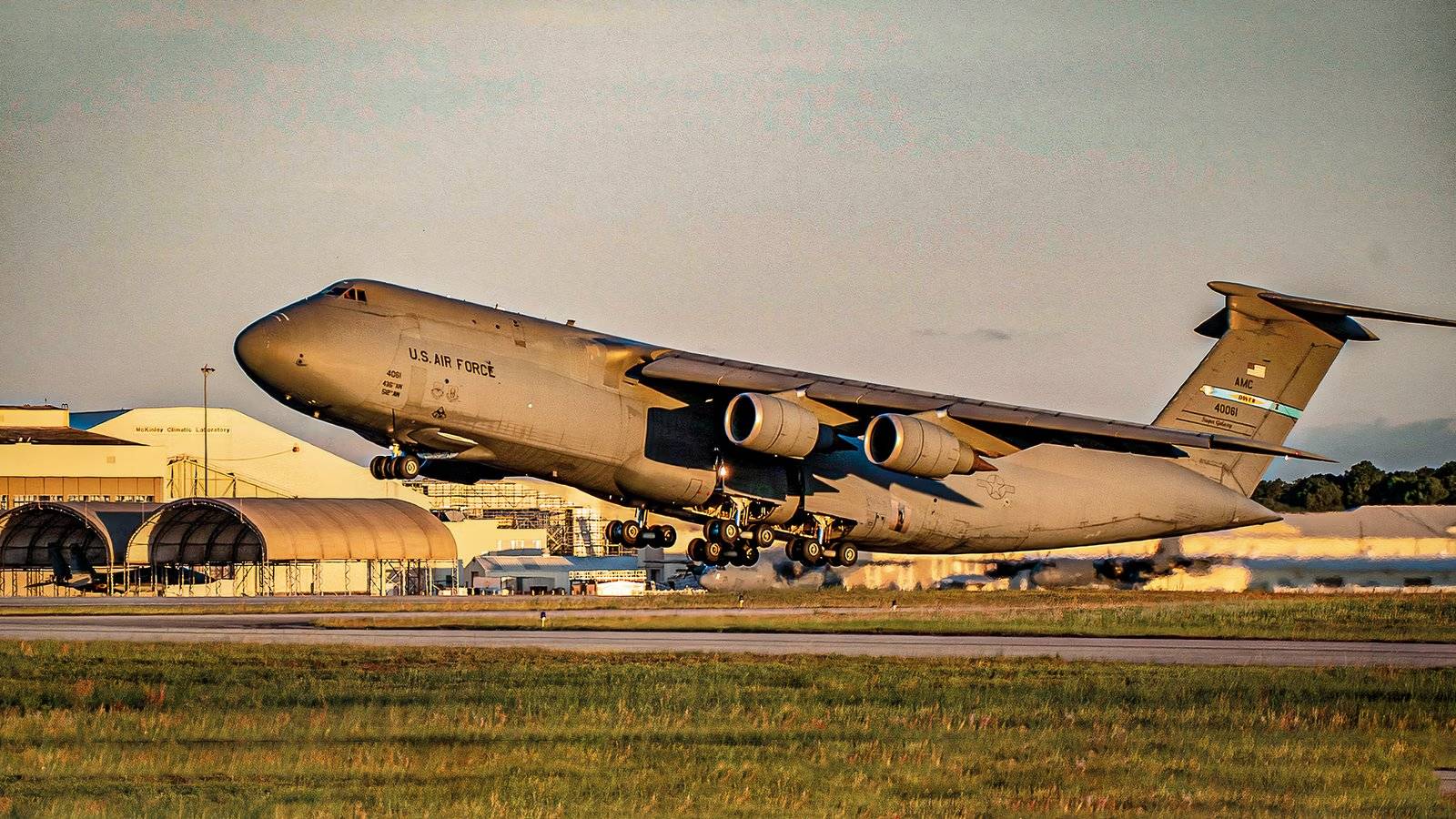
Published Jul 19, 2026, 9:00 AM EDT Chris earned a Master’s degree in Defense and Strategic Studies (Highest Honors) from the University of Texas at El Paso. His graduate work concentrated on Global and National Security, Low-Intensity Conflict, Modern Warfare, and US grand strategy. He also undertook extensive regional studies, analyzing how key regions integrate into the broader US security architecture. This rigorous program provided him with a comprehensive understanding of U.S. military operations, global strategy, and weapons systems. Additionally, he gained a strong appreciation for great power competition.—an increasingly central force shaping international relations and conflict for the foreseeable future. Sign in to your Simple Flying account The Lockheed Martin C-5 Galaxy has been the backbone of the United States Air Force's (USAF) strategic heavy airlift fleet for more than five decades. Since entering service, the aircraft has supported numerous conflicts and seemingly countless operations in support of the US military's global commitments. By the turn of the millennium, the fleet's aging TF39 engines had become an increasing operational burden, with declining performance, rising maintenance requirements, and spare parts shortages affecting the aircraft's readiness. The answer to this dilemma came in the form of the F138 turbofan, a military derivative of General Electric's commercially proven CF6-80C2. Once installed across the Galaxy fleet, the new powerplants delivered substantially improved performance, reliability, and fuel efficiency, ensuring the aircraft would remain a viable component of the USAF's strategic airlift capability through at least 2040. What Factors Led The USAF To Replace The Engines On Its C-5 Fleet? Credit: US Air Force The C-5 is the largest aircraft in the USAF's inventory, and it has played a crucial role in the service's air mobility mission since its inaugural delivery to the 437th Airlift Wing, based at Charleston AFB, South Carolina, in June 1970. Thirty years later, the Galaxy fleet had participated in numerous wars, conflicts, and operations, most notably the Vietnam War, Operation Just Cause, and Operations Desert Shield and Desert Storm. During those operations, the C-5 was utilized to deliver heavy military equipment such as tanks and helicopters, conduct medical evacuations, and provide general logistical support for forward-based US and allied military units. The intensive operational use over the three decades since its initial delivery had taken its toll on Galaxy's TF39 high-bypass turbofan engines, which had accumulated more than two million flight hours (by 2006). The result was a range of engine-related issues, including high maintenance requirements and spare parts shortages, which contributed to reduced fuel efficiency, lower thrust, and declining mission-capable rates. Following a study that found the C-5 fleet retained approximately 80 percent of its airframe service life, Air Mobility Command launched an aggressive modernization program for the fleet in 1998. In December 2001, Lockheed Martin was awarded a System Development and Demonstration (SDD) contract for the C-5 Reliability Enhancement and Re-engining Program (RERP). This initial demonstration phase applied to four C-5 Galaxies. The initial CF6-80C2-derived F138 engines for this phase were delivered to Lockheed for in-flight testing in 2004, with the first flight taking place on June 19, 2006. By 2009, the first RERP production contract, valued at $299 million (£224 million), had been awarded for the modernization of nine aircraft, and the overall program value was roughly $4.5 billion (£3.37 billion). The last Galaxy was delivered to Lockheed in 2014, and by 2018 the program was complete following the upgrade of 52 C-5s. In total, the program modernized 49 C-5Bs, two C-5Cs, and one C-5A. Following the upgrades, these aircraft received the new designation of C-5M Super Galaxy. The exception was the two C-5Cs, which were redesignated as the C-5M-SCM (Space Cargo Modification) due to their role in transporting oversized cargo such as satellites. With their upgraded propulsion system, the Galaxy fleet gains numerous advantages. The Benefits Of The F138 Engines Credit: US National Archives When the USAF chose the CF6-80C2-derived F138 engine, it was acquiring a proven means of propulsion. By 1998, the powerplant had already entered military service aboard the 767 AWACS aircraft operated by the Japan Defense Agency. Commercially, the CF6 family had also achieved a renowned level of reliability, accumulating approximately 200 million flight hours with more than 150 airline operators worldwide by the year 2000. Additionally, aircraft powered by the CF6 family achieved a dispatch reliability rate of 99.94 percent. For the USAF, the C-5M Super Galaxy fleet, equipped with its new F138 engines, would experience a 25 percent reduction in operating costs due to dramatically improved reliability and performance. Specifically, the fleet saw a 30 percent reduction in takeoff roll, a 58 percent increase in climb to operating altitude, and a 38 percent higher initial cruise ceiling. Going further, USAF Air Mobility Command states: "The improvements allow the C-5M to climb more rapidly, reaching higher cruise altitudes to reduce fuel consumption and carbon emissions; fly greater strategic distances, decreasing en route stops and diminishing dependency on in-flight refueling support; and increase the maximum load weight to 840,000 pounds, which gives the aircraft greater lift and range, increasing velocity and throughput." These improvements mentioned above were also demonstrated during flight testing. Galaxy pilot Captain Cory Damon (USAF) stated that the modified C-5s beat the required 25-minute climb to 31,000 feet by nearly five minutes, even in less-than-favorable conditions on a hot day while carrying a large payload. Additionally, the aircraft achieved a break rate of 8.5 per 100 sorties, surpassing the requirement of 10.5 or fewer, and reportedly exceeded maintenance performance requirements after four, 12, and 24 hours by a comfortable margin. The aircraft also surpassed the noise and emissions requirements of both the FAA and foreign aeronautical agencies. While the aircraft is generally used to transport military personnel and essential supplies and equipment, the C-5 also partners with federal agencies to move atypical cargo. Busted: A C-5 Crew Assisted Federal Law Enforcement With Moving Seized Narcotics Credit: US Air Force When federal agencies request military assistance for auxiliary roles, the US Air Force readily provides support. In this case, a C-5 crew from the 433rd Airlift Wing (Air Force Reserve) was dispatched to assist Drug Enforcement Administration personnel under inter-agency Operation Burnout. The mission marked the largest recorded aerial transport of hazardous narcotics destined for destruction. Spanning three days, from May 18 to May 20, 2026, the 433rd Airlift Wing (based at Joint Base San Antonio–Lackland) mobilized a C-5M Super Galaxy to transport its illicit cargo of 23 pallets—approximately 50 metric tons—of seized narcotics. The shipment, valued at approximately $5 billion (£3.8 billion), was airlifted from March Air Reserve Base, California, to Wright-Patterson Air Force Base, Ohio. Following landing, the cargo, which included fentanyl, cocaine, and methamphetamine, was securely transported to an incineration facility in Indiana for immediate destruction. Rashida Weathers-Hurst, section chief of laboratory management and operations for the DEA Office of Forensic Sciences, highlighted the stark contrast between overland and air transport for an operation of this size and scope. She stated: “If we had not partnered with the Air Force, we would have had to drive it across several states, which would have taken tons of manpower and days to do,” Weathers-Hurst said. “Drug evidence is currency on the street, so it is definitely a high-security mission. The precision of military logistics and their ability to execute a mission safely makes this teamwork top tier.” While the C-5M is primarily associated with transporting tanks, helicopters, and other oversized military equipment, Operation Burnout demonstrated the aircraft's broader utility. Beyond supporting combat operations, the Galaxy's immense payload capacity and long-range reach also make it an invaluable asset for time-sensitive domestic missions requiring exceptional security and logistical precision. Sustaining The C-5M Fleet Into The 2040s Credit: US Air Force The Reliability Enhancement and Re-engining Program has been a great success, significantly enhancing the performance of the C-5 fleet and transforming one of the USAF's most important strategic airlift assets. This has allowed the aircraft to maintain its position as the service's premier heavy cargo airlifter, a role some have projected it will retain through 2040. With counterterrorism operations ongoing in Africa, support for Ukraine in Eastern Europe, continued deterrence on the Korean Peninsula, and numerous joint exercises across the Indo-Pacific, the Galaxy fleet is likely to maintain a heavy operational tempo. As long as the United States continues to sustain military commitments across multiple theaters simultaneously, the C-5M will remain indispensable for rapidly transporting the oversized cargo needed to support those operations. The true test of the modernization effort will be whether the C-5M can continue supporting simultaneous global commitments without the reliability shortcomings that constrained earlier variants. However, fleet availability has now come to the fore, and the F138 engines are not the primary issue. According to Air Force Chief of Staff Gen. Kenneth S. Wilsbach, the Galaxy fleet has a 37% mission-capable rate. It remains to be seen whether this can be improved in the near future, particularly since the Air Force has requested $4 billion (£3.0 billion) to procure critical spare parts for maintaining the C-5, C-17, and other aircraft following the completion of Operation Epic Fury. While the mission-capable rate must be improved given the US military's global commitments—particularly as great power competition intensifies—the C-5M fleet's lift capacity remains crucial to enabling US military operations abroad. Whether transporting armored vehicles, helicopters, humanitarian aid, or other outsized cargo, few aircraft can match the Galaxy's unique capabilities. Speaking about the fleet's future service life, former Lockheed Martin Vice President Lorraine Martin said, "This aircraft is going to fly to 2040. Or beyond." She elaborated further, "2040 is really the minimum that they did the analysis against, but it can fly past that."
How New CF6 Engines Made The C-5M Galaxy More Fuel Efficient Than The Original C-5
Full Article
📰 Original Source
Read full article at Simpleflying →KhanList aggregates and links to publicly available news content. We do not host full articles from third-party sources. Always verify important information with original sources.