
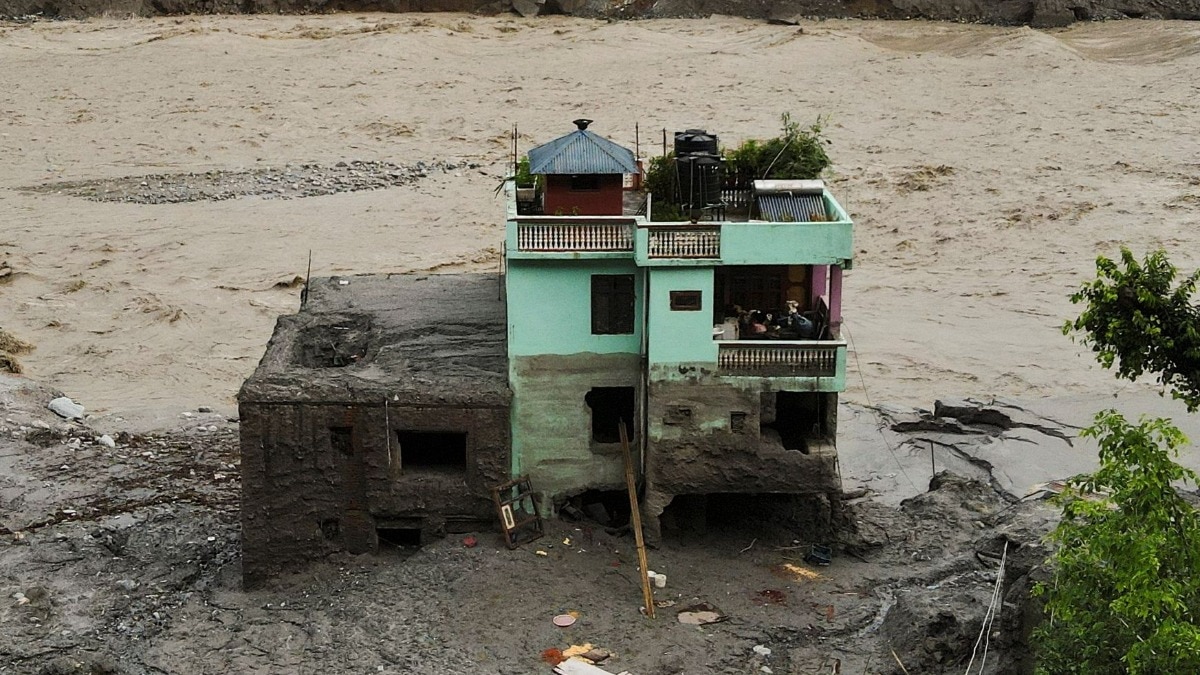
When the floodwaters of Nepal's Trishuli River turned into a violent torrent of mud, rocks and debris, almost everything in their path appeared to have the fate of destruction. Yet, amid the devastation, one mint-green, 40-year-old house belonging to Prakash in Nuwakot district's Dunge Bazaar remained standing. The striking image of the house, surrounded by raging floodwaters while neighbouring structures disappeared under the force of the disaster, has since gone viral and has shocked the world.A family of six was trapped inside the building. They were clinging to the upper floors of the house as the water rose around them. They were uncertain whether the house would withstand the next surge. But in the end, the house survived and saved everyone inside the house. After that, the question that followed was how did one modest-looking house survive when so many structures around it were swept away?The answer might lie in a combination of structural design, the house's location and the way the floodwater interacted with its shape, although some of these explanations remain assessments rather than an official engineering investigation. Green miracle house: A drone view of the house owned by Prakash as it stands amid debris after surviving flash floods and a mudslide in Nepal. (Image: Reuters/Screengrab) NEPAL FLOODS: A DISASTER OF EXTRAORDINARY SCALEOn August 26, a flash-flood occurred after an ice-and-rock collapse near the Nepal-Tibet border sent a huge volume of water, mud and debris downstream. The resulting flows affected the Bhotekoshi and Trishuli river systems, causing widespread destruction. As the scale of the disaster became clear, videos from the affected areas showed buildings being torn apart, vehicles being swept away and roads disappearing beneath torrents of debris. Against that backdrop, the green house looked surreal.Videos showed the structure standing amid a landscape of mud and destruction, with members of the family gathered on its upper levels as floodwaters surged around the building. The house has since been dubbed Nepal's "miracle house". India Today TV's ground reporting confirmed that the three-storey structure remained largely intact even as buildings, vehicles and other belongings around it were swept away.But for the man who owns it, the experience was anything but miraculous at the moment. "I thought our lives were about to end," said Prakash.Speaking to The Lallantop, India Today Digital's sister publication, from the spot, Prakash recalled the terrifying moments when the Trishuli River began rising around his home.Prakash's family initially moved to the fourth floor, but even that level was eventually reached by the rising water. They then moved towards the highest point of the house.Prakash told The Lallantop that six people were present, including himself, while one of his sons was away at school. The house survived, but its lower portion did not escape the destruction.According to Prakash, the ground level was being used as a warehouse for goods from his shop. A large amount of material was destroyed, while two vehicles, bikes and scooters were swept away. And Prakash believes the house's survival was not entirely accidental. THE 40-YEAR-OLD MIRACLE HOUSE WAS BUILT TO WITHSTAND RIVERPrakash told The Lallantop that the house was around 40 years old and that its construction had been given special attention because of its proximity to the river.He said the quality of cement and construction materials used at the time was better and that the family had spent considerably on strengthening the house.Most importantly, he pointed to its foundation. Prakash said that, because the house stood close to the river, two or three layers of road material had been placed underneath the structure, strengthening its base.Prakash's explanation reveals that the house was not simply an ordinary structure that happened to get lucky. It had been built with the risks of its location in mind.A viral 1-minute-30-second video from the X account Architecture Presentation offers a more detailed structural explanation about how this house survived.THE SIGNIFICANCE OF CONCRETE AND STEEL INSTEAD OF FRAGILE MASONRY SHELLAccording to the Architecture Presentation analysis video, one of the biggest differences between the green house and many surrounding structures was its structural system. The video explained that many traditional houses in Himalayan valleys rely on unreinforced stone masonry. Such construction can perform well under gravity loads, but is considerably more vulnerable when subjected to powerful edgeway forces.A flash flood carrying mud, rocks, trees and other debris produces exactly that kind of force. The Architecture Presentation video weighed in that the green house, by contrast, had a reinforced-concrete frame, with steel reinforcement connecting its columns, beams and foundation into a continuous structural skeleton.That distinction is crucial because in a conventional masonry structure, a powerful lateral impact can cause walls to crack or separate, eventually destabilising the building. A reinforced-concrete frame can distribute forces through interconnected structural members rather than allowing the entire impact to be concentrated on one wall.As the Architecture Presentation explained, the connected columns, beams and foundation could absorb and redistribute the lateral force towards the ground. In simple terms, the house behaved more like one connected structure rather than a collection of walls. Displaced lives: Rescuers in Nepal's Nuwakot district use an earthmover to carry a victim of flash flooding to safety along the Trishuli River. (Image: AP) STRENGTH ALONE MIGHT NOT EXPLAIN THE SURVIVAL OF THE HOUSEWhere the house stood is another part of the puzzle. Architecture Presentation argued that debris flows do not distribute their destructive force uniformly across the entire floodplain.The deepest part of a flow channel tends to carry the largest and heaviest components of the debris. Huge rocks, trees and other material can therefore concentrate along the main channel.The green house, according to the analysis, was positioned slightly away from this deepest central path and on comparatively higher ground. That could have reduced the direct impact of the most destructive part of the debris flow. The house was not directly in the deepest section of the debris-flow channel.So, the house had two advantages working together. One, a stronger structural skeleton and second, a relatively favourable position. THE GREEN HOUSE MIGHT HAVE THE FLOOD SPLIT AROUND ITGeometry is the third piece of the explanation. The Architecture Presentation video argued that the compact shape of the building allowed the incoming mass of water, mud and debris to divide and flow around both sides instead of hitting a broad surface head-on.That matters because a structure that takes the full force of a moving debris mass directly can experience enormous lateral loading. But if the flow is diverted around it, some of that energy is redirected rather than transferred directly into the building.As the first surge deposited mud and debris around the structure, the accumulated material could have created a kind of natural ramp. Later waves would then encounter this newly formed slope and be deflected around or over the structure rather than repeatedly striking its walls at the same angle.The house might not have survived because of one magical engineering trick. Its survival could have been the result of several favourable factors coinciding at exactly the right place. The plight: A girl cries as she waits for news of relatives missing after flash floods in Bidur, Nepal's Nuwakot district. (Image: AP) THE SOCIAL MEDIA THEORY OF RIGHT AND LEFT FLOW OF WATERSocial media have produced yet another explanation. Some viewers examining the viral footage of the house have suggested that the water appears to have approached the house from two different directions, one flowing coming from the right, apparently associated with the river surge, while another stream appears to move from the left.If correct, that could help explain why the house was not subjected to one single, uninterrupted frontal impact. But this theory has not been independently verified. There is currently no confirmed engineering assessment establishing that the apparent two-directional flow was a decisive factor in the house's survival.The green house has become an extraordinary visual symbol as a single building standing almost untouched in the middle of a landscape where homes, vehicles and belongings were swept away.But its survival might ultimately tell a less mysterious story. Disaster resilience is often about reducing the number of things that can go wrong. No one factor alone can be conclusively declared the reason the house survived without a detailed structural and hydrological investigation.- EndsPublished By: Avinash KateelPublished On: Sep 2, 2026 08:30 IST
How Nepal's miracle green house survived the monster flood. Here's what we know
Full Article
Original Source
Read the full article at Indiatoday →KhanList aggregates and links to publicly available news content. We do not host full articles from third-party sources. Always verify important information with original sources.