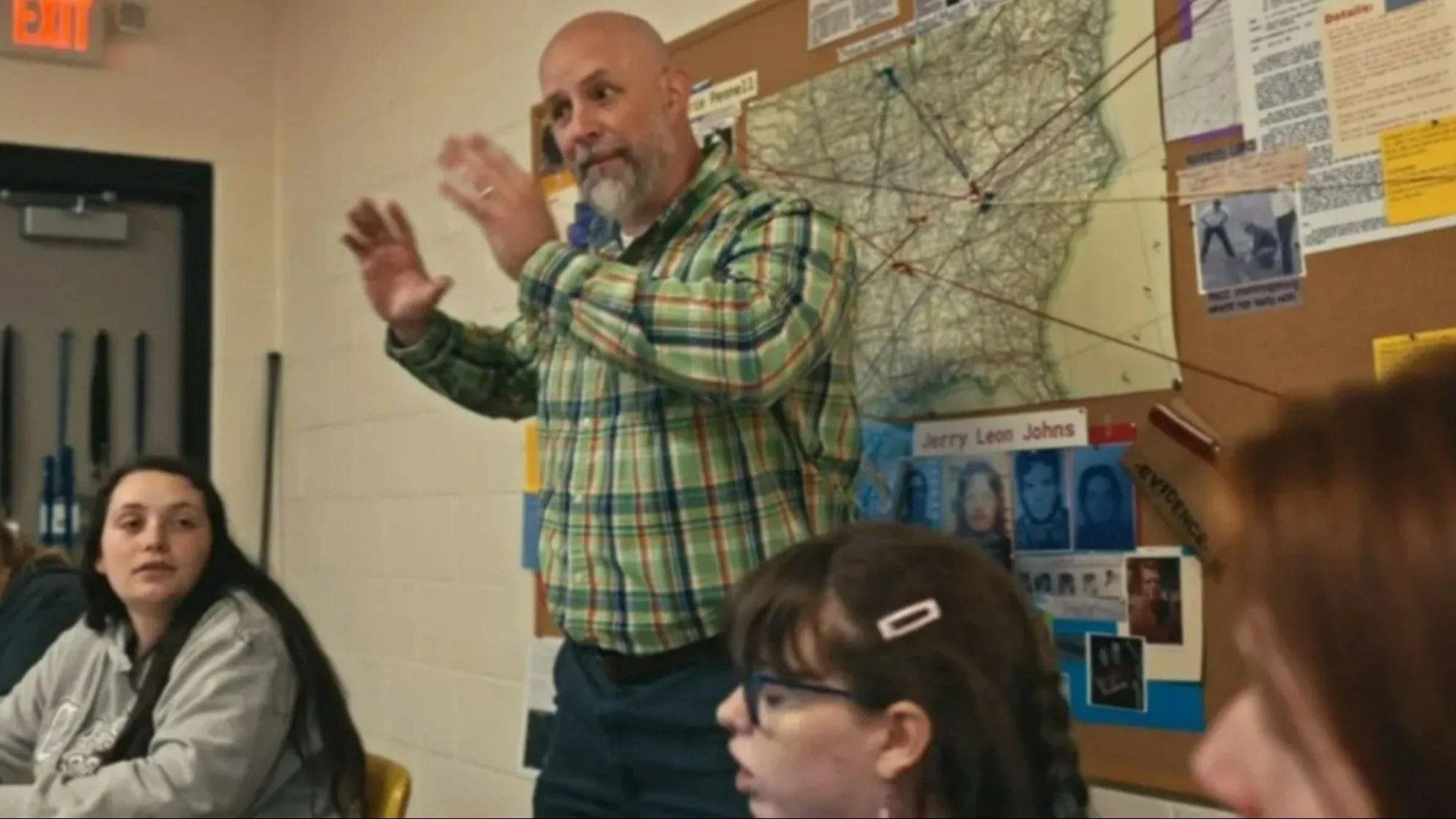
FOR nearly two decades, a phantom killer haunted America’s highways – leaving 14 red-haired women dead beside remote roads while investigators struggled to find a single suspect. The victims, many of them hitchhikers or sex workers, were often buried in anonymity, with no relatives able to confirm their identities and no killer brought to justice. A high school teacher tasked his students to solve one of America’s biggest mysteries Linda Schacke – the only known survivor of murderer Jerry Leon Johns’ attack Credit: Prime Video That was until a high school sociology teacher, Alex Campbell, tasked his 17-year-old students in 2018 to solve the twisted jigsaw of murders that had defeated investigators for decades. The teenage sleuths threw themselves into the macabre mystery, painstakingly sifting through forgotten files, dusty archives and long-overlooked evidence until they unearthed a crucial lead. After analysing more than 180 roadside murder victims in the area, the young detectives concluded the decades-long killing spree was not the work of one highway reaper, but nine separate killers operating along different highway routes. Their forensic deep dive into one suspect dubbed “The Bible Belt Strangler” led them to Jerry Leon Johns – an interstate truck driver responsible for the core six redhead murders. As many as 24 women – not all redheads – were originally believed to be woven into the eerie pattern of seemingly connected murders. But the groups remarkable research linked the suspected offenders to 82 confirmed victims, more than 100 possible victims and 15 survivors after cops missed 11 major signs. Cops had overlooked a string of chilling patterns, including the victims’ red hair, causes of death, repeated dumping locations, the women’s shared vulnerabilities, body disposal methods and links to truck stops along major highways. Officials also ignored a survivor’s direct evidence, delayed forensic testing, failed to re-interview key witnesses, cross-check missing persons databases and the take into account timing surrounding the murders. The classroom detectives found found the prime suspect, Jerry Leon Johns Credit: Tennessee Bureau of Investigation The class linked Jerry to the killing of Tina Marie McKenney Farmer, whose remains were found by the roadside Credit: Tennessee Bureau of Investigation Alex told The Sun: “My students were more right than they could ever imagine. “Law enforcement said, well, we don’t really know if there was a killer, what a joke. Now we know, we’ve proven that there’s nine! “I mean, they’re in prison right now for this.” The students revelations landed three suspects in prison, three had already died behind bars and three others are under investigation. The investigation began when the class at Elizabethton High School began analysing a trail of forgotten paperwork seized after Johns’ 1987 arrest for kidnapping and attempting to murder a red-haired woman, Linda Schacke, in Tennessee. As shown in the new Amazon docu-series, “Murder 101”, the students trawled through decades of newspaper reports and court records, mapping body locations against America’s vast trucking routes. Alex Campbell, a high school sociology teacher, and his students cracked the case for the first time in 2018Credit: Refer to source Their extraordinary work has now restored the identities of six forgotten victims once buried as Jane Does Credit: Prime Video But it was what lay inside the untouched police files – where yellowing fuel receipts, hotel slips and trucking records – that revealed fragments of the killer’s movements. The students then worked alongside FBI investigators to examine the paperwork. Alex said: “He [Johns] had three receipts on him, and one of the receipts was for gas on Loop Street in Houston, Texas. “Then we found beside the body of one of the ‘Redhead Murder’ victims was also a matchbook business card from a hotel on Loop Street. “These are the clues we found to see if he was related to any other murders. He had never been mentioned as a suspect in that case. “But what other killer is killing women and dumping them beside the road in the 80s with this methodology, who’s been on Loop Street?” The class reconstructed Johns’ movements and the emerging picture, they believed, placed Johns’ truck near highway exits where victims were abandoned around the time investigators believed killings occurred. Although Jerry Leon Johns was convicted of one murder and one attempted murder, the school’s investigation linked the interstate truck driver to at least six specific highway killings. In March 1985, Johns abducted Linda, bound and strangled her before dumping her near Interstate 40 Credit: Prime Video The students later worked with a knot expert who identified the type of knot used Credit: Prime Video But as the classroom detectives dug deeper into the mountain of forgotten evidence, a shocking flaw emerged – the rest of the redhead bodies did not fit the profile of a single killer. When students mapped out the murders against time, distance and trucking routes, the pattern began to fracture. Some killings happened too close together in time across vastly different states, making it impossible for one driver to have carried them out alone. The breakthrough shattered the long-held belief in a single phantom killer and revealed a far more complex web of suspected offenders operating across the highways. One of the investigation’s most significant breakthroughs came when the students tracked down Linda Schacke – the only known survivor of Johns. In March 1985, Johns abducted her, bound and strangled her before dumping her near Interstate 40. When students mapped out the murders against time, distance and trucking routes, the pattern began to fracture Credit: Prime Video Epsy Pilgrim was discovered inside a refrigerator in 1985 Credit: NamUS After losing consciousness, she woke inside the drain and crawled towards the highway – surviving an assault that the students believe revealed Johns’ method. Linda told them Johns approached her at a club in Knox County and quickly gained her trust, then using a torn piece of her shirt to bind and strangle her before dumping her inside a storm drain. The location mirrored the scene where 21-year-old Tina Farmer’s remains were discovered on the road side. The students’ findings helped reignite the investigation into Tina’s murder – the girl who was strangled to death, wrapped in a blanket and also dumped along a highway. DNA evidence later confirmed Johns – the man Campbell’s class had identified as their prime suspect – murdered Farmer, while a Campbell County grand jury ruled in 2019 that he would have been indicted had he still been alive. Alex said: “That’s what my first class did in 2018, they profiled him. This is before we even knew who Jerry Johns was. Linda recalled how Johns used a torn piece of her shirt to bind and strangle her before dumping her inside a storm drain Credit: Prime Video After more than four decades, “Baby Girl” was revealed to be 15-year-old Tracy Sue Walker, from Indiana Credit: Justice4TracySue “We profiled the person who was probably killing these women. And then it comes out he killed Tina Farmer.” Although Linda’s testimony revealed similarities in Johns’ alleged attacks – it also confirmed that some of the other murders couldn’t have been Jerry’s doing. The class of 15 analysed dozens of cold cases, examining causes of death, body disposal methods and the killers’ chilling techniques – uncovering some stark differences. Some victims were bound, strangled and stripped, just like Linda, while others were beaten to death and dumped fully clothed. Alex said: “He appeared to prefer to strangle his victims with a ligature made from something at the crime scene out of cloth.” The students later worked with a knot expert who identified the type of knot used and determined the killer was right-handed – matching Johns. But some of the other knots used to bind some victims simply didn’t match those found with Johns’ known murders. Crime scenes painted wildly different pictures too – while some bodies had been meticulously concealed, others were callously dumped in roadside ravines. To the students, the contradictions were impossible to ignore and they split the murders into nine distinct offender profiles – each pointing to a different suspect. Serial killer Jerry Johns remained the strongest match for their original profile. Alex explains: “He was a trucker. He did live in Tennessee, though, so obviously he was moving back and forth from Tennessee a lot.” He believes the social climate in the area created the perfect hunting ground for predators. Alex added: “A lot of people were into drugs, they were hitchhiking, they’re looking for jobs, they’ve gone into sex work. So that gives you more victims.” Tennessee’s rugged landscape also made it frighteningly easy for killers to vanish without a trace. Alex said: “There’s lots of mountains, creeks, woods – it’s very easy to acquire a victim. “There’s hardly anybody going by, there’s trees and gullies right beside the road – easy places to hide them.” Alex said Tennessee’s rugged landscape made it frighteningly easy for killers to vanish without a trace Credit: Prime Video The cases left America baffled for decades Credit: Prime Video Back then, police forces rarely shared intelligence across state borders, allowing travelling killers to slip through the cracks. Alex said: “If you’re a highly mobile killer who’s abducting in one state, killing them in another state, and putting their body in another state, it’s very hard for police to connect those things together.” For decades, detectives and the media bundled many of the killings together under the chilling banner of the “Redhead Murders”, convinced the victims’ hair colour was the twisted trademark of one monster. But the students’ argued the red hair link was largely a grim coincidence, with vulnerable women repeatedly falling prey to different predators prowling America’s interstate highways. Many of the victims were hitchhikers, runaways or sex workers travelling through isolated truck stops and lonely stretches of road, making them easy targets for opportunistic killers constantly on the move. That breakthrough led the class to another haunting mystery – an unidentified teenager known only as “Baby Girl”. Her remains were found in 1985 at Big Wheel Gap in Elk Valley, Tennessee, an isolated spot locals call “the back door”. The students successfully pushed for the case to be reopened and after more than four decades, “Baby Girl” was revealed to be 15-year-old Tracy Sue Walker, from Indiana. The class then joined forces with the TBI to launch a relentless campaign to identify her killer, highlighting the case through their podcast and new Amazon Prime docuseries, although her killer still remains at large. Another forgotten victim whose identity was regained was Epsy Pilgrim. On April 1, 1985, this Epsy’s body was found in a discarded refrigerator at a dumping area just off the Cumberland Gap Parkway. The woman died of asphyxiation but there were no marks indicating strangulation – leaving gaps in the theory it was Johns who murdered her. To date, no one has been officially charged or definitively proven in a court of law to be her killer. Alex said families had never come forward because they had no idea the unidentified victims could be their missing loved ones. He said: “The murder stopped in ’85, so there was not a lot of attention being put into it. “So that’s what the students said: let’s bring attention back to this case, and let’s see if more attention could actually help get some stuff done.” Their extraordinary work has now restored the identities of six forgotten victims once buried as Jane Does. Among the killers identified by the students was Robert Ben Rhoades, known as the “Truck Stop Killer”, a long-haul trucker who turned the sleeper cab of his lorry into a torture chamber and is now serving life without parole. Now, nine years after their investigation began, Alex and his sociology students are still chasing leads, and continue helping unravel some of America’s most haunting cold cases.
How my school kids solved phantom ‘redhead murders’ cold case after spotting 11 signs baffled cops missed
Full Article
Original Source
Read the full article at Thesun →KhanList aggregates and links to publicly available news content. We do not host full articles from third-party sources. Always verify important information with original sources.