
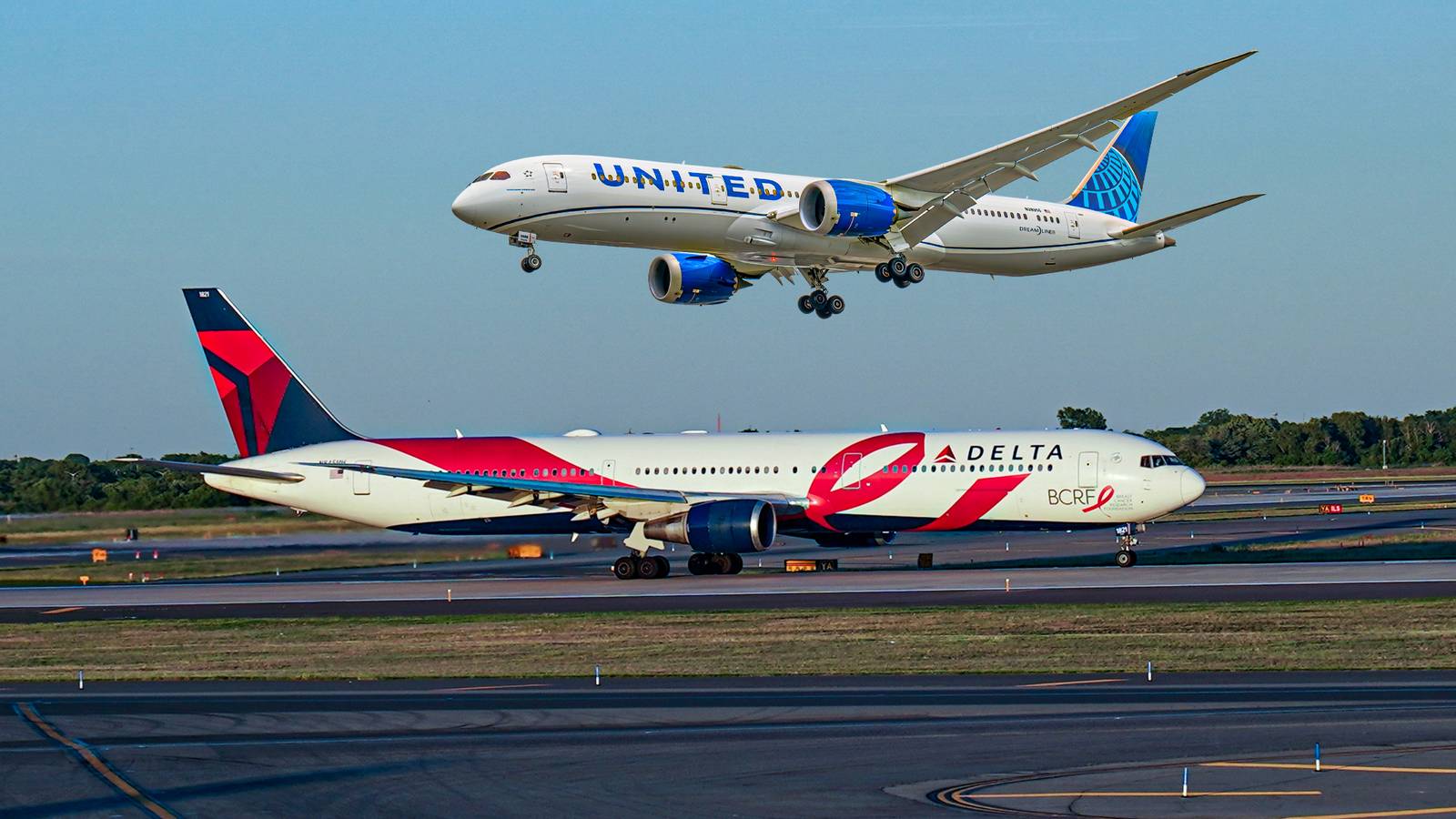
Credit: Leonard Zhukovsky & Craig Russell | Shutterstock, Simple Flying Published Nov 14, 2026, 8:00 AM EST Based in the UK, Josh is a keen writer with a degree in Military History. Having worked previously as a financial journalist, he has covered the aviation industry extensively, reporting on airlines' results and monthly passenger statistics in the aftermath of the pandemic, alongside the likes of regulation around sustainable fuels, and the prospects for hydrogen-powered commercial flight. He joins Simple Flying with a lifelong love of all things aviation. Sign in to your Simple Flying account Boeing built both the 767 and 787 to serve similar roles, albeit decades apart. Each is an example of a twin-engine widebody designed to serve medium- to long-haul routes, but at a fraction of the cost of more fuel-hungry quadjets. Naturally, the newer technology available when the 787 — or Dreamliner as it is known — was built means it trumps its older counterpart in efficiency and range. But passenger comfort is another matter, and whether one aircraft offers a better experience for those on board than the other is somewhat debatable when it comes to the 767 and 787. No doubt, the 787 has the edge in several areas. Fuselage width, however, does not necessarily work in its favor, despite the 787 offering more space in this sense than the 767. Boeing 787 Noticeably Wider Than Boeing 767 Credit: United Airlines As to how much wider it is, the short answer is: Significantly enough. The 787’s fuselage measures an extra two feet, five inches (0.74 meters) in width than the 767’s. Internally, the distance between each cabin wall is a slightly more moderate two feet, four inches (0.71 meters) greater aboard the 787 than the 767. That applies to all variants within the respective 787 and 767 families, given that each set of aircraft shares a common cross-section. Although the differences cited above may appear marginal, they do have very real ramifications for airlines and passengers alike. With an interior trim-to-trim width of 15 feet, six inches (4.72 meters), the 767 allows for rows of seven abreast economy seats laid out in a 2-3-2 configuration, according to Boeing aircraft characteristics documents. Each walkway running down the cabin is said to measure one foot, seven inches (0.48 meters) across. Boeing 767 and 787 family fuselage cross-section widths: Aircraft/Specification Boeing 767 Boeing 787 Exterior fuselage width 16 feet, 6 inches (5.03 meters) 18 feet, 11 inches (5.77 meters) Interior cabin width 15 feet, 6 inches (4.72 meters) 18 feet, 0 inches (5.49 meters) In contrast, the 787’s internal cabin width of 18 feet (5.49 meters) means enough space is available for airlines to fit rows of nine economy seats in a 3-3-3 configuration. Its walkways also measure a slightly smaller one foot, six inches (0.46 meters) in the standard cabin, per the Boeing documents. All of that goes to say, the 787 does boast a wider fuselage and internal cabin, but that does not necessarily translate to more room per passenger onboard. Boeing 787: Boeing’s Latest Clean-Sheet Design Credit: Lufthansa Beyond space per passenger, in economy seating at least, the 787 trumps the 767 on pretty much every other metric. Boeing officially launched the Dreamliner program in 2004, well after the 767’s own introduction. Come 2011, when the 787 debuted commercially with All Nippon Airways, the airliner was unlike anything that had come before it. Instead of relying so heavily on traditional materials such as aluminum, Boeing primarily built the 787s out of carbon fiber composites. Such materials, which are lighter and more resistant to corrosion, make up roughly 50% of the aircraft by weight, according to the manufacturer. That means “less fuel to lift, cruise, climb and maneuver,” as Boeing writes. Coupled with improved aerodynamics and newer engine technology, that translates to a 25% reduction in fuel burn compared to the planes the 787 was intended to replace. Boeing 787 family specifications, from Boeing: Aircraft model/Specification Boeing 787-8 Boeing 787-9 Boeing 787-10 Seats (two-class) 200–275 250–325 300–375 Range 8,000 nautical miles (14,820 km) 8,300 nautical miles (15,370 km) 7,500 nautical miles (13,890 km) Length 186 feet, 1 inch (56.7 meters) 206 feet, 1 inch (62.8 meters) 224 feet, 1 inch (68.3 meters) Wingspan 197 feet, 3 inches (60.1 meters) 197 feet, 3 inches (60.1 meters) 197 feet, 3 inches (60.1 meters) Height 55 feet, 6 inches (16.9 meters) 55 feet, 10 inches (17.0 meters) 55 feet, 10 inches (17.0 meters) Engine GE Aerospace GEnx-1B / Rolls-Royce Trent 1000 GE Aerospace GEnx-1B / Rolls-Royce Trent 1000 GE Aerospace GEnx-1B / Rolls-Royce Trent 1000 But the wide use of composites in the 787 has offered benefits beyond just improved efficiency. For passengers, dehydration and jet lag are common effects of long-haul flights. Boeing was able to incorporate features into the 787 to mitigate both, though. Given that carbon composites do not rust, cabin humidity levels can be kept higher in the newer-generation widebody. Similarly, fatigue-resistant properties allow a lower cabin altitude—which plays a large part in the severity of jet lag—to be maintained than on older aluminum aircraft. Boeing 767: Boeing’s First Twin-Engine Widebody Credit: Delta Air Lines In contrast, the 767 is very much a product of its time. Developed alongside the Boeing 757, the 767 program was officially launched back in 1978. The widebody then made its first commercial flight with United Airlines in 1982. Needless to say, technology moved on a fair bit in the near-three-decade gap between the 767 and 787’s respective entries into service. As with many aging models built primarily from aluminum, the 767’s cabin altitude tends to sit in the 7,000- to 8,000-feet (2,137 to 2,439-meter) range. That is cut to 6,000 feet (1,829 meters) on the 787, meaning passengers experience a smaller drop in blood oxygen saturation—which itself contributes to classic jet-lag symptoms. Humidity in the 767 and older jets’ cabins can also drop below 10%, deliberately to stave off corrosion. Aboard the 787, moisture is less of a worry, so humidity tends to be higher, at between 15% and 25%, contributing to a more comfortable experience for those onboard. Select Boeing 767 family specifications, from Flightradar24 and Boeing: Aircraft model/Specification Boeing 767-200 Boeing 767-300ER Boeing 767-300F Boeing 767-400 Maximum capacity 255 290 - 409 Typical capacity (two-class) 216 261 - 296 Range 3,900 nautical miles (7,200 km) 5,980 nautical miles (11,070 km) 5,980 nautical miles (11,070 km) 5,625 nautical miles (10,415 km) Length 159 feet, 2 inches (48.5 meters) 180 feet, 3 inches (54.9 meters) 180 feet, 3 inches (54.9 meters) 201 feet, 5 inches (61.4 meters) Wingspan 156 feet, 1 inch (47.5 meters) 156 feet, 1 inch (47.5 meters) 156 feet, 1 inch (47.5 meters) 170 feet, 4 inches (51.9 meters) Height 52 feet (15.8 meters) 52 feet (15.8 meters) 52 feet (15.8 meters) 52 feet (15.8 meters) Engine Pratt & Whitney JT9D / Pratt & Whitney PW4000 / General Electric CF6 Pratt & Whitney JT9D / Pratt & Whitney PW4000 / General Electric CF6 / Rolls-Royce RB211 Pratt & Whitney JT9D / Pratt & Whitney PW4000 / General Electric CF6 / Rolls-Royce RB211 Pratt & Whitney PW4000 / General Electric CF6 No doubt, Boeing built the 787 to trump its predecessors across the board on efficiency and passenger comfort. The irony is that, in offering a cabin that was wider and more spacious than the 767’s, Boeing effectively gave airlines the choice of squeezing in more seats or giving passengers the extra room. As it turned out, airlines almost universally opted to use the extra width for capacity. Boeing 787 Cabin Can Be More Cramped Than Boeing 767's Credit: Delta Air Lines Indeed, Boeing reportedly originally intended the 787 to seat eight passengers per row in economy, in a 2-4-2 configuration. Instead, the 3-3-3 layout has become favored by most airlines. That means it is on the 767, which tends to seat economy travelers in a 2-3-2 pattern, where space is more abundant—despite its narrower fuselage. United, as an operator of both the 787 and 767, offers a clear example of this. Economy seat width — measured from the inner sides of armrests — across its Dreamliner fleet ranges from approximately 16.6 inches (42.2 centimeters) to 17.6 inches (44.7 centimeters) depending on model and specific interior, per the carrier’s website. Aboard its 767s, this varies between 18.0 inches (45.7 centimeters) and 18.5 inches (47.0 centimeters). Boeing 767 and Boeing 787 deliveries to date, from Boeing data: Aircraft family Total deliveries Boeing 767 1,380 Boeing 787 1,322 *As of time of writing in mid-November Of course, seat pitch and recline also play a part in determining how much room each passenger gets, and similarly vary from carrier to carrier. That said, the trend of economy seats being wider on 767s than 787s is not limited to United; most carriers put the latter’s wider fuselage to work by installing extra seats. Japan Airlines’ 787 Fleet: The Notable Exception Not all do, though. Japan Airlines is a notable exception when it comes to the 787, given its Dreamliner economy cabins feature a seat less per row than at the majority of other carriers. Unsurprisingly, this means the airline’s standard 787 seats are wider than those on its 767s. Based on figures from the Japanese flag carrier’s website, passengers can expect their economy seat to measure approximately 18.9 inches (48 centimeters) from the inside of one armrest to the other if on one of its 787s. Conversely, this drops to around 17.7 inches (45 centimeters) aboard Japan Airlines’ 767s. This is because, unlike others, the carrier’s 787s host a 2-4-2 instead of a 3-3-3 configuration in their main cabins. As the airline writes itself: “A more relaxed eight-across seat layout rather than the industry standard nine-across [allows] for an extra five centimeters in seat width.” Compared to Japan Airlines’ 767s, which use the usual 2-3-2 main cabin layout, more of the extra space afforded by the 787’s wider cabin goes to passengers. Wider 787 Fuselage Plays Into Airlines’ Hands All told, Japan Airlines is an outlier when it comes to its 787 seating plan. The bulk of airlines have instead taken to getting the maximum out of the Dreamliner’s width by fitting more passengers per row than on the 767. In other words, the fact that the 787 offers more space between cabin walls does not necessarily mean a more spacious seat onboard in most cases. There is also the noteworthy fact that 767s tend to feature just one middle seat across each main cabin row. That is impressive not only compared to the 787, but also to even bulkier jets like the Boeing 777, where economy passengers will usually find ten adjacent seats laid out in a 3-4-3 formation.
How Much Wider Is The Boeing 787's Fuselage Compared To The 767?
Full Article
Original Source
Read the full article at Simpleflying →KhanList aggregates and links to publicly available news content. We do not host full articles from third-party sources. Always verify important information with original sources.