
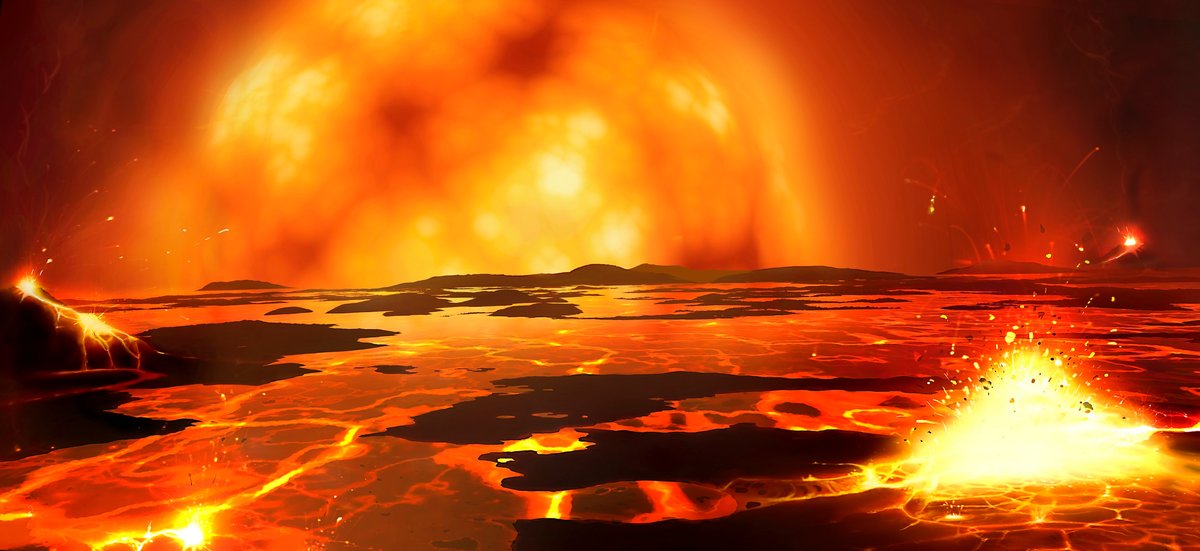
The sun seems unchanging—a constant source of light and warmth for Earth and the most fundamental necessity for life as we know it.But nothing in this universe is unending.Eventually the sun will cease to be the nurturing star we know as it undergoes a series of dramatic—and, in some cases, cataclysmic—changes that will ultimately lead to its demise. These won’t happen for eons yet, but the seeds of those transformations have already been planted in our star’s heart and are slowly growing.On supporting science journalismIf you're enjoying this article, consider supporting our award-winning journalism by subscribing. By purchasing a subscription you are helping to ensure the future of impactful stories about the discoveries and ideas shaping our world today.The key to the sun’s life (if I may call it that) is thermonuclear fusion—squeezing lighter elements so tightly together that their nuclei fuse to form heavier elements. This fusion process in the sun’s core is actually quite complex. Called the proton-proton chain, it involves a series of steps that, in the end, convert four hydrogen nuclei (that is, four protons) into a single helium nucleus.This nets a meager trickle of energy per helium atom forged, but there are a rather large number of hydrogen atoms in the sun’s core: our star fuses about 600 million metric tons of hydrogen into 596 million metric tons of helium every second. The difference of four million metric tons is converted (via the equation E = mc2) into a staggering amount of power: 4 × 1026 watts. That means the sun emits more than 600,000 times as much energy in one second as all of humanity is estimated to use in a year.That’s enough to power a star.Fusing hydrogen requires very high temperatures, about 15 million degrees Celsius. But even at that scorching level, the newly formed helium nuclei are inert. They fall down to the center of the sun and settle there, like ash in a fireplace. Although millions of metric tons accumulate every second, the core of the sun is so huge that the amount of helium added to it is relatively small on human timescales.But it does add up. Because four hydrogen atoms are needed to make one helium atom, over time, there are fewer atoms in the core to support the enormous pressure from the mass above them. Squeezed by the mounting pressure, the core shrinks and heats up, which, in turn, makes the sun shine brighter. This process is slow but inexorable. The sun is about 4.6 billion years old, and over that time, its luminosity—the rate at which it emits energy—has increased by about 30 percent.In a billion years or so, the sun will be so much brighter that it will trigger a runaway greenhouse effect on Earth. The oceans will boil, and all the water will be lost to space. At that point, it’s very likely our planet will no longer be able to support life.But the sun won’t be done yet.It will continue to fuse hydrogen into helium—at least, for a while. When it reaches an age of about 10.9 billion years (a little more than six billion years from now), it will run out of available hydrogen fuel to fuse. By then, the inner core will be comprised of inert helium, which will continue to contract and get very hot—so hot that a thin shell of hydrogen outside the core will begin fusing.That will pump even more energy into the sun’s overlying layers, which will expand as they heat up, causing the entire star to swell. At this point, the sun will be what astronomers call a subgiant, but the expansion will continue. After another 700 million years (when the sun is more than 11 billion years old) it will reach about twice its current size. Counterintuitively, this will also cause its surface temperature to drop. The surface area of the sun will increase so much as it swells that the amount of energy it radiates per square centimeter will actually decrease. The gas, once white-hot, will cool to red, and the sun will become a true red giant.For the next 600 million years, the nascent red giant will continue to grow, peaking at around 170 times its current diameter and cooling all the while. Its luminosity, however, will grow enormously, peaking at more than 2,000 times its current level. This will cook the planets; in fact, our star will expand enough at that point to physically consume the planet Mercury.As the sun swells, its surface gravity will drop: the force of gravity weakens with distance. Paired with the fierce luminosity, this weakened gravity will cause strong winds of gas to blow out from its surface. Over the time it will take to reach the peak of the red giant stage, the sun will lose more than a quarter of its total mass to these winds.Meanwhile helium will still be accumulating in its core—and will be getting hotter. About 1.3 billion years after running out of hydrogen, the core’s temperature will reach about 100 million degrees C—high enough to begin fusing helium into carbon and oxygen. This will actually produce less energy than shell hydrogen fusion, so the sun will shrink to about 10 times its current size, and its surface will get hotter and bluer. Fusion will continue steadily for 100 million years, until the sun runs out of available helium in the core.Then a semirepeat of previous events will unfold. This time, carbon and oxygen will accumulate in the core, where they will heat up and spark helium fusion in a surrounding shell (and hydrogen fusion in a shell around that). The sun will swell again, getting even bigger than before: almost 200 times its current diameter. It will blast out energy at 2,000 times its current rate, cooling and reddening yet again. This is called the asymptotic giant branch phase of the sun’s life, and this phase will also be accompanied by powerful stellar winds.As those winds blow away even more mass, the sun’s gravitational pull will decrease, becoming so weak that the planets will start to move outward. This migration won’t save Venus, which, like Mercury, will get consumed. Earth may manage to avoid being eaten—the science on this isn’t clear—but it hardly matters: the giant sun will fill nearly half of Earth’s sky and will quite thoroughly broil our planet.Amazingly, it gets worse. Shell helium fusion is extremely sensitive to temperature, and even tiny changes in the core will cause the rate of fusion to fluctuate wildly. Every time that happens, a huge pulse of energy will be emitted, swelling the sun and causing its luminosity to soar. After the fourth (and final) pulse, the sun will be well more than 200 times its current size and more than 5,000 times more luminous! These pulses will blast away the remaining outer layers, exposing the core: an ultradense, extremely hot ball of oxygen and carbon, only about the size of Earth but hundreds of thousands of times denser. Astronomers call this a white dwarf.At that point, at an age of more than 12 billion years, the sun will be essentially dead. No longer generating energy, it will cool and darken over billions more years to fade away into a black dwarf.I’ll admit this sounds bleak. But it’s eons away, so remote from now that, even if humanity survives into that far-off future, it’s impossible to know what our species’ existence will look like. Perhaps we’ll have long since found a different, younger star to make our home. Perhaps we won’t even need one by then.Astrophysics shows us the inevitable timeline of the sun, but humans are a bit more complex. Our own future is much trickier to predict.My thanks to astronomer Richard Pogge for conversations on this topic some years ago; the timings listed above are from his wonderful page outlining the sun’s future.
How much longer will the sun shine?
Full Article
Original Source
Read the full article at Scientificamerican →KhanList aggregates and links to publicly available news content. We do not host full articles from third-party sources. Always verify important information with original sources.