
Credit: Michael Derrer Fuchs | Shutterstock, Simple Flying Published Nov 23, 2026, 9:00 AM EST Brandon's passion for aviation started at a young age. He became involved in the flight simulator and VATSIM communities, which sparked his interest in aviation and eventually led him to earn his private pilot license. Outside of work, he continues to build flight hours, explore new airports, and stay involved in the aviation community. Sign in to your Simple Flying account Boeing’s 777-300ER entered service in 2004 and is still the backbone of many long-haul fleets, but the cost of flying one is harder to pin down than its age suggests. Published estimates for a mid-life aircraft range from about $18,000 an hour to the mid-$20,000s. Most of that gap comes from two inputs: the jet fuel price each estimate assumes, and how much engine maintenance it counts. Fuel became far more expensive in 2026. Jet fuel prices roughly doubled after the war in Iran began, so any estimate built on pre-war prices now understates the highest cost of operating a widebody. Lease payments, crew, maintenance, airport charges and insurance make up the rest of the bill, and each one varies with the airline, the route and the age of the aircraft. What The Published Estimates Say Credit: Markus Mainka | Shutterstock Simple Flying’s April 2026 analysis puts the hourly cost of a mid-life 777-300ER at about $18,000 to $19,000, or roughly $5 million a month and $60 million a year. That estimate assumes jet fuel at about $2.50 a gallon, which puts fuel at $5,000 to $6,000 an hour. The analysis also points out that actual costs vary widely with fuel prices, region, maintenance, financing, and how the aircraft is used, and cites a lower Eurocontrol estimate of about $40 million a year at 2022 prices. Aircraft Investigation produces a higher figure. Its model gives the 777-300ER a direct operating cost of €24,804 an hour, which the site lists elsewhere as about $26,000. That total assumes the aircraft’s hourly cruise burn of about 2,833 gallons (10,722 liters) costs €6,433, which implies a price of roughly €0.60 a liter, well below 2026 levels. The site cautions that its calculations “must be regarded as indication not as facts.” Side by side, the two estimates agree closely on fuel and crew. The split comes on maintenance, where Aircraft Investigation lists the engines separately and ends up at more than twice the April figure. Its model also does not itemize leasing, airport fees, or insurance, so the two totals cannot be reconciled line by line. Maintenance, unlike fuel, has no public market price, and each estimate has to decide how to spread the cost of major engine work, which can come years apart, across individual flight hours. Cost per hour Simple Flying (April 2026) Aircraft Investigation Fuel $5,000–6,000 €6,433 Crew About $2,000 €1,650 Maintenance, airframe $3,000–4,000 (includes engines) €4,842 Maintenance, engines Included above €4,414 Lease About $1,540 Not itemized Airport fees About $1,500 Not itemized Insurance About $25 Not itemized Other, including en route fees About $2,000 Not itemized Total About $18,000–19,000 €24,804 Fuel Is The Largest Cost, And Its Price Doubled In 2026 Credit: Bulent camci | Shutterstock At economical cruise speed, the 777-300ER burns about 2,833 gallons (10,722 liters) of fuel an hour, or roughly 18,560 lb (8,417 kg). Fuel burn is highest during takeoff and climb, so the cruise figure understates the average across a full flight. All of that fuel goes through two GE90-115B engines, the only engine ever offered on the type. The price of that fuel rose sharply in 2026. The Argus US Jet Fuel Index put the average US price at $3.99 a gallon in mid-March, up from $2.50 the day before the war began two weeks earlier. By June, IATA said the price had “roughly doubled since late February.” Using IATA’s late-September price of $4.415 a gallon, an October 2026 analysis put cruise fuel for the 777-300ER at about $12,500 an hour, more than double the April estimate. In the week ending October 9, IATA’s global average reached $190.18 a barrel, 111.2% higher than a year earlier. Prices have eased since then but remain well above pre-war levels. IATA’s most recent weekly figure put the global average at $169.82 a barrel, down 5.1% from the week before, or about $4.04 a gallon. At that price, the 777-300ER’s cruise burn would cost roughly $11,450 an hour. Across the industry, IATA forecasts fuel expenses of $351 billion in 2026, lifting fuel’s share of operating costs to 31.4%. Hedging softens the blow for some carriers. Airlines had hedged roughly one-third of their 2026 fuel needs, but many hedged against crude oil rather than jet fuel, which left them exposed to the widening gap between the two prices. Leasing, Crew, Airport Fees, And Insurance Credit: Sorbis | Shutterstock Ownership is a smaller share of the hourly cost than fuel. Aircraft valuation firm IBA put the lease rate for a mid-life 777-300ER at about $450,000 a month, or about $15,000 a day, in September 2024. At 292 flight hours a month, that comes to about $1,540 per flight hour. IBA valued the same aircraft at about $80 million, compared with the 2023 list price of $150 million that Aircraft Investigation records. Airlines that own their aircraft outright carry depreciation and financing costs instead of a lease payment. Crew costs come to about $2,000 per flight hour, and more than half of that goes to the pilots. Long-haul 777 flights typically carry two active pilots and two relief pilots, and senior captains can earn up to $400 an hour. Aircraft Investigation’s estimate of €1,650 an hour falls in a similar range. The total rises with sector length, because longer flights require relief pilots in addition to the operating crew. Airport charges vary the most between routes. At New York JFK (JFK), for example, landing fees have been $7.43 per 1,000 lb of maximum takeoff weight since January 1, 2025. With a maximum takeoff weight of 775,000 lb, a 777-300ER pays roughly $5,760 to land there. More broadly, a large 777 may pay $5,000 to $7,000 per arrival, plus $2,000 to $5,000 for handling and parking, which averages about $1,500 per flight hour. Insurance is minor at about $86,000 a year, or roughly $25 per flight hour. Another $2,000 or so per flight hour covers en route fees, cleaning, catering, and other expenses. Maintenance Is Where The Estimates Split Most Credit: GE Aerospace Maintenance accounts for most of the difference between published estimates. The April 2026 analysis puts it at more than $1 million a month, or $3,000 to $4,000 per flight hour, with the engines making up a major part of that total. On those figures, maintenance is the second-largest cost after fuel. It also climbs as an aircraft ages, since a 777-300ER reaching midlife needs costly heavy maintenance on top of routine line work. Aircraft Investigation separates the engines from the rest of the aircraft and reaches a much higher number. Its model puts airframe maintenance at €4,842 an hour and adds €4,414 an hour for the engines, about €9,256 combined. That is more than double the April estimate before any currency conversion. The site rates the confidence of its underlying data as medium and does not explain how it spreads the cost of major shop visits across flight hours, which is the biggest variable in any engine maintenance estimate. How an airline pays for engine work shapes its hourly cost as much as the work itself. Many 777 operators buy engine support from GE at a fixed rate per flight hour, which turns irregular shop visits into a steady monthly cost. Emirates, for example, extended its TrueChoice Flight Hour agreement with GE covering maintenance, repair and overhaul for the 54 GE90-115B engines on its 777-300ERs, a deal valued at more than $400 million over the life of the contract. An airline that covers its own shop visits instead faces large bills at irregular intervals, which each estimate spreads across flying hours in its own way. Because flight-hour rates are negotiated, two airlines flying identical aircraft can carry very different maintenance costs per hour. How The 777-300ER Compares With The A350-1000 And 747-8 Credit: guilhem gaubert | Shutterstock At September 2026 fuel prices, the 777-300ER sits between its newer and older rivals. The A350-1000 burns about 2,268 gallons (8,585 liters) an hour at cruise, costing roughly $10,000, against the 777-300ER’s 2,833 gallons and $12,500. The four-engine 747-8 burns 3,914 gallons (14,818 liters) an hour, for about $17,280. On those numbers, the A350-1000’s cruise fuel cost is 20% lower than the 777-300ER’s, while the 777-300ER’s is nearly 28% lower than the 747-8’s. Capacity narrows the gap with the Airbus on a per-seat basis. Two-class layouts range from 350 to 425 seats on the 777-300ER, against 369 on the A350-1000 and more than 500 on the 747-8. An airline with a dense 777-300ER cabin spreads its higher fuel bill across more passengers than an A350-1000 operator with a premium-heavy layout. Engine count matters too. The 747’s four engines mean more overhaul programs and greater repair risk than the twin-engine 777 or A350, which is one reason the older Boeing’s block-hour cost is well above $20,000 and sometimes approaches $30,000. Ownership costs pull in the opposite direction from fuel. IBA’s September 2024 rates put a new A350-900 at $1.15 million a month to lease, against about $450,000 for a mid-life 777-300ER. IBA did not publish a comparable A350-1000 figure in that set, but the A350-900 rate alone shows how far a new widebody’s lease payment can exceed an older 777’s. For an airline choosing between them, the 777-300ER’s lower ownership cost offsets part of its fuel disadvantage.
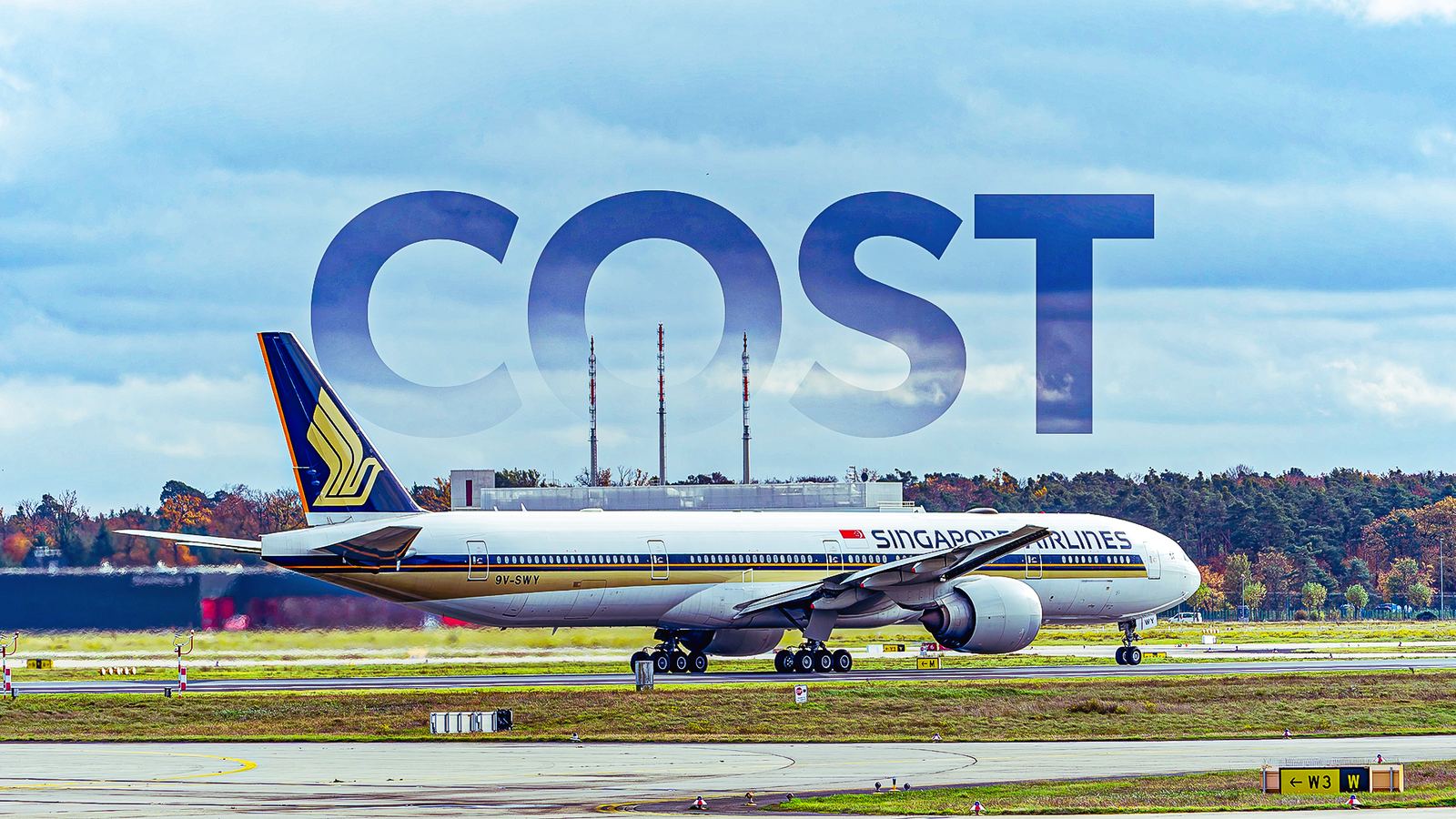
How Much Does A Boeing 777-300ER Cost To Operate Per Hour?
Full Article
Original Source
Read the full article at Simpleflying →KhanList aggregates and links to publicly available news content. We do not host full articles from third-party sources. Always verify important information with original sources.