
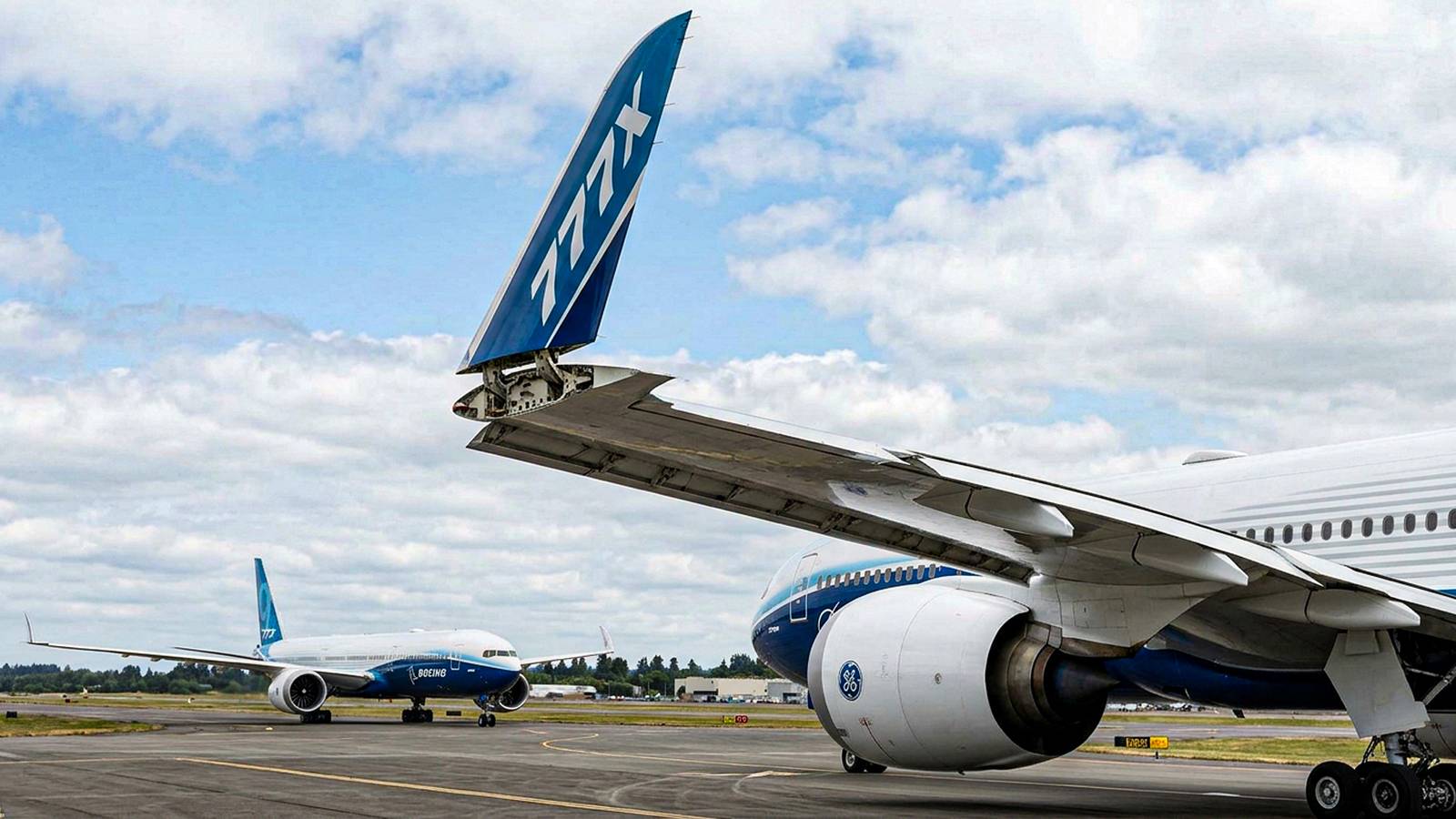
The Boeing 777X has some of the largest and most technologically advanced wings ever fitted to a commercial airliner. Its enormous carbon-fiber structure combines greater aerodynamic efficiency with folding wingtips, allowing the aircraft to use existing airport gates despite its impressive wingspan. Developing such an ambitious design, however, comes at a considerable price, and Boeing has never disclosed exactly how much a finished pair costs. Boeing does not sell 777X wings separately, and the company has never published a unit price for a finished pair. That leaves no simple price tag to quote and forces us to look elsewhere for clues. Aircraft values, development spending, factory investment, and industry estimates can all help narrow the range, but they do not point to exactly the same number. So what can they actually tell us about the cost of the 777X's wings? Boeing 777X Wing Cost Could Reach $35 Million To $55 Million Credit: Coby Wayne | Shutterstock The most defensible estimate for a pair of Boeing 777X wings is roughly $35 million to $55 million. That is an inference rather than an official Boeing figure. It comes from applying a commonly cited aerospace benchmark, which places advanced composite wings at roughly 15% to 25% of an aircraft's value, to an estimated Boeing 777-9 street price of approximately $190 million to $230 million. That calculation produces a much wider theoretical range of about $29 million to $58 million, making $35 million to $55 million a reasonable middle ground. The comparison becomes even more striking when the aircraft's official pricing is considered. The 777-9's last published list price was about $442 million, but airlines generally negotiate substantial discounts from published prices. That difference is why using the list price directly would produce a very different wing estimate. There are also estimates that go considerably higher. A BlackJet pricing guide puts the cost of each 777X wing at around $50 million. Taken literally, that would mean approximately $100 million for a pair. The problem is that the source does not make sufficiently clear whether the figure represents one wing, a complete wing set, or another valuation measure. The bigger numbers associated with the 777X belong to a different category altogether. Boeing reportedly spent at least $2 billion on research, engineering, and testing for the wing, although that figure is widely repeated rather than officially disclosed by the company. The manufacturer also invested more than $1 billion in the facility where the wings are produced. As reported by Reuters through The National, Boeing has taken about $15 billion in losses related to the 777X program as delays, higher costs, and other problems have pushed the price of developing and building the aircraft far beyond the original expectations. That figure helps show how expensive the program has become, but it cannot be used to calculate the price of a pair of wings. The 777X Wing's Size And Manufacturing Drive Its Cost The first reason the 777X wing is expensive is impossible to miss: it is enormous. With its folding tips extended, the wing spans 235 feet, 5 inches (71.8 meters), which the Herald of Everett noted makes it the longest wing Boeing has ever built. Its size is not simply a matter of appearance. According to Simple Flying, the carbon-fiber wing has roughly 18% more area than the wing fitted to the 777-300ER. On the ground, the folding tips reduce the span to 212 feet, 9 inches (64.8 meters), allowing the aircraft to remain compatible with airport infrastructure designed around smaller wings. That mechanism adds another layer of engineering to an already large structure. Material requirements are only part of the equation. Boeing also needed a dedicated manufacturing system capable of producing the wing at the required scale. Unlike the 787, whose composite wing was outsourced to Mitsubishi Heavy Industries, Boeing decided to manufacture the 777X wing itself. The Seattle Times reported that the Everett wing center represented an investment of about $1 billion. The facility itself illustrates why the wing cannot be compared with a conventional aluminum structure simply by looking at raw material prices. Boeing said at the facility's opening that the building contains three of the world's largest autoclaves, each large enough to accommodate two 737 fuselages. According to The Seattle Times, each autoclave measures 120 feet (37 meters) long and 28 feet (8.5 meters) in diameter. The production process adds another layer of cost. The Seattle Times described automated equipment laying carbon-fiber tape across the wing's spars and skins, while a single wing skin requires about 300 separately programmed robot runs. The folding wingtip system then adds actuators, locks, sensors, and associated certification work that a conventional fixed wing does not need. There is another problem for Boeing: production volume. The company is not building hundreds of 777X wing sets every month. When a program produces relatively small numbers of a highly complex component, the cost of specialized tooling, robotics, autoclaves, engineering, and inspection has to be spread across fewer aircraft. That does not necessarily make every wing physically expensive to manufacture, but it makes recovering the enormous upfront investment much harder. Boeing's 777X Wing Investment Goes Far Beyond The Factory Credit: Michelangelo DeSantis | Shutterstock, Simple Flying The factory investment therefore tells only part of the story. Boeing's spending on the wing began long before the first production-standard aircraft could fly, and much of that money cannot be recovered simply by producing another wing. Boeing's clearest public figure came in 2016, when the company said it had invested more than $1 billion in the Everett site for the new composite wings. Since then, Boeing has focused publicly on the aircraft's certification and delivery schedule rather than disclosing a detailed unit-cost breakdown. In October 2025, AP reported that CEO Kelly Ortberg moved the first 777X delivery target to 2027 and that Boeing took a $4.9 billion charge during the quarter. Ortberg said the delay was related to certification rather than newly discovered technical problems. That distinction matters because the financial consequences of a delayed program can become much larger than the cost of the physical hardware itself. A factory can continue to incur expenses while aircraft wait for certification, production can become inefficient, and engineering teams can remain committed to a program for years longer than originally planned. Aircraft valuation provides another way to estimate the underlying economics. According to the BlackJet guide, valuation firm Avitas placed the 777-9's discounted purchase price at approximately $200 million in 2018 dollars. Airlines have nevertheless continued to commit to the aircraft. AP noted that Qatar Airways was waiting for 124 aircraft and Emirates had ordered 205 at the time. That demand matters because the wing's development cost ultimately has to be recovered across the aircraft Boeing sells. As Simple Flying reported, the roughly $15 billion in 777X charges largely reflects accounting costs associated with delays, production inefficiencies, and certification problems rather than the entire development bill. The same report cites BlackJet's view that final development costs could approach $20 billion. That puts the $35 million to $55 million wing estimate into perspective. The physical cost of carbon fiber, labor, machinery, and assembly is only one part of what Boeing ultimately has to recover. For the early aircraft, program-level costs and years of development can have a much larger effect on the economics of each delivered jet. The 777X Wing Trades Higher Cost For More Efficiency The 777X wing becomes easier to understand when compared with the alternatives Boeing and Airbus have chosen. The closest Boeing comparison is the Boeing 787, which also uses a carbon-fiber wing but has a different production model. Boeing outsourced the 787 wing to Mitsubishi Heavy Industries, while the larger 777X structure is produced internally at Everett. The older 777-300ER offers a different benchmark. Its aluminum wing spans roughly 212 feet (64.8 meters) and does not require folding tips. It is therefore less complex from both a structural and manufacturing perspective, even though the 777X wing has to provide a considerably larger aerodynamic surface. Carbon fiber gives Boeing advantages that help explain the investment. The material is lighter and stiffer than aluminum, allowing the manufacturer to increase wing span and fuel-carrying capability without accepting the same weight penalty that a comparable aluminum structure would impose. The 777X therefore uses a much more expensive production system to obtain an aerodynamic advantage that would have been difficult to achieve through a simple evolution of the previous-generation wing. Airbus followed a more conservative path with the A330neo. Instead of developing an entirely new carbon-fiber wing, Airbus lengthened the existing aluminum structure from 197.8 feet (60.3 meters) to 210 feet (64 meters), with composite elements incorporated into the design. The approach is less revolutionary and requires less specialized manufacturing infrastructure, although it also delivers a smaller aerodynamic step. Boeing is paying for a much larger and more complex structure, but the purpose is to reduce fuel consumption over thousands of flights. The relevant question is whether the additional cost produces enough efficiency over the aircraft's service life to justify the investment. The $35 Million To $55 Million Estimate Comes With Major Caveats Credit: Falcons Spotters | Shutterstock A percentage of an aircraft's purchase price is not necessarily a reliable measure of what it costs to manufacture a particular component. Aircraft pricing reflects far more than the sum of its individual parts, including commercial negotiations, customer support, equipment options, and the manufacturer's own financial position. Applying a percentage to the 777-9's estimated selling price therefore provides a useful comparison, but it does not reveal the actual resources required to build its wings. The distinction becomes even more important when comparing different generations of aircraft. The 777X's composite structure, folding tips, and dedicated production infrastructure have little in common with the manufacturing economics of an older aluminum wing. Even another composite-wing aircraft, such as the 787, follows a different production model. A percentage that might be reasonable for one aircraft cannot automatically be transferred to another. Ultimately, there is no publicly available breakdown showing how much of a 777-9's selling price can be attributed to its wings. The $35 million to $55 million range is therefore a way of illustrating their potential economic scale, not a figure that can be independently verified against Boeing's manufacturing accounts. The 777X Wing's Final Cost Will Take Years To Judge For now, $35 million to $55 million remains a defensible estimate for a pair of Boeing 777X wings, based on a 15% to 25% share of a $190 million to $230 million aircraft value. Boeing has not confirmed that figure, and the higher estimates circulating online demonstrate just how uncertain the calculation remains. The more firmly established numbers tell a different story. Boeing invested more than $1 billion in the factory, reportedly spent at least $2 billion on wing development, and has accumulated roughly $15 billion in 777X program charges. Those figures show that the real economic burden of the wing is not contained in its carbon-fiber materials or assembly labor. A large share of the cost was created before the first airline could operate the aircraft. That distinction will become increasingly important once the 777X enters airline service. Boeing is targeting first delivery in 2027, with the production-standard aircraft now flying while certification hurdles remain. Once airlines begin accumulating operational experience, fuel-burn and maintenance data will provide something current estimates cannot: evidence of whether the enormous investment behind the 777X wing produces enough real-world savings to justify its cost. Until then, the $35 million to $55 million range is best treated as a calculated estimate, not a price tag. The first years of airline service should reveal whether Boeing's most ambitious commercial-airliner wing has become an expensive engineering achievement, a worthwhile investment, or some combination of both.
How Much Do A Pair Of Boeing 777X Wings Cost?
Full Article
Original Source
Read the full article at Simpleflying →KhanList aggregates and links to publicly available news content. We do not host full articles from third-party sources. Always verify important information with original sources.