
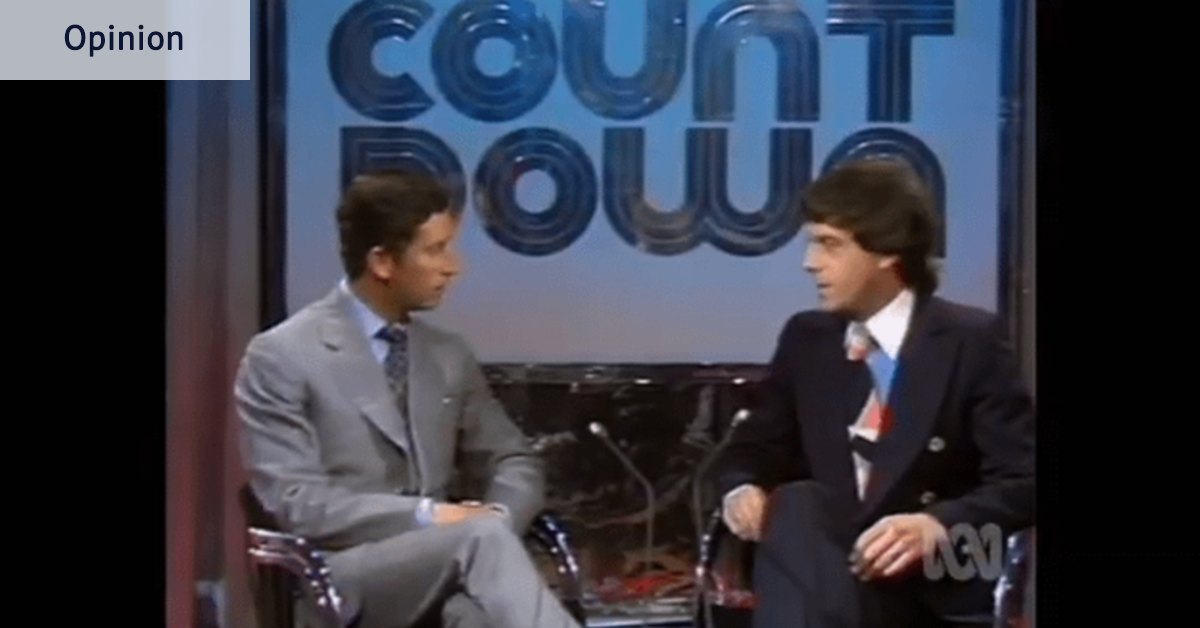
OpinionSenior Writer, CultureNovember 24, 2026 — 5:00amNovember 24, 2026 — 5:00amIt is almost impossible for anyone who didn’t live through it to comprehend how big Countdown was in its day. And it’s just as impossible to imagine that any TV show could be so big again.At its height, the ABC’s Sunday night pop music program was watched by nearly 3 million people a week. Remember that Australia had a population of just 15 million at the time. In other words, one in five of us were tuning in to hear and see the music and the artists we would all be talking about over the week to come. (As an aside, the first show didn’t air on a Sunday at all, but at 6.30pm on a Friday – November 8, 1974.)Molly Meldrum with Dolly Parton on the set of the hit show, Countdown, which ran for almost 13 years.ABCHeck, we were even emotionally invested in the top 10 countdown that gave the show its name and ended it each week, backing this song or that to take out the top spot (come on, Fernando; you can do it, Ant Music – make it seven weeks in a row!).Molly Meldrum was central to it all. He didn’t start off as host, but inevitably he assumed that role, as his Humdrum news segment gradually seeped out of its five- or 10-minute allocation to infect the entire hour with the same sense of giddy enthusiasm for the new, the fresh, the latest. He was the high priest of fan culture, long before we had a term for it.Molly would gush about the new acts he’d discovered on his latest jaunts, whether they be from the United States (The Knack), the UK (Gary Numan, Kate Bush, Adam and the Ants), Sweden (ABBA), or even Belgium (Plastic Bertrand).Closer to home, he shone a light on Skyhooks, Sherbet, Split Enz, Models, James Freud and the Teenage Radio Stars, Mi-Sex, Kids in the Kitchen, I’m Talking. Chances are, you heard or saw them all for the first time on Countdown, probably with the cover of their new record disappearing in a blaze of white as Molly inexpertly caught the reflected glare of a studio light.Camera craft aside, Molly knew his stuff, and he knew the stuff Australia was likely to like. That made him an expert of sorts, but you’d never have guessed it. He bumbled, he stumbled, he mumbled. Occasionally, he even grumbled, though his whole shtick was predicated on being a likeable and harmless duffer who just happened to be incredibly well-connected and switched on when it came to music – a tastemaker, and a career-maker, too, if you were lucky enough to be anointed.I asked Red Symons – guitarist with Skyhooks and long-time cast member of Hey Hey It’s Saturday, where Meldrum took his prognostications after Countdown was axed in 1987 – for his thoughts on the man. “Attribution of the wit of others pains me,” he replied, in typically arch Symons style, “but Michael Shrimpton, the executive producer of Countdown, described Molly as ‘a verb in search of nouns’.”That certainly captures something of the swirl of chaos he generated, and the inadequacy of the spoken language to the task of marshalling the frenzy of his thoughts. But it wasn’t the full truth, adds Symons. “His vaudeville charm was pretending to get it wrong.”“He was sharp as a tack,” concurs Gavin Wood, the Countdown voiceover man from 1980 until its end. “He knew what was going on. He could play the game.”Countdown was a big production, with around 40 people – “set builders, floor managers, producers, people in the control room; we all wanted to make the best show we could,” Wood says – but it was Meldrum who “brought the life” to it.“He was the talent co-ordinator, he brought the acts,” Wood recalls. “He would sit down with the Countdown unit a couple of days before the show, and he’d present 20 acts he wanted on, and then they’d yell and scream and argue and throw things, and eventually, he’d get the ones he wanted on the air, probably three live Australian acts and half-a-dozen overseas clips.”Countdown’s power and appeal owed much to Meldrum’s curation. But it was also a product of much broader forces: the upsurge in and assertion of Australian cultural identity in the early 1970s; the fact the ABC was unique in reaching into metro and rural areas alike; the transition from black-and-white to colour television; the emergence of the music video as a distinct art form; the paucity of viewing options in the pre-digital era; and, at least until VCRs became ubiquitous in the mid-’80s, the fact you could only watch a show when it was actually broadcast.That all combined to make Countdown must-watch TV. And it made Meldrum one of the most powerful people on it.Fans queuing up outside the ABC’s former Ripponlea studios in the Melbourne suburb of Elsternwick to be part of the live Countdown audience.Fairfax archiveMolly became massive not in spite of but precisely because of his limitations as a presenter. His ineptitude made him seem an enthusiast who had stumbled into a brilliant job rather than a scheming careerist, and that made him comfortingly ordinary even as he was doing the most extraordinary things, meeting the world’s biggest stars, and fronting one of the nation’s biggest shows.More:ValeOpinionFor subscribersCity lifeAustralian TVLive musicAustralian musicFrom our partners
How Molly Meldrum turned Countdown into must-watch TV
Full Article
Original Source
Read the full article at Smh →KhanList aggregates and links to publicly available news content. We do not host full articles from third-party sources. Always verify important information with original sources.