
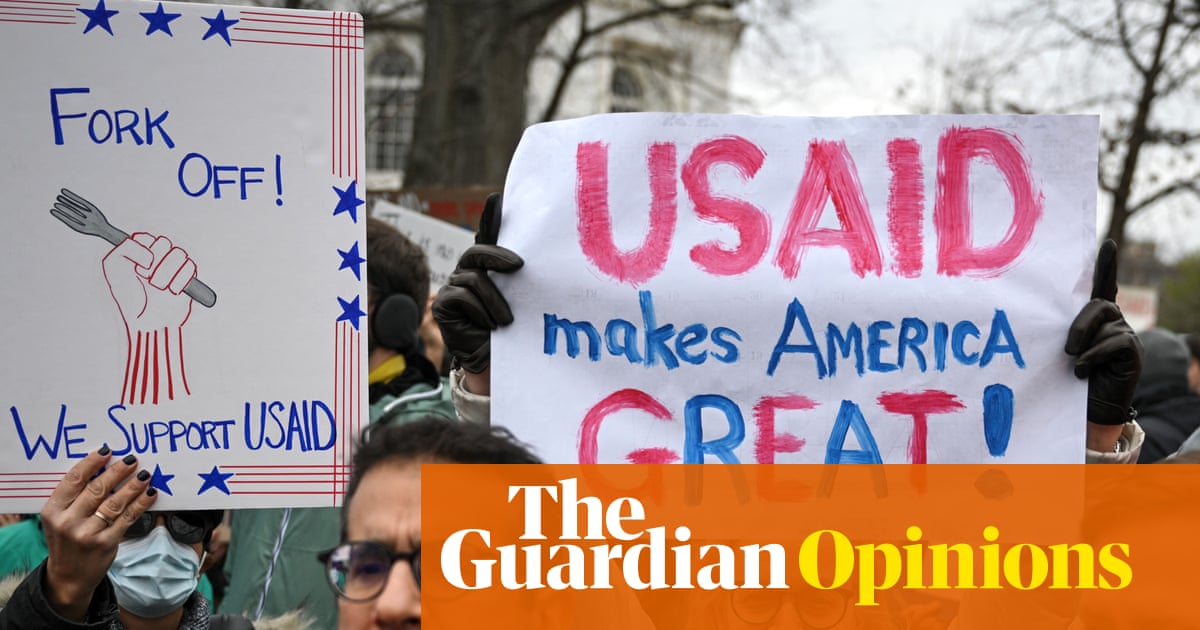
A year has passed since I and thousands of colleagues lost our jobs at USAID. Asking myself “Why us?” I have come to the conclusion that the American public had very little idea of what we were doing and why.Doge, the “department of government efficiency”, began its work in January 2025, with USAID as its first target, in a reckless campaign that even Elon Musk has said he would not repeat. At that moment of chaos, Americans lacked the knowledge that could contradict the false narrative presented by Musk, who called the agency a “criminal organisation” and “a viper’s nest of radical left-marxists who hate America”.But what if Doge had eliminated Nasa, not USAID? Such a scenario seems highly implausible. Despite the rise of private space companies, Nasa remains an icon of national prestige, with broad bipartisan congressional support. How many kids want to be astronauts when they grow up? I sure did. And that’s because Nasa has spent decades carefully communicating its results and cultivating its image with the public.In contrast, USAID is not well known or understood. One expert on USAID’s brand noted that the agency’s handclasp emblem and the tagline “from the American people” were “well known in the developing world, even if not well known in Washington”. How much worse is that brand recognition in middle America?Misunderstandings around foreign aid abound. In March 2025, a Kaiser Family Foundation survey reported: “Nearly nine in 10 (86%) adults overestimate the share of the federal budget spent on foreign aid, saying on average that the US spends about a quarter (26%) of its budget on foreign aid.” In fact, about 1% of the federal budget goes on foreign aid.Unfortunately, that lack of recognition and those gross misunderstandings were key factors in USAID’s elimination. It may never be resurrected, but the question remains important: what could future foreign assistance learn from Nasa’s approach to public communications, to ensure broad public understanding and support?Without a doubt, stories were there to be told. In Colombia, where I was deputy director of the largest USAID mission in the hemisphere from 2021 to 2025, we contributed to solving major regional challenges. We helped tens of thousands of Venezuelans take advantage of generous Colombian migration policies by processing legal residency cards, training them for jobs and establishing healthcare access. That meant they could stay in Colombia legally, rather than add to the thousands of migrants trying to enter the US.A community kitchen set up by USAID and the World Food Programme in Cucuta, Colombia, 2019. Photograph: Marco Bello/ReutersWe guaranteed hundreds of millions of dollars in loans Colombian banks made to new businesses. These businesses promoted tropical forest products such as açaí to keep the Amazon’s trees standing. Other loans helped poor farmers build businesses with legal crops instead of coca, which is turned into cocaine, causing addiction and death in the US and Europe. These loan-guarantee programmes cost the US government pennies on the dollar to reduce risk so that Colombian banks would extend their loans to new, unfamiliar businesses.And after Colombia’s government successfully negotiated a historic peace accord in 2016, ending 50 years of civil conflict, USAID was the largest donor to help them implement it. Among many things, that meant helping prosecutors gather testimony from thousands of victims of violence so the truth could be told and justice done.When fighters turned in their guns to lead peaceful lives, efforts such as ours helped Colombians achieve some form of reconciliation and turn the page.These are not simple stories to tell. As these examples illustrate, real development work is not handing out goodies for a photo op. It is making strategic nudges to a country’s own efforts to do the things that solve global challenges – illegal migration, climate breakdown, illegal drugs and yes, world peace – while reflecting its national interest.Telling USAID’s story to the American public accurately – describing projects far from home, in complex and unfamiliar foreign contexts – is challenging.Yet faced with its own challenges in communicating technically complex scientific work performed thousands of miles from home, Nasa succeeded where USAID failed. The 2014 book Marketing the Moon, by David Meerman Scott and Richard Jurek, focuses on the Apollo programme, when 94% of American televisions were tuned to the first lunar landing. They argue that “without strong public support abetted by high-profile, enthusiastic public relations, the entire achievement and its funding would have been unthinkable”.Echoes of these strategies are still seen, and Nasa still excels in communicating with the public. There are three ways it does this:Helping voters understand Rather than use woolly phrases such as “capacity building” and “democracy strengthening”, as we did at USAID, Nasa goes to great efforts to help viewers grasp what it is doing. Computer visualisations and animations show orbits and flight paths. Saying a Mars rover is “about the size of a small SUV” explains in everyday terms what its scientists have built. The media are willing allies to show these graphics and allow Nasa spokespeople to explain the mission and its impact.Telling stories that link to the US’s highest national aspirations In the Apollo programme, astronauts became superheroes, signing exclusive agreements with Life magazine to profile them. On unmanned missions, Nasa has linked its efforts to timeless questions of science: was there water on Mars, for instance, and did it support life? As its website says: “For more than 65 years, Nasa has made the seemingly impossible, possible.” Nasa has connected its work to national pride, reminding Americans of its cutting-edge science, world-class innovative tech and heroic astronauts.The Nasa headquarters in Washington DC. Photograph: Kevin Carter/Getty ImagesTalking about positive side-effects Nasa is highly vocal about how technology developed for space missions has been repurposed for everyday use and benefited our lives, from memory foam to infrared ear thermometers to cordless tools. Given the prestige associated with Nasa, there is even a small cottage industry of inventions that are falsely attributed to the space programme, such as lasers, Velcro and Teflon.Decades of effective PR and brand recognition may not have been enough to overcome the onslaught of misinformation that USAID faced in 2025. Its international focus – on cultures and contexts completely unfamiliar to Americans – made it vulnerable. The sheer quantity of projects made it easy to find some that would appear indefensible, so when the attacks did come, the gas tank of “brand equity” was nearly empty and the public outcry was muted, with many only just learning of the agency’s existence. USAID was shuttered with startling speed.When an information vacuum allows Americans to overestimate how much of the federal budget goes to foreign assistance, they fail to see it for the bargain it truly is for our nation. Americans spend several times more on pet food and treats than the government did on USAID. What USAID spent on some aid programmes in a year was the equivalent of a few dozen Patriot missiles.In short, as the US aspires to be a great nation – generous, admired and strategic in solving global challenges – the work USAID did seems an absolute bargain. As we reimagine what foreign assistance looks like, let’s be more like Nasa, communicating that value and making Americans proud. Jeremiah A Carew was a senior Foreign Service Officer for USAID; his final tour was as deputy mission director of USAID/Colombia from 2021 until the mission’s closing in 2025.
How misconceptions and woeful PR allowed Musk to shred USAID so easily | Jeremiah A Carew
Full Article
Original Source
Read the full article at Theguardian →KhanList aggregates and links to publicly available news content. We do not host full articles from third-party sources. Always verify important information with original sources.