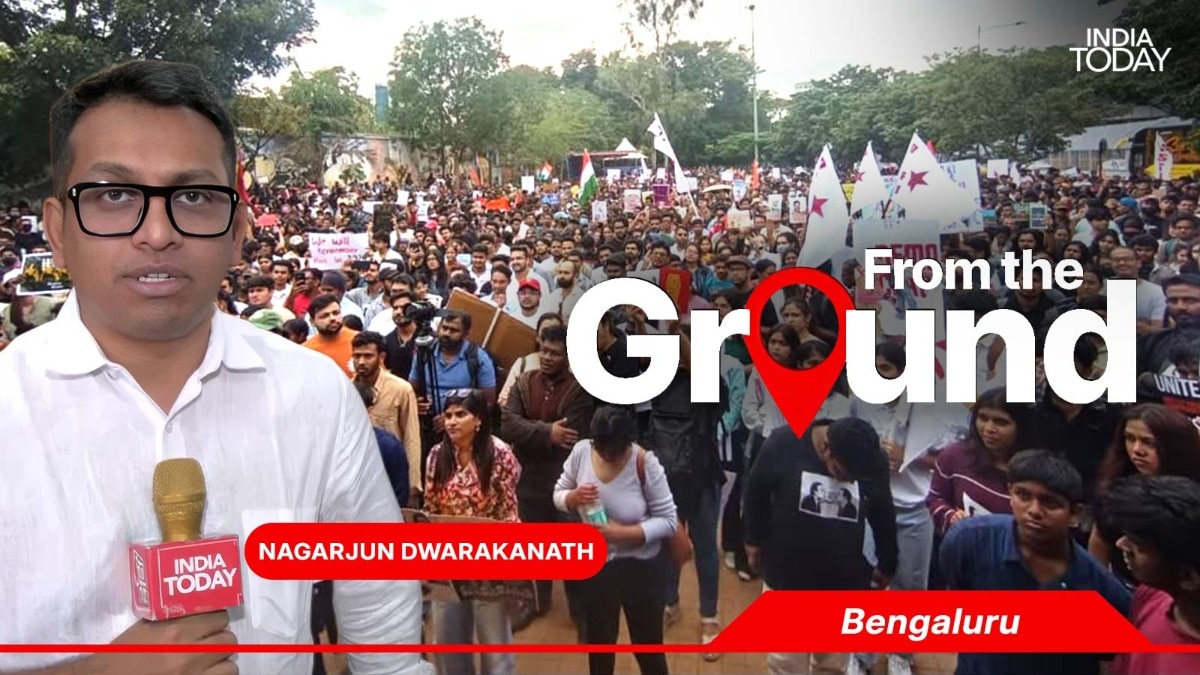
Over the past 10 days, the Freedom Park in Bengaluru became something much more than the city's designated protest venue. It became a gathering place for a generation that refused to remain spectators.Each day, between 1,000 and 3,000 people gathered at the park. Most had never met each other before. There were no political banners, no central leadership, and no student union leading the movement. Yet the crowds continued to grow.The movement sustained itself through something far more familiar to Gen Z than traditional political structures: Instagram. As videos, memes and live streams from New Delhi's Jantar Mantar flooded social media, thousands of young people in Bengaluru found themselves emotionally invested in a protest unfolding more than 1,500 kilometres away.Many wanted to travel to Delhi but couldn't do so because of work, studies or financial constraints. Freedom Park became their alternative, a place where they could express the same anger closer to home. People arrived carrying handmade placards, portable speakers filled the park with slogans and music, volunteers ensured there was a constant supply of drinking water, and strangers quickly became companions.Kannada slogans echoed alongside Hindi and English chants. Poetry sessions sprang up between speeches, and posters carried Bengaluru’s unmistakable local humour and slang. Yet, despite the carnival-like atmosphere created by memes, music and social media culture, participants insisted the issue itself remained deeply serious.Abhishek, a Bengaluru-based lawyer, said his involvement began online."Every night I spent at least an hour watching memes and videos from Jantar Mantar. It gave me a strange high. I wanted to be part of it. Even though I'm not Gen Z, I felt connected to what they were doing. I even sent five burgers from McDonald’s to protesters at Jantar Mantar," he said with a laugh.Eventually, watching from a screen was no longer enough.Like many others, he made his way to Freedom Park.Riya, who works in the marketing division of a private company, skipped work on Friday to join the gathering."I didn't even have a protest poster. When I reached, I realised almost everyone had one. I ordered a printed placard through Blinkit and joined them," she said.For her, the memes may have attracted attention, but the underlying issue was what kept people on the ground.She said, "The jokes made people notice the protest, but everyone here knew why they had come. This is about education and paper leaks. Half my family supports the BJP. I argued with my father three times before coming here. I told him I don't care. This isn't only about Dharmendra Pradhan. It's about young people feeling they're being taken for granted."One of the most striking features of the Bengaluru protests was the absence of any political ownership.Unlike demonstrations that often become platforms for politicians, Freedom Park remained largely free of political speeches. No senior political leader visited the protest site during its peak.A handful of actors, mostly known for one or two films, made brief appearances, but the spotlight remained firmly on students and young professionals.The police, too, adopted a noticeably restrained approach.Freedom Park is the only location in Bengaluru where protests are permitted under the Karnataka High Court's directions. Officers remained present throughout the day but largely focused on coordination rather than confrontation.They repeatedly requested protesters to remain within the designated boundaries, ensured traffic outside was unaffected, and engaged with organisers and volunteers to keep the gathering peaceful.Participants, in turn, dispersed voluntarily at the end of each day.There were no dramatic confrontations or attempts to breach barricades. Instead, the demonstrations resembled a disciplined public assembly driven more by shared emotions than by organisational planning.Perhaps that is what made Freedom Park unique over the past week. It was a protest born online but expressed offline.A movement without a central leader, without political patronage and without elaborate planning. Instagram connected the participants, memes sustained their attention, but the frustration over education, competitive examinations and accountability brought them to the park.For nearly 10 days, Freedom Park mirrored the mood of Jantar Mantar; not because the two protests were identical, but because they were connected by the same generation, the same digital conversations and the same belief that simply watching history unfold on a phone screen was no longer enough.- EndsPublished On: Jul 26, 2026 15:11 IST
How memes turned into a Gen Z movement at Bengaluru's Freedom Park
Full Article
Original Source
Read the full article at Indiatoday →KhanList aggregates and links to publicly available news content. We do not host full articles from third-party sources. Always verify important information with original sources.