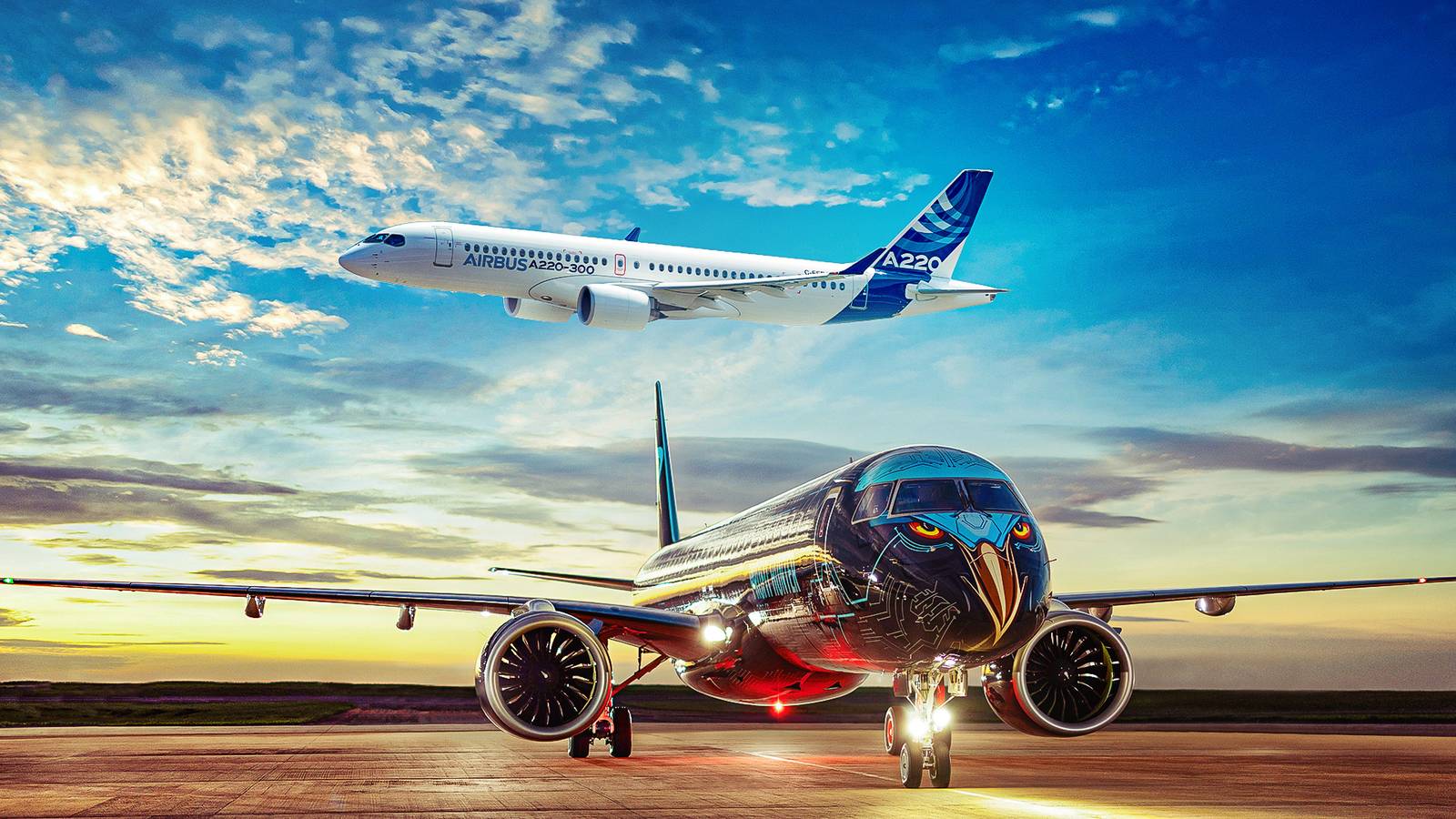
Credit: Embraer, Airbus | Simple Flying Published Jul 30, 2026, 7:00 AM EDT Experienced ICAO English Language Proficiency Instructor for pilots and ATCOs and conference interpreter who is passionate about facilitating effective communication within aviation-related businesses. Possess a deep understanding of the aviation industry, including aviation regulations, terminology, and industry-specific communication protocols. Has been working at numerous airshows across Europe since 2014. Being an ultralight pilot in her free time, she also promotes safety and efficiency in aviation operations. Based in Italy and Malta Sign in to your Simple Flying account How efficient are today's smallest new-generation airliners? Two aircraft in particular, the Airbus A220 and Embraer E195-E2 are frequently described as the world's most efficient small single-aisle passenger airliners. Airlines often compare them when replacing aging Embraer E-Jets, Bombardier CRJs, Airbus A319s, and even smaller Boeing 737 variants because fuel costs remain one of the industry's largest operating expenses. That naturally raises an interesting question: just how many miles per gallon do these aircraft actually achieve? The answer is surprisingly impressive. Despite weighing tens of tonnes and carrying well over 100 passengers, both aircraft can exceed 100 passenger-miles per gallon under typical airline operating conditions. Their efficiency comes from clean-sheet or extensively redesigned airframes, Pratt & Whitney geared turbofan (GTF) engines, advanced aerodynamics, and lightweight structures. In our article, we will compare their passenger capacity, range, fuel capacity, fuel burn, and real-world efficiency to determine whether one truly outperforms the other. What Aircraft Is More Fuel Efficient? Credit: Shutterstock The simple answer is that both aircraft are exceptionally fuel efficient, and there is no overwhelming winner. Both offer advantages and disadvantages that airlines must consider before placing orders. On longer routes, the larger Airbus A220-300 generally enjoys a slight per-seat advantage because its larger wing and highly optimized airframe spread fuel consumption across more passengers, as shown in the official Airbus online brochure. Several industry analyses estimate its per-seat fuel efficiency advantage at roughly 11% compared with the E195-E2 on longer sectors. Meanwhile, the Embraer E195-E2 has dramatically narrowed the gap and can equal, and occasionally outperform, the A220 on shorter missions where its lower trip costs become more important than absolute seat-mile efficiency. Both aircraft also share one major technological advantage: Pratt & Whitney's geared turbofan family. The Airbus uses the PW1500G, while the Embraer employs the PW1900G, giving both aircraft approximately 20–25% lower fuel burn per seat than the previous-generation regional jets they replaced, which attracted dozens of regional airlines. Perhaps the most remarkable statistic is their passenger efficiency. Depending on seating layout and mission length, both routinely achieve well over 100 passenger-miles per gallon, placing them among the most efficient commercial aircraft ever built on a per-seat basis. That means a fully occupied A220 or E195-E2 can rival or even exceed much larger twin-aisle aircraft in fuel efficiency when measured per passenger. What Makes The Airbus A220 And Embraer E195-E2 So Fuel Efficient? Credit: Shutterstock Comparing aircraft fuel efficiency is considerably more complicated than simply looking at how many gallons of fuel an airplane burns per hour. Unlike cars, commercial aircraft are typically measured by fuel burn per available seat mile (ASM) or fuel burn per seat, since a larger aircraft naturally consumes more fuel overall while also carrying significantly more passengers. These metrics provide a far more meaningful indication of operating efficiency because they reflect how effectively an airline converts fuel into passenger transport rather than focusing solely on total fuel consumption. The mission itself also plays a major role in determining efficiency. Short sectors require proportionally more fuel during taxi, take-off, climb, and descent, whereas cruise performance becomes increasingly important on longer flights. Passenger configuration further complicates comparisons, as airlines can configure the Airbus A220-300 with anywhere from around 120 to 160 seats, while the Embraer E195-E2 typically accommodates 120 to 146 passengers. Filling more seats spreads fuel consumption across additional travelers, increasing passenger-miles per gallon even if total fuel burn remains unchanged. Weather, payload, airport elevation, reserve fuel requirements, taxi delays, and cruise altitude can all influence fuel consumption as well. Both the Airbus A220-300 and Embraer E195-E2 achieve their impressive efficiency through a combination of advanced aerodynamics, lightweight structures, and Pratt & Whitney's geared turbofan (GTF) engine technology, although they arrived at that point through very different development paths. The A220 began life as Bombardier's clean-sheet C Series program before Airbus acquired a majority stake in 2018. Designed from the outset around modern composite materials, advanced aluminum alloys, an aerodynamically efficient wing, and the Pratt & Whitney PW1500G, Airbus says the aircraft delivers approximately 25% lower fuel burn and CO₂ emissions per seat than the previous generation of similarly sized aircraft. Embraer, by contrast, chose to evolve rather than replace its successful first-generation E-Jet family. Instead of designing an entirely new aircraft, the manufacturer extensively redesigned the E195 with a new high-aspect-ratio wing, updated avionics, revised systems, and the Pratt & Whitney PW1900G engine. The result was a highly optimized aircraft that Embraer marketed as the "Profit Hunter," promising airlines substantially lower operating costs while retaining the commonality and reliability of the original E-Jet platform. According to Embraer, these improvements reduced fuel consumption by approximately 20–25% compared with the first-generation E195, allowing the E195-E2 to close much of the efficiency gap to the larger Airbus A220. At the heart of both aircraft is Pratt & Whitney's geared turbofan architecture. Unlike conventional turbofan engines, the GTF uses a reduction gearbox that allows the large front fan and the low-pressure turbine to rotate at their own optimum speeds. This enables a larger, slower-turning fan for improved propulsive efficiency while allowing the turbine to spin faster for maximum performance. The result is significantly lower fuel consumption, reduced carbon emissions, and a much smaller noise footprint than previous-generation engines. This is one of the primary reasons why both the Airbus A220-300 and Embraer E195-E2 are now regarded as the most fuel-efficient aircraft in the 120- to 160-seat market. Airlines And Expert Reviews Credit: Shutterstock Industry analysts agree that the efficiency battle has become remarkably close. For instance, AirInsight noted that although the A220 initially established a noticeable efficiency lead, Embraer's continual improvements have enabled the E195-E2 to catch up significantly. According to its analysis, the gap has narrowed to the point where the Embraer can compete directly on many routes, particularly when lower trip costs are prioritized over absolute seating capacity. The Flying Engineer similarly concludes that neither aircraft universally dominates. Instead, airlines should choose based on mission profile. Operators requiring maximum range and larger seating capacity often favor the A220, while carriers prioritizing lower acquisition costs and slightly smaller markets frequently find the E195-E2 more attractive. Mentour Pilot also emphasizes that operating economics depend on much more than fuel burn alone. Acquisition price, maintenance costs, airport charges, financing, fleet commonality and passenger demand often outweigh a small percentage difference in fuel consumption. As a result, airlines such as Air France, Delta Air Lines, JetBlue and airBaltic have embraced the A220, with the latter being the A220 mono fleet operator, while Porter Airlines, KLM Cityhopper, Azul and Royal Jordanian have invested heavily in the E195-E2. Porter Airlines' case is emblematic, as it dropped its initial Airbus A220 in favor of the Embraer E2. The Canadian carrier decided to invest in this jet partly due to the smaller seat capacity, which was ideal for its route network; overall, the airline required aircraft that were slightly bigger than its old DeHavilland Dash 8 turboprops but not as big as the A220. The E195-E2 was exactly what would work well, as it features a 2-2 configuration with zero middle seats, akin to the Dash-8, which tested exceptionally well with passengers compared to the 2-3 layout of the A220. These purchasing decisions demonstrate that airlines view both aircraft as outstanding performers for slightly different missions. Airbus A220-300 vs Embraer E195-E2 Credit: Shutterstock Looking purely at performance, the Airbus holds several advantages. The A220-300 accommodates up to 160 passengers, compared with 146 for the E195-E2. It also offers substantially greater range at approximately 3,400 nautical miles (3,913 miles / 6,300 km) versus roughly 2,600 nautical miles (2,992 miles / 4,815 km) for the Embraer. Airbus also provides a larger maximum fuel capacity of 5,681 gallons (21,508 liters), enabling its superior endurance. However, the Embraer counters with lower trip costs. Because it carries fewer passengers and has a lower overall operating weight, airlines can profitably operate routes that may not consistently fill an A220. This flexibility is particularly valuable for regional airlines and thinner point-to-point markets. Airbus A220-300 vs Embraer E195-E2 Specification Airbus A220-300 Embraer E195-E2 Engines 2 × Pratt & Whitney PW1500G 2 × Pratt & Whitney PW1900G Typical seats 120–150 120–132 Maximum seats 160 146 Maximum range 3,400 nm (3,913 mi / 6,300 km) 2,600 nm (2,992 mi / 4,815 km) Maximum fuel capacity 5,681 gallons (21,508 liters) ~4,460 gallons (16,900 liters) Cruise speed Mach 0.82 Mach 0.82 Fuel burn improvement ~25% vs previous generation ~20–25% vs previous generation Passenger efficiency Typically over 100 passenger-miles per gallon Typically over 100 passenger-miles per gallon Best mission Medium-haul, higher-capacity routes Short- to medium-haul, lower-demand markets The comparison illustrates why airlines remain divided. Airbus delivers greater capability, range, and seating capacity, while Embraer provides exceptional economics on routes where every additional seat cannot be filled. Main Drawbacks And Limitations Credit: Shutterstock The biggest limitation is that miles per gallon is not an ideal way to compare commercial aircraft. Airliners operate under constantly changing conditions: headwinds, routing restrictions, payload, reserve fuel policies, weather deviations, and airport congestion all significantly affect fuel consumption. Two identical aircraft flying the same route on different days may record noticeably different fuel burns. Another consideration is engine durability. Both aircraft rely on Pratt & Whitney geared turbofan engines that have experienced well-publicized reliability and maintenance issues in recent years. Although Pratt & Whitney has reported that the situation has improved significantly and groundings of A220s and Embraer E2 aircraft have largely disappeared, maintenance considerations remain an important operational factor for airlines, as reported by Reuters. Finally, fuel efficiency alone rarely determines purchasing decisions. Airlines also evaluate acquisition cost, financing, maintenance programs, pilot training, fleet commonality, residual values, and airport infrastructure before selecting either aircraft. Who Is The Winner? Credit: Shutterstock The Airbus A220-300 and Embraer E195-E2 represent the current state of the art in small narrowbody efficiency. Both achieve fuel economy that would have seemed almost impossible only two decades ago, routinely exceeding 100 passenger-miles per gallon while offering passengers quieter cabins, greater comfort and substantially lower emissions than the aircraft they replace. If maximum range, additional seats and the lowest possible fuel burn per passenger are the priority, the Airbus A220-300 generally holds a modest advantage. If lower trip costs, greater flexibility and excellent economics on thinner routes matter more, the Embraer E195-E2 becomes an equally compelling choice. The difference is no longer dramatic enough to produce a universal winner. This rivalry is likely to remain one of commercial aviation's most closely watched competitions in the regional aviation market. As airlines continue replacing older regional jets and smaller narrowbodies, both aircraft will play a major role in reducing fuel consumption and emissions while connecting cities more efficiently than ever before.
How Many Miles Per Gallon Does An Airbus A220 Get Compared To An Embraer E195-E2?
Full Article
Original Source
Read the full article at Simpleflying →KhanList aggregates and links to publicly available news content. We do not host full articles from third-party sources. Always verify important information with original sources.