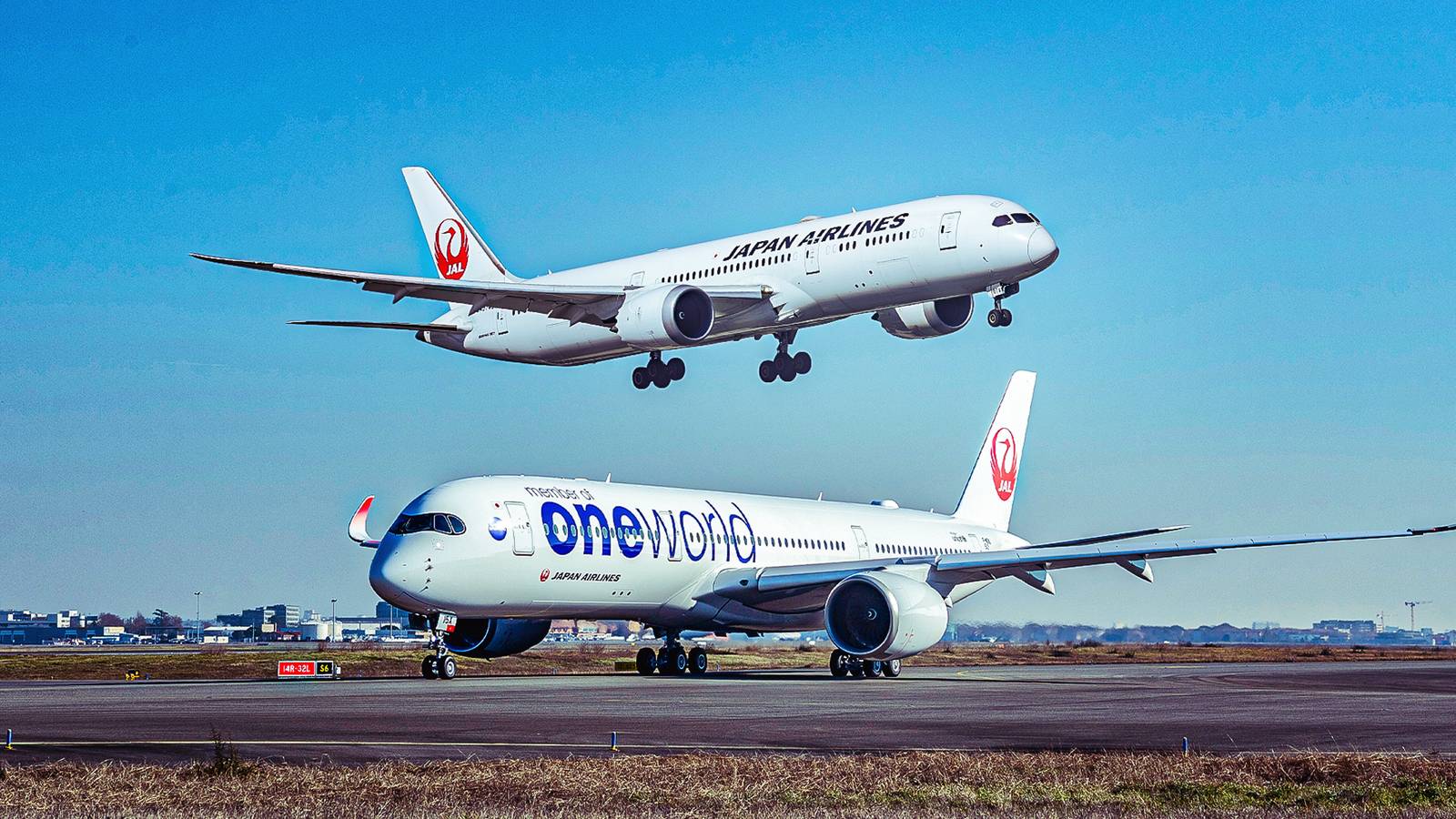
Credit: Airbus, Shutterstock | Simple Flying Published Aug 14, 2026, 10:00 AM EDT Based in the UK, Josh is a keen writer with a degree in Military History. Having worked previously as a financial journalist, he has covered the aviation industry extensively, reporting on airlines' results and monthly passenger statistics in the aftermath of the pandemic, alongside the likes of regulation around sustainable fuels, and the prospects for hydrogen-powered commercial flight. He joins Simple Flying with a lifelong love of all things aviation. Sign in to your Simple Flying account Boeing and Airbus developed their clean-slate, next-generation widebodies with one unifying thought top of mind: efficiency. By adopting advanced aerodynamics, high-bypass engines, and lightweight composite airframes, the two major manufacturers rolled out aircraft that set a new bar for the economics of flight. But the Airbus A350 and Boeing 787 Dreamliner families as a whole naturally came with their own individual strengths. Where the largest A350 variant remains unmatched in range to this day, the 787 series has come to offer airlines more flexibility around route planning. Two models from each family do share a score of common features however, in the A350-900 and 787-9, making intriguing comparisons possible. So with that in mind, which of them is the more efficient option? Boeing 787-9 Wins On Raw Fuel Burn Credit: Shutterstock When pitted against each other, the 787-9 is the less fuel-hungry of the two based on the sole consideration of miles per gallon. But only just. That is in terms of raw fuel burn, too, so it only represents one side of the story where passenger economics are not considered. For the sake of argument, though, miles per gallon can be worked out using figures provided by both Airbus and Boeing. Airport characteristic planning documents from each tell us that the 787-9 has a maximum usable fuel capacity of 33,399 US gallons (126,429 liters), while this stretches to 36,456 gallons (138,000 liters) for the A350-900. Separate maximum range data shows the 787-9 and A350-900 are capable of flying up to 9,550 miles (15,370 km) and 9,782 miles (15,750 km), respectively. By dividing such ranges by usable fuel for each, the 787-9 emerges as the more efficient, achieving 0.286 miles per gallon (822 liters per 100 km), against the 0.268 miles per gallon (878 liters per 100 km) of the A350-900. Bear in mind, these equate to upper-limit estimates based on the absolute maximums offered by each manufacturer, so values would vary in practice depending on the likes of passenger numbers. That said, the approximation offers a useful comparison, and one that is reflected in other metrics. Figures published on FlyingFuel place the cost of operating a 787-9 per block hour at $16,899, against $18,370 for the A350-900, for instance. The Boeing 787-9 & Airbus A350-900 Credit: Shutterstock Both the 787-9 and A350-900 are the bestselling variants from their respective series, according to manufacturer data. Of the 1,289 787s ever delivered at the time of writing, 749 of these were 787-9 variants. Similarly, 606 of the total 718 A350s handed over to airlines as of May this year were A350-900s. While stark, the explanation for the disparity in each case is simple. Both hit more of a sweet spot for airlines when compared against the other variants in their families. In the former’s case, the 787 family has come to encompass three variants: the 787-8, 787-9, and 787-10. These numbers correspond with the smallest to largest models, and also their release date. The smallest entered service in 2011, and despite being highly versatile, was trumped in both range and capacity by the 787-9 that followed three years later. With the 787-10’s commercial launch in 2018, Boeing rolled out the largest and most specialized of the trio, which improved capacity once again, but this time at the expense of range. Specifications / Aircraft Airbus A350-900 Boeing 787-9 Dreamliner Maximum capacity 440 406 Typical two-class capacity 315 290 Maximum range 8,500 nautical miles (15,750 km) 8,300 nautical miles (15,370 km) Overall length 219 feet, 1.9 inches (66.80 meters) 206 feet, 1 inch (62.81 meters) Wingspan 212 feet, 5.2 inches (64.75 meters) 197 feet, 3 inches (60.12 meters) Fuselage width 19 feet, 6 inches (5.96 meters) 18 feet, 11 inches (5.77 meters) Fuselage height 19 feet, 11.8 inches (6.09 meters) 19 feet, 6 inches (5.94 meters) Maximum takeoff weight 617,295 lbs (283,000 kg) 571,500 lbs (259,220 kg) Like the 787-9, the A350-900 offered carriers a more versatile option when compared to the other member of its family. Again, this was largely down to the specialized purpose that the larger A350-1000 was developed for. Here, though, Airbus developed the A350-1000 for high-density ultra-long-haul routes, where Boeing made the 787-10 to target the medium-to-long-haul market. Either way, the more versatile 787-9 and A350-900 variants have proven disproportionately popular, and that is no doubt in part due to their exceptional economics. Boeing 787-9 Smaller & Lighter Than Airbus A350-900 Credit: Shutterstock Back to the point at hand, and why the 787-9 is marginally more efficient than the A350-900 on raw fuel usage is down to the difference in size and weight of the two aircraft. Compared to its Airbus-built counterpart, the 787-9 is smaller and lighter, so it requires just that bit less fuel to keep it moving. Realistically, very little divides the duo in terms of their dimensions, with the difference coming down to a matter of inches in some cases. Take the fuselages of each, for example. Where the A350-900’s fuselage measures 19 feet, six inches (5.96 meters) in width and is 19 feet, 11.8 inches (6.09 meters) tall, the 787-9’s is marginally smaller. At 18 feet, 11 inches (5.77 meters) by 19 feet, six inches (5.94 meters), the 787-9’s fuselage is just seven inches thinner and 5.8 inches shorter. Although that may not sound like much, the 787-9’s reduced frontal cross-section and wetted area contribute to less aerodynamic drag than the A350-900 when compared directly. Add in the fact that the Boeing model is also the lighter aircraft by some 52,426 lbs (23,780 kg), with a maximum takeoff weight (MTOW) of 571,500 lbs (259,220 kg), compared to 617,295 lbs (283,000 kg) for the A350-900, and the difference in fuel burn really begins to make sense. But Airbus A350-900’s Capacity Is Higher Credit: Shutterstock There is a major caveat to the miles-per-gallon comparison, though. As mentioned, raw fuel burn only represents one side of the story, given it fails to consider the actual amount of fuel used per passenger onboard. As such, the capacities that both the A350-900 and 787-9 offer are worth considering. Naturally, varying seating configurations mean capacities can be chopped and changed. But overall, the A350-900 tends to carry more people than its closest Boeing rival. According to Airbus, a typical two-class layout on the A350-900 can fit 315 seats. That is, 48 in business and 267 economy seats, per the manufacturer’s characteristics document. In its own version, Boeing lists a typical two-class layout on the 787-9 as being able to fit 290 seats, with 262 of these in economy and 28 in business class. Again, this varies depending on operator and route, but the point stands: the maximum number of people that can be carried aboard an A350-900 is higher than that on a 787-9. Specifically, up to 406 seats could in theory be installed on a 787-9, per Boeing’s characteristics for the aircraft, while 440 could be squeezed in on the A350-900 based on Airbus’ figures. All of this means raw fuel usage matters far less when passengers and capacity are factored in. A350-900 Ahead On Fuel Burn Per Passenger Credit: Shutterstock Indeed, the 787-9 might be more efficient overall, but it simply cannot carry as many people as the A350-900. So, for each person it can carry, the A350-900 becomes the more efficient option. Figures from aviation data firm Skailark covering seven North American and European carriers in 2022 found the A350-900’s cost per seat mile to amount to $0.121. The same metric for the 787-9 over the same period came in at $0.125. Here, the difference was 35 seats between the 787-9s and A350-900s running typical layouts like those advertised by both Boeing and Airbus, meaning fuel used per passenger was actually lower on the latter. Separate figures published last year in Simple Flying went further in laying bare the A350-900’s advantage over the 787-9 when passenger count was considered. Assuming 325 people, an approximate fuel burn of 1,400 US gallons (5,299.6 liters) an hour, and a speed of Mach 0.85 (roughly 560 mph or 900 km/h), the Airbus jet was found to achieve 120 passenger-miles per gallon (2.6 liters per 100 km). For a 290-seat strong 787-9, this came in at 55 passenger-miles per gallon (3.2 liters per 100 km). Either Way, Both Are Leaps & Bounds Ahead Of Predecessors Credit: Shutterstock The truth is, there are several ways to look at it. Based on miles per gallon alone, or even hourly running costs, the 787-9 outdoes its rival on efficiency. Conversely, the A350-900 clearly takes the title when passenger numbers are taken into account. Whichever way one goes, the numbers vary. Comparisons aside, however, the clean-slate models Boeing and Airbus rolled out to drastically improve the economic and environmental cost of flight worked outstandingly well. As Boeing writes on its website, the 787 family boasts an overall “25% reduction in fuel use compared to the airplanes the 787 typically replaces,” thanks to its weight being 50% made up of composite materials. Airbus also places the A350’s fuel use at 25% less than its predecessors, and again partly attributes this to the advanced materials like carbon fiber that account for 53% of the jets’ weight, as well as new-generation engines.
How Many Miles Per Gallon Does A Boeing 787-9 Get Per Passenger Compared To An Airbus A350-900?
Full Article
Original Source
Read the full article at Simpleflying →KhanList aggregates and links to publicly available news content. We do not host full articles from third-party sources. Always verify important information with original sources.