
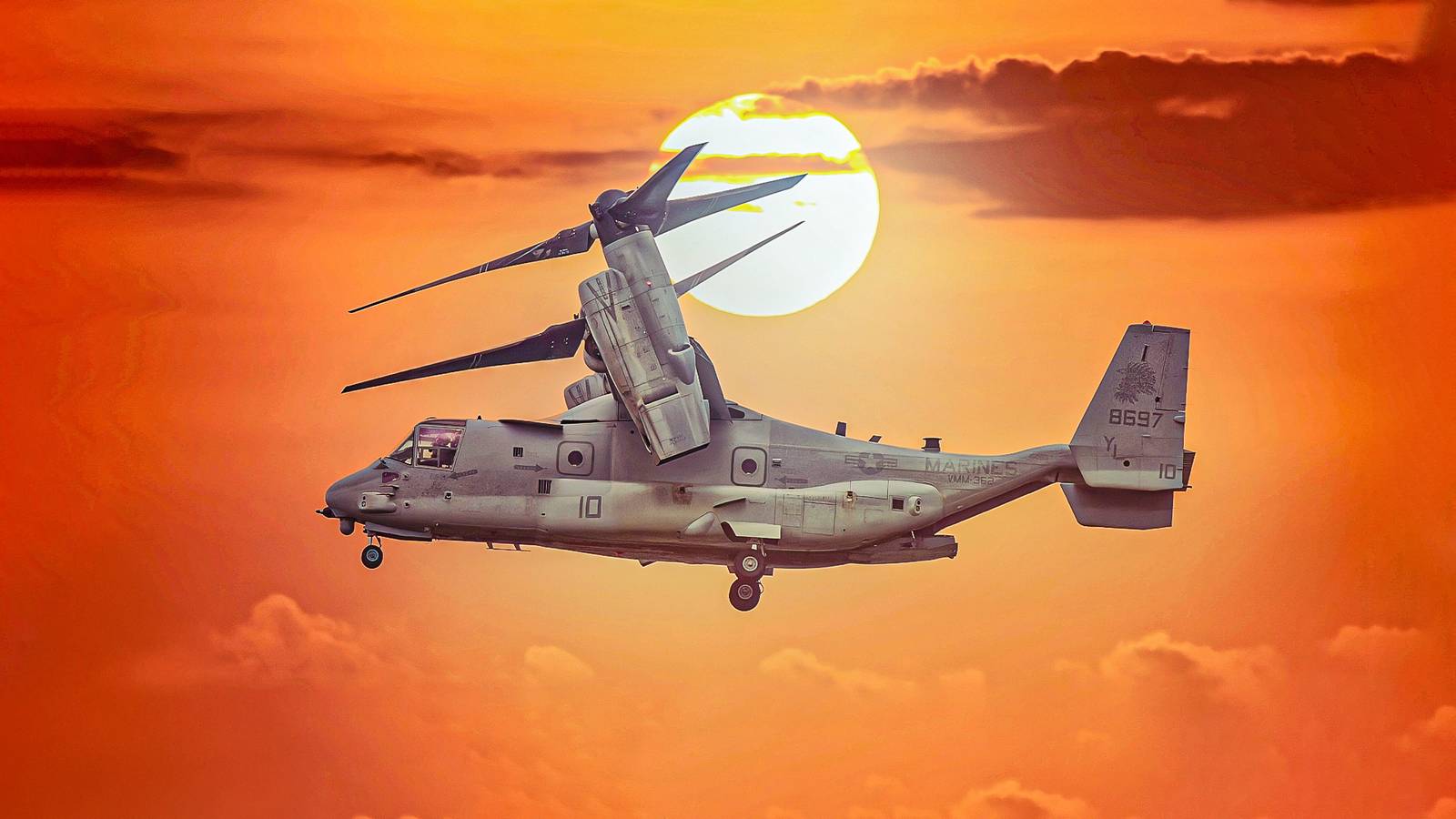
Published Nov 1, 2026, 3:00 PM EST Passionate about promoting aviation, the beauty of flight and the science behind it, Antonio is an avid reader of aviation magazines and books, and he loves visiting airshows all over the world, taking photos and writing about airplanes and helicopters as well. He is currently based in Palermo, Sicily. The Bell Boeing V-22 Osprey was designed to combine capabilities that conventional helicopters and airplanes cannot offer in quite the same way. But operating such an unusual aircraft involves more than mastering its distinctive flight characteristics. The way military crews work around it can be just as revealing as the machine itself. The US Marines Corps, United States Air Force and US Navy all operate the Osprey, and Japan has joined them. Yet the aircraft does not occupy quite the same place in each service. Looking at the people responsible for flying it gives a different perspective on the demands of a machine that has never fitted neatly into a single category. V-22 Osprey Crew Size By Service Across the V-22 family, the two pilots are the constant; the rest of the crew depends on the mission. According to the Naval Air Systems Command (NAVAIR) specifications for the MV-22B, the Marine Corps version carries two pilots and one crew chief, a crew of three. The Air Force goes further. As reported by Air Force Special Operations Command, its CV-22 flies with four: a pilot, a copilot and two flight engineers. The Navy matches that number, since NAVAIR's CMV-22B page lists a pilot, a copilot, and two crew chiefs. The crew difference becomes easier to understand when you consider what the Osprey was designed to do. The Osprey is a tiltrotor, an aircraft that lifts off like a helicopter and then swings its two 38-foot (11.6-meter) proprotors forward to cruise like a turboprop airplane, as the Navy's V-22 fact file explains. The MV-22B was built as the Marines' medium-lift assault aircraft, and NAVAIR says it offers twice the speed, six times the range and three times the payload of the Boeing CH-46E Sea Knight it replaced. Hauling a rifle squad needs two pilots and one person watching the cabin. Real flights can look different, though: an Osprey pilot writing in Stars and Stripes in November 2024 described flying alongside a copilot and multiple crew chiefs, a hint that the published number is a baseline, not a ceiling. That baseline works for Marines, who mostly move troops and cargo between ships and shore. It does not work for everyone. If three people can move a platoon across an ocean, what exactly is the fourth person doing on an Air Force Osprey? Why The Air Force CV-22 Osprey Needs Four Crew Members Credit: Antonio Di Trapani | Simple Flying The answer begins with the mission. AFSOC describes the CV-22 as an aircraft for long-range infiltration, exfiltration and resupply of special operations forces. It carries integrated threat countermeasures, terrain-following radar and a forward-looking infrared sensor, equipment that a standard assault transport does not need. The fact sheet does not divide the workload, but that sensor suite goes a long way toward explaining why a second specialist sits behind the pilots. The Air Force's current CV-22B fact sheet uses the title special mission aviator, while older sheets say flight engineer. The performance figures show how demanding the job is. The AFSOC lists a maximum speed of 280 knots (519 km/h), a ceiling of 25,000 feet (7,620 meters), and a combat radius of 500 nautical miles (926 km) with one internal auxiliary fuel tank. The cabin holds 24 seated personnel or 10,000 lb (4,536 kg) of cargo, and a .50-caliber machine gun covers the ramp. According to our previous report, the CV-22B is based at Cannon Air Force Base (CVS) in New Mexico, alongside the Lockheed Martin MC-130J Commando II and the A C-130J Ghostrider gunship. The Navy's version carries the same four-person crew, but for a very different reason. Rather than inserting special operations teams, the CMV-22B moves people and priority cargo to aircraft carriers at sea. That raises a practical question: what does the second crew chief contribute to a delivery flight? The Navy CMV-22B's Four-Person Carrier Crew The CMV-22B replaces the Grumman C-2A Greyhound on the carrier onboard delivery mission, hauling personnel, mail and priority cargo from shore bases to ships at sea. NAVAIR says the Navy version adds extended range, a beyond-line-of-sight HF radio, a passenger public address system and improved cargo lighting, and that it can move up to 6,000 lb (2,722 kg) of cargo or people over 1,150 nautical miles (1,323 miles, or 2,130 km). Every extra feature is another system a crew member has to monitor, and the Navy's passengers are often sailors who have never ridden in a tiltrotor and need briefing, seating, and a calm voice during every conversion. The Navy's own history shows how the crew took shape. On July 12, 2018, USNI News reported that an all-Navy crew flew an Osprey for the first time, two pilots and two aircrewmen, from Naval Station Norfolk to Marine Corps Air Station New River. Passengers, pallets, and a moving flight deck leave little room for a one-person cabin, and a second crew chief gives the pilots another set of eyes on the ramp, the cargo, and the deck crew during every approach. Simple Flying's coverage of the Greyhound's replacement adds that the Osprey's vertical capability lets it land on decks that helicopters such as the Sikorsky SH-60 Seahawk already use, in most cases. The cabin crew can keep passengers, cargo and the ramp under control, but they do not take the pilots' place. A second crew chief gives the Navy more help in the cabin, particularly when cargo, passengers and carrier operations compete for attention. But that still leaves the most unusual part of the job unexplained. The Osprey must change from helicopter to airplane mode in flight, and the people managing that transition cannot afford to lose track of what is happening around them. How V-22 Osprey Pilots Manage Tiltrotor Flights Credit: Department of Defense The Osprey's transition between helicopter and airplane flight is central to the pilots' workload. The Navy fact file says the Osprey has triple-redundant fly-by-wire flight controls designed to reduce pilot workload, which matters because the pilots must also tilt the nacelles, the engine and proprotor assemblies on each wingtip, between helicopter and airplane modes. Moving from vertical flight to forward flight is the Osprey's defining task, and doing it safely, with two sets of hands on the controls and one set of eyes in the cabin, is a team sport. The Stars and Stripes pilot credited three things for making that manageable: a progressive training pipeline, cockpit technology that sharpens situational awareness, and a crew large enough that no one flies alone. Learning to manage those systems starts well before a pilot joins an operational squadron. As explained by Simple Flying , a Marine aviator first completes military flight training, then aircraft-specific instruction, and dedicated V-22 units such as the training squadron VMMT-204 prepare pilots and aircrew for operational assignments. That squadron, the Marine Corps says, also trained the first Japanese instructor cadre. That training pipeline also became the bridge between the US Osprey community and Japan's new fleet. When Japan ordered its first aircraft, its pilots and maintainers had no experience on the type. Building a crew therefore meant more than handing over aircraft; it meant teaching an entirely new group how to operate and maintain them. How Japan Trained Its First V-22 Osprey Crews Japan built that capability gradually, with help from the US Marine Corps. The Navy fact file lists the Japan Ground Self-Defense Force (JGSDF) as an international customer, and The Aviationist reported that the JGSDF began flight operations at Kisarazu Air Field on November 6, 2020, becoming the first military outside the United States to fly the type. Its aircraft are V-22B Block C models, the same version the Marine Corps flies. JGSDF pilots, crew chiefs and maintainers had been training at VMMT-204 and the Navy's technical training unit at MCAS New River since 2016, and Military Times noted that Japan's Block C carries Japan-specific communication systems. One early milestone shows how much of the effort depended on people rather than deliveries. In April 2017, DVIDS recorded that a JGSDF soldier had been chosen as Japan's first MV-22 crew chief at New River. The JGSDF later moved its fleet of 17 Ospreys to a permanent home. According to the Associated Press, deployment to Camp Saga began in July 2025, amid local protests and memories of an October 2024 incident in which a JGSDF Osprey tilted and struck the ground during takeoff in a joint exercise. None of the sources reviewed for this article publishes a JGSDF crew figure. Because Japan flies the Marine-style Block C and trains pilots and crew chiefs, a Marine-style crew is the reasonable inference, but it is an inference, not a confirmed number. Japan's experience shows how much preparation goes into putting a new Osprey fleet into service. Training can teach crews how to operate the aircraft, but it cannot remove every risk from a demanding flight. That distinction matters for a tiltrotor whose operating history has included fatal accidents and fleet-wide groundings. What happens after something goes wrong is another measure of how well its crews are prepared. V-22 Osprey Safety And The Crew's Role The crew count is only part of the safety picture. In November 2023, a US Air Force Osprey crashed off Japan's southern coast and killed eight people, according to the Associated Press. The Aviationist reported that the accident led to a three-month stand-down of about 400 Ospreys across the services, and the JGSDF also grounded its fleet. Flights in Japan then resumed gradually, near home bases first, with the pace tied to how well pilots and crews had mastered new operating and maintenance procedures. In other words, the people in the aircraft, and how well they are trained, became the center of the recovery. The question of crew workload remains relevant as the Navy's fleet takes shape. NAVAIR says the Navy's program of record calls for 48 CMV-22Bs but that only 44 are currently planned for procurement, so the four-person carrier crew model will remain a small fleet's business. Meanwhile, Voice of Emirates reported that on October 28, 2026, a US military MV-22 made a precautionary landing at Kagoshima airport in southwestern Japan during the Keen Sword exercise, resumed its flight about three hours later, and reported no injuries. The Kagoshima Prefectural Government asked Tokyo to press Washington for the cause. That is the point behind the difference between three and four crew members. Whatever the variant, the people aboard must recognize a problem and respond quickly when something goes wrong. The next time an Osprey lands early, the useful question will not only be how many people were aboard, but what each of them was trained to do in the next sixty seconds.
How Many Crew Members Does It Take To Fly A V-22 Osprey?
Full Article
Original Source
Read the full article at Simpleflying →KhanList aggregates and links to publicly available news content. We do not host full articles from third-party sources. Always verify important information with original sources.