
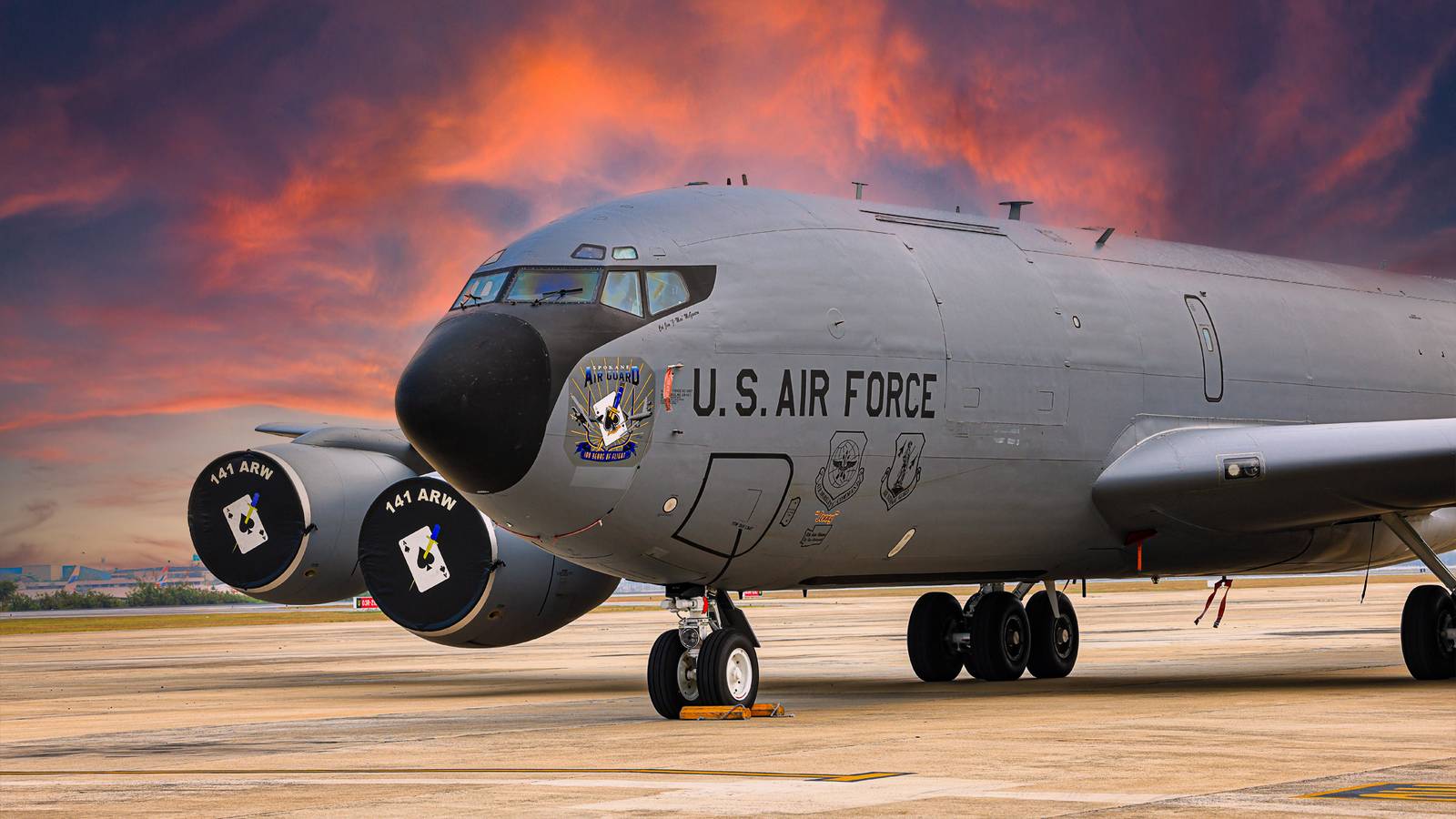
First flown in 1956, the Boeing KC-135 Stratotanker has spent decades refueling US military aircraft in flight. Despite its age, it remains a major part of the United States Air Force's tanker fleet, supporting fighters, bombers, and other aircraft on missions around the world. But how many people does it actually take to operate an aircraft responsible for such an important job? The answer raises some interesting questions about how the Stratotanker was designed and how its crew responsibilities have changed over the years. The KC-135's crew arrangement is not quite as straightforward as it might seem. Its refueling missions require close coordination between the cockpit crew and the operator responsible for transferring fuel, while other missions can bring additional personnel aboard. Its history also raises questions about why it differs from commercial aircraft of the same era and how its crew compares with that of the newer KC-46 Pegasus. Looking at these differences helps explain how the Stratotanker has continued to serve for so many decades. How Many Crew Members Does A KC-135 Normally Fly With? Credit: US Air Force For a normal refueling mission, according to the US Air Force's KC-135 fact sheet, the standard crew is three. The KC-135R and KC-135T normally operate with a three-person crew: a pilot, a copilot, and a boom operator. The two pilots occupy the cockpit, while the boom operator works at the rear of the aircraft, controlling the flying boom used to transfer fuel to the receiving aircraft. The National Museum of the US Air Force confirms the same crew number for the KC-135R. The more interesting question is how those three people divide the work. The workload is substantial. The Air Force fact sheet gives the Stratotanker a maximum takeoff weight of 322,500 pounds (146,285 kg), with up to 200,000 pounds (90,719 kg) of transfer fuel and, depending on configuration, as much as 83,000 pounds (37,648 kg) of cargo. The aircraft carries all of that on a wingspan of 130 feet, 10 inches (39.88 meters), yet the normal crew is still small enough to sit around a kitchen table. That was not always the case. Early KC-135s carried four people, with a navigator joining the two pilots and boom operator, before advances in navigation and avionics removed that position from the standard crew. The aircraft has nevertheless remained in service for decades. According to Simple Flying, the Air Force still operates roughly 396 Stratotankers across active-duty wings, the Air National Guard and the Air Force Reserve. More recent Air Force figures cited by the Government Accountability Office put the fleet at 373 aircraft as of early March 2026, before accounting for the losses and damage sustained during Operation Epic Fury against Iran. The Congressional Research Service later listed seven KC-135s as lost or damaged during the conflict. With hundreds of Stratotankers still in the inventory and the basic crew arrangement remaining central to their operation, the obvious next question is what each crew member is actually responsible for. What Does Each Crew Member Actually Do? The three-person crew arrangement makes more sense once the KC-135's refueling system comes into view. Aerial refueling requires two aircraft to maintain close formation while a rigid boom connects them in flight. The Air Force lists the KC-135's maximum speed at 530 miles per hour (853 km/h) at 30,000 feet (9,144 meters), although fuel transfer takes place at speeds appropriate to the aircraft involved. The receiving jet moves into position below and behind the tanker, the boom extends, and the final connection is made from the rear of the Stratotanker. Each crew member has a specific responsibility. The pilot flies the tanker and maintains a stable flight path, while the copilot shares flying duties, handles communications and checklists, and monitors aircraft systems. At the back, the boom operator, an enlisted airman, controls the boom and guides its nozzle into the receiving aircraft. The National Museum of the US Air Force explains that the operator uses small wing-like control surfaces called ruddervators to steer the boom into position. Working from a prone position and looking through a window, the operator effectively flies the boom itself. The system can transfer nearly all the KC-135's usable fuel, while a drogue attachment can be fitted to support aircraft equipped with refueling probes. The arrangement has proved capable of some extraordinary missions. The museum's KC-135R earned the Mackay Trophy for a sortie flown on May 31, 1967, after a Navy pilot was shot down in Southeast Asia and a rescue operation ran into fuel difficulties. Two US Navy Douglas KA-3 Skywarriors kept a pair of Vought F-8 Crusaders airborne, but both the tankers and the fighters were running low on fuel. The KC-135 crew began refueling the KA-3s while continuing to pass fuel to the F-8s. In effect, one tanker was refueling another tanker that was simultaneously refueling a fighter. The KC-135 subsequently provided additional fuel to two McDonnell Douglas F-4 Phantom fighters on its way to an alternative landing base. Interestingly, although the KC-135 could operate with a basic crew of three, the aircraft involved in this award-winning mission carried four. Its crew consisted of Major John H. Casteel, aircraft commander; Captain Richard L. Trail, copilot; Captain Dean L. Hoar, navigator; and Master Sergeant Nathan C. Campbell, boom operator. This historical example illustrates the distinction between the aircraft's earlier four-person arrangement and its modern standard crew. The additional crew member was a navigator, not a flight engineer. Why The KC-135 Has No Flight Engineer Credit: US Air Force The navigator's presence on earlier KC-135 missions helps explain how the tanker's crew evolved over time, but it also highlights a more fundamental difference between the aircraft and its civilian contemporaries: the absence of a dedicated flight engineer. The tanker was developed alongside the Boeing 707, and many airliners of the period used a third cockpit crewmember to monitor engines and systems. Yet Air Force records for the KC-135 identify pilots, a boom operator and, on earlier versions, a navigator. The absence of a flight engineer from the standard KC-135 crew does not mean the aircraft never employed one. In a 2017 Air Force profile, Master Sgt. Robert Self was described as the service's last KC-135 flight engineer, following a career that included assignments on specialized NKC-135 and KC-135 aircraft used for testing and support programs. His responsibilities included operating the fuel panel, monitoring aircraft systems and advising the pilots. He also recalled that earlier KC-135 configurations had carried both flight engineers and navigators, positions that gradually disappeared as onboard computers and avionics became more capable. Two pilots were always intended to occupy the front seats, with the boom operator handling refueling from the rear. Then the avionics changed. As reported by the National Guard in a story about Iowa's 185th, PACER CRAG brought compass, radar, and GPS improvements to the fleet by the early 2000s, while modern GPS removed the need for the navigator on standard missions. GlobalSecurity's overview of the program likewise notes that the commercial off-the-shelf upgrade eliminated the navigator requirement on most missions. The Simple Flying report mentioned earlier adds that digital flight decks and enhanced autopilots have further reduced the workload. The tradeoff is workload. A base spokesman at Fairchild told the Spokane Journal that, while the upgrades were arriving,it basically meant more responsibility for the pilot and copilot. Navigation functions moved into the avionics, while some tasks previously handled by another crew member became part of the cockpit workload. This distinction is important when comparing the KC-135 with the Boeing KC-46, which was designed from the outset around a very different refueling station and a more modern approach to crew responsibilities. KC-135 Vs KC-46: Two Very Different Refueling Crews The easiest way to see the difference is to look at the boom operator. On the KC-135, that person works at the rear of the aircraft and looks outside through a window. On the KC-46 Pegasus, there is no comparable window to look through. According to Air Mobility Command's KC-46A fact sheet, the Pegasus uses a fly-by-wire refueling boom and gives its Air Refueling Operator panoramic displays with wingtip-to-wingtip situational awareness. From that station, the operator controls the boom, centerline drogue, and wing aerial refueling pods. The screen-based system was intended to offer advantages, but it also created problems that required a major redesign. The same fact sheet says that the Air Force and Boeing agreed in April 2020 on the final Remote Vision System design, known as RVS 2.0, after deficiencies had affected safe and effective refueling. The issue has not disappeared completely: as Simple Flying reported, the Pegasus still has refueling limitations with some US Air Force aircraft, including the FairchildA-10 Warthog, while Boeing works on boom and vision-system fixes. The KC-135's window may look primitive alongside the KC-46's cameras, but it also offers a remarkably direct view of the aircraft being refueled. The contrast does not mean the KC-135 is about to disappear. According to Simple Flying, the Air Force originally planned to field 179 KC-46s, but that figure has since grown substantially. The current program calls for 263 Pegasus tankers, almost 100 more than the original requirement, as the service looks to replace much of its aging KC-135 fleet. As of early March 2026, the Air Force had 373 KC-135s and 103 KC-46As in its inventory, according to the Government Accountability Office. The Pegasus is the newer design, but the Stratotanker remains a major part of the force and is being kept in service for decades longer than originally intended. That creates an important question about the three-person crew: is it sufficient for every mission the aging tanker is now being asked to perform? When A KC-135 Needs More Than Three Crew Members Credit: US Air Force The three-person crew is a starting point, not a fixed rule. The Air Force fact sheet notes that some missions require a navigator and that only a limited number of navigator suites are available for those specialized tasks. It is an uncommon arrangement today, but it shows why the published crew number needs a little context: the KC-135's staffing changes with the mission. Aeromedical evacuation is the clearest example. The KC-135 can carry litter and ambulatory patients on patient support pallets, and the fact sheet says an aeromedical evacuation mission adds a basic medical crew of five: two flight nurses and three medical technicians. That number can change according to the patients being carried. In the basic configuration described by the Air Force, a hospital mission can therefore put eight crew members aboard before the patients themselves are counted. For aeromedical evacuation, the KC-135's cargo compartment can be fitted with a stanchion litter system, allowing patients to travel on a secured litter rather than ordinary passenger seats. The system must be assembled and attached inside the aircraft by support personnel, while the medical team brings the equipment needed to monitor and care for patients during flight. Another issue that is harder to solve with crew changes is age. The last KC-135 was delivered in 1965, so even the newest aircraft are now decades old. As reported by ExecutiveBiz, SNC has assembled a team with BAE Systems, Collins Aerospace and GE Aerospace to pursue the Air Force's KC-135 Center Console Refresh, a program aimed at replacing aging fuel-system equipment, flight displays and computing architecture. SNC announced the consortium in November 2026. BAE would design the fuel management system to reduce pilot workload; Collins, which has supplied KC-135 avionics for more than three decades, would add new displays and computers built on an open architecture; and GE Aerospace would contribute avionics already flying on the KC-46 and Lockheed C-130 Hercules. The proposal also includes autothrottle capability, with performance projected from July 2028 through June 2038 and the award still anticipated. In other words, the same aircraft that learned to do without a navigator decades ago may soon get another set of tools designed to make the remaining crew's jobs easier. How The KC-135 Crew Could Change In The Future Credit: Antonio Di Trapani | Simple Flying The standard KC-135 Stratotanker crew consists of three people: a pilot, a copilot, and a boom operator. Earlier configurations commonly included a fourth crew member, a navigator, whose position gradually disappeared as navigation systems and avionics improved. Specialized missions can still require additional personnel, while aeromedical evacuation typically adds five medical crew members to the basic crew. Flight engineers also served aboard certain specialized KC-135 aircraft, but they were not part of the standard operational crew. The result is an aircraft that has retained its essential three-person operating arrangement while adapting to decades of technological change. That makes the boom operator the most distinctive member of the crew. From the rear of the tanker, one person is responsible for the final connection between two aircraft moving in formation, doing it through a window that has been part of the KC-135's design for generations. The KC-46 approaches the same task from the opposite direction, replacing that view with cameras and displays. The basic mission has barely changed; the way the crew carries it out has. The KC-135's story is not yet finished simply because the KC-46 is entering the force. Looking ahead, Air & Space Forces Magazine reports that the Air Force plans to keep the KC-135 until at least 2050, even as it considers a bridge tanker and a future Next-Generation Air-Refueling System. If the cockpit refresh moves forward, the old tanker could receive a substantially modernized flight deck under the program's 2028 to 2038 timeline. For a design that first flew in the 1950s, the next chapter may be less about adding people and more about giving the same three-person crew better tools for the job.
How Many Crew Members Does It Take To Fly A KC-135 Stratotanker?
Full Article
Original Source
Read the full article at Simpleflying →KhanList aggregates and links to publicly available news content. We do not host full articles from third-party sources. Always verify important information with original sources.