
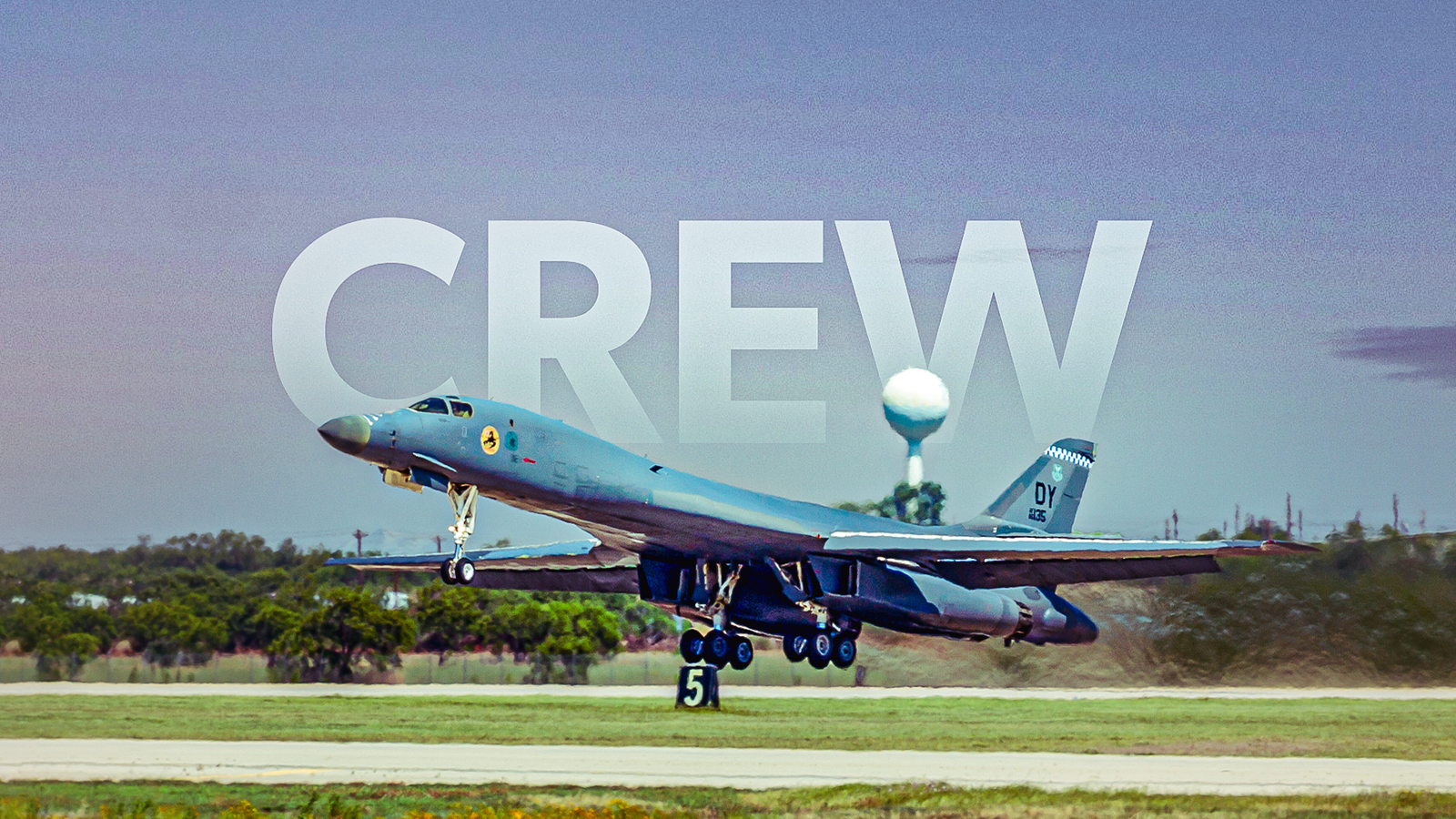
Published Nov 28, 2026, 1:00 AM EST Based in the UK, Josh is a keen writer with a degree in Military History. Having worked previously as a financial journalist, he has covered the aviation industry extensively, reporting on airlines' results and monthly passenger statistics in the aftermath of the pandemic, alongside the likes of regulation around sustainable fuels, and the prospects for hydrogen-powered commercial flight. He joins Simple Flying with a lifelong love of all things aviation. Sign in to your Simple Flying account The B-1 Lancer remains an integral part of the US Air Force’s long-range bombing capability. While the process of phasing out the supersonic variable-sweep-wing heavy bomber is underway, the aircraft is set for at least a decade more of service. This is especially true as the Air Force awaits the moment it can drop the Lancer from its ranks with absolute certainty that it will not leave a weaker fleet overall. Reaching such a moment was always going to be tough, though. The Lancer is highly versatile, capable of carrying the largest payload of conventional weapons among any jet in the US Air Force to target precision or non-precision targets on various missions. No doubt, that is hard to replicate. It also explains why operating such an aircraft takes a whole team of crewmembers. B-1 Lancer Houses Four Crew Members Onboard Credit: Richard Gonzales | US Air Force In total, it requires four personnel onboard to split the workload of operating the B-1 Lancer. Two pilots — an aircraft commander and co-pilot — sit up front and handle the task of getting the high-speed bomber to target, often over hours-long missions. Two personnel located behind them in the aft crew station are then responsible for managing the jet’s weapons systems. But each crewmember’s task is complementary to another's, and their jobs are interlinked in practice. By design, the Lancer boasts multi-mission capabilities that Boeing — the primary contractor for the program since acquiring Rockwell International in 1996 — notes can be applied anywhere in the world. That means managing the Lancer’s variable wing sweeps, carrying out air-to-air refueling, and even flying low-level at high speed across variable terrain, to name a few, all before deploying weapons. That, naturally, takes a team. While the pilots divvy up tasks like handling the Lancer and carrying out standard communications, the rear-seat weapons systems officers — or combat systems officers, as the Air Force calls them — directly offer aid in several ways. The offensive systems officer (OSO) is responsible for navigation, as well as primarily operating the plane’s Lockheed Martin targeting system known as a Sniper Pod, for instance. Including a defensive systems officer (DSO) who monitors threats and might deploy countermeasures, the rear-seaters also assist during low-flying by calling out altimeter readings, for example. Each weapons systems officer is trained to do the other's jobs too, and can communicate with ground forces to coordinate strikes. Again, it takes a crew to fly the Lancer, and that is partly down to its extensive capabilities. B-1 Lancer Arguably The Most Versatile Bomber In US Fleet Credit: Senior Airman Spencer Perkins | US Air Force Alongside the B-52 Stratofortress and B-2 Spirit, the B-1 Lancer is one of three bomber types the US Air Force uses today. Accordingly, each has a specific role. The B-52 is the heaviest of the trio and the backbone of the fleet by number in service. Conversely, the stealth B-2 is designed to penetrate air defenses. Each of these can be equipped with nuclear, as well as conventional weapons. While the B-1 only carries conventional payloads, it is arguably the most versatile. Indeed, the B-1 trumps its counterparts in range and service ceiling, as detailed below in figures from the Washington DC-based industry publication The National Interest. Notably, it is the quickest of the three, being the only one capable of surpassing supersonic speeds. It also boasts the highest maximum payload, at roughly 75,000 pounds (34,000 kg) compared with the B-52’s approximate 70,000 pounds (31,500 kg) and the B-2’s maximum 40,000 pounds (18,100 kg). US Air Force bombers, from The National Interest: Specification B-52 Stratofortress B-1 Lancer B-2 Spirit Number in fleet 76 45 19 Year introduced 1955 1986 1997 Length 159 feet, 4 inches (48.5 meters) ~146 feet (44.5 meters) 69 feet (21 meters) Wingspan 185 feet (56.4 meters) ~79 feet swept / ~137 feet extended (24/41.8 meters) 173 feet (52.4 meters) MTOW ~488,000 pounds (221,000 kg) ~477,000 pounds (216,400 kg) ~336,500 pounds (152,600 kg) Engines Eight P&W TF33-P-3/103 turbofans Four GE F101-GE-102 turbofans Four GE F118-GE-100 turbofans Top speed Mach 0.86 ~Mach 1.25 Mach 0.95 Range 1,620-3,780 nautical miles (3,000-7,000 km) ~6,480 nautical miles (12,000 km) ~2,173 nautical miles (4,023 km) Service ceiling ~50,000 feet (15,240 meters) ~60,000 feet (18,300 meters) ~50,000 feet (15,240 meters) Payload ~70,000 pounds (31,500 kg) of mixed ordnance, including conventional bombs, precision-guided munitions, stand-off weapons, and nuclear weapons ~75,000 pounds (34,000 kg) of conventional weapons Up to 40,000 pounds (18,100 kg) of conventional and nuclear precision munitions Aircrew 5 4 2 Developed in the 1970s, the B-1 was initially slated to replace the B-52. Some to-and-fro saw the program canceled in 1977; however, it was reinstated under the Reagan administration, at which point improvements were made and the B-1B variant we know today emerged. As the Air Force writes: “[Its] capabilities, when combined with its substantial payload, excellent radar targeting system, long loiter time, and survivability, make the B-1B a key element of any joint or composite strike force.” Huge Effort Behind Maintaining Each B-1 Lancer Credit: Senior Airman Jacob Wrightsman | US Air Force In any case, getting a B-1 Lancer off the ground takes far more than just its four-strong flight crew. Behind the scenes, everything from refueling to major fixes can pile on the human hours required to keep just one of the jets in service. The 28th Maintenance Group, responsible for servicing B-1s at Ellsworth Air Force Base, South Dakota, and one of the jet’s two primary stations, is said to encompass some 1,500 professionals, for reference. This is split into four squadrons, each supplying personnel for specific work — be it loading and supporting mission operations, servicing munitions, managing overall fleet utilization and health, or carrying out heavy repairs. While a flight crew rested, ate, checked out equipment, received several briefings, and so on before a mission during Operation Enduring Freedom in Afghanistan, ground-based maintenance crews regularly spent five or more hours preparing each B-1, per the Air Force. That is, the entire aircraft was analyzed to be cleared to fly by a crew chief. Upon each B-1’s return, about 10 maintenance specialists would meet the flight crew for a briefing on the plane’s performance, before an intelligence officer sat down with those onboard to go over the mission details. While substantial, the large-scale effort required for each B-1 flight is similarly mirrored by its counterparts. B-52 Stratofortress And B-2 Spirit Also Have Huge Ground Crew Requirements Credit: Master Sgt. Eric Summers | US Air Force As the largest US bomber in operation today, the B-52 Stratofortress also requires the largest aircrew. No doubt that's also down to its roots dating back to the 1950s, and to older technology that relies on several specialist operators. In contrast, the B-2 Spirit is operated with a smaller, more conventional crew than both the B-52 and B-1. For the B-52, five personnel go on each mission, including an aircraft commander, co-pilot, and electronic warfare officer—all seated on the upper deck—alongside a radar navigator and a navigator located downstairs. Add in those on the ground and the number needed per flight balloons once again. The 5th Mission Support Group — one of five groups assigned to support B-52 operations from Minot Air Force Base, North Dakota — has 1,600 military and civilian members alone, for instance, though it also serves the 91st Missile Wing. Just two crew members are needed to operate the far more modern B-2, developed in the 1980s and first delivered in 1993. This includes a pilot and mission commander. They are also joined by numerous people on the ground, with the 509th Bomb Wing at Whiteman Air Force Base, Missouri, again encompassing several groups dedicated to supporting B-2 operations at one of two sites that primarily house the bomber. Aging B-1 Lancers Set To Be Replaced Credit: Todd Schannuth | US Air Force Such a two-strong crew makeup, like that of the B-2 Spirit, is on course to become increasingly common across the US Air Force’s bomber fleet. With the Northrop Grumman B-21 Raider set to start arriving with the military from next year, existing B-2s and B-1 Lancers will make way. This process has already begun, in fact. In 2021, it was announced that 17 B-1s would be retired, leaving an active fleet of 45. “Due to the wear and tear placed on the B-1 fleet over the past two decades, maintaining these bombers would cost tens of millions of dollars per aircraft to get back to status quo,” then Air Force Global Strike Command head Timothy Ray said at the time. “And that’s just to fix the problems we know about.” Northrop Grumman B-21 Raider specifications, from The Defense Post: Specification Value Note Crew Two Confirmed Length ~98 feet (30 meters) Estimated Wingspan ~200 feet (61 meters) Estimated MTOW 374,786 pounds (170,000 kg) Estimated Range Over 8,000 nautical miles (14,816 km) Estimated Those that are left are expected to be retained into the 2030s to ensure time for the new B-21 fleet to be delivered and incorporated. Given that plans are for the Air Force to acquire at least 100 of the new stealth bombers, extensive training of flight and maintenance crews will be needed, of course. Days Are Numbered For B-1 Lancer And Its Unique Crewing Requirements Credit: Airman 1st Class Josiah Brown | US Air Force Either way, that means the B-1 Lancer’s days are somewhat numbered, along with its unique four-person aircrew requirement. As to when the B-1 will ultimately be phased out, time will tell. Plans previously called for this to happen in the early 2030s. Now it is expected to be closer to the end of the decade. In the meantime, funds are still being poured into sustaining and modernizing what is left of the fleet. Back in 2019, Boeing secured a $14.2 billion contract to test and modify weapons systems on both B-1 Lancers and B-52 Stratofortresses.
How Many Crew Members Does It Take To Fly A B-1 Lancer?
Full Article
Original Source
Read the full article at Simpleflying →KhanList aggregates and links to publicly available news content. We do not host full articles from third-party sources. Always verify important information with original sources.