
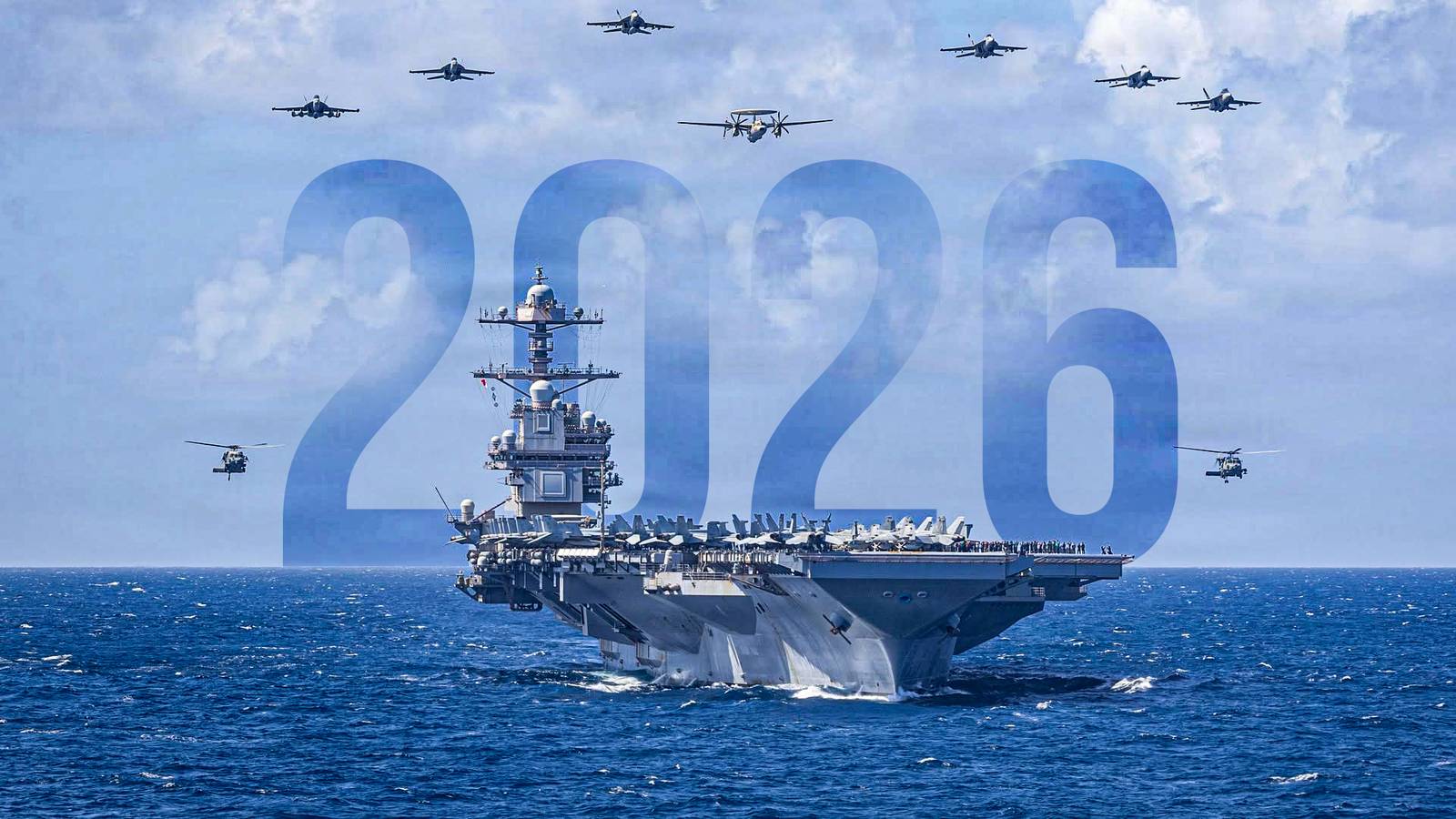
Published Oct 17, 2026, 7:00 AM EDT Luke Diaz is a freelance military writer with experience with active duty experience in the US Navy as well as defense and industrial engineering. He is a former Naval Flight Officer who performed tactical air control on the carrier-based E-2 Hawkeye. A single figure hardly does justice in summing up the vast and diverse inventory of the Department of the Navy. As the world's second-largest Air Force, the combined Fleet of the US Navy and Marine Corps amounts to over 3,800 airframes. Out of that total between the two service branches, the USN lays claim to almost 2,600 aircraft, including helicopters, tiltrotors, and fixed-wing planes. The Navy actually has a very large number of training planes, roughly 40% of the total inventory, as it owns all the trainers used by its own student pilots as well as those of the Marine Corps. Of the combat airframes, approximately 20% are helicopters, and there are nearly as many fighter jets as well. The remaining 20–25% is split among a number of special mission platforms like maritime patrol, electronic attack, and carrier-on-board delivery. The most notable new naval aviation platforms include the Lockheed Martin F-35C Lightning II stealth fighter, Bell CMV-22B Osprey tiltrotor, and Boeing P-8A Poseidon anti-submarine warfare jet. Legacy aircraft like the Sikorsky MH-60R/S Seahawk and Boeing F/A-18E/F Super Hornet continue to serve as staples on the flight deck. The first 'tailhook' drone will arrive soon when the Boeing MQ-25 Stingray drone arrives, and development of the sixth-generation F/A-XX was formally kicked off after Boeing was officially awarded the contract in September. Tailhook: Strike Fighters, Stealth Jets, And The Hummer Credit: US Navy The integration of the F-35C Joint Strike Fighter was a leap forward in carrier strike fighter tactics. Instead of competing with the legacy F/A-18E/F Super Hornet, the fifth-generation JSF functions as a stealthy 'node' that multiplies the effectiveness of the entire air wing. To maintain its low observable profile, the F-35C carries weapons internally, which limits its payload. Conversely, the 4.5-generation F/A-18E/F 'Rhino,' as it is also called, serves as a rugged 'missile truck' capable of lugging massive payloads on external wing pylons. Operating in tandem, the F-35C slips past enemy radar networks to track threats, allowing a trailing package of Super Hornets to ripple-fire long-range standoff missiles from a safe distance. This data-link-networked 'combat cloud' style of engagement also relies greatly on the Air Wing's airborne early warning and control conductor to oversee the battlespace: the E-2 Hawkeye. The Navy has steadily been phasing out its Cold War-era Northrop Grumman E-2C Hawkeye platforms in favor of the upgraded E-2D Advanced Hawkeye. As the most expensive aircraft in Navy history before the F-35C arrived, the E-2D features an advanced APY-9 active electronically scanned array radar that acts as a digital magnifying glass to track low-flying cruise missiles and stealth targets at immense ranges. This multi-generational flight deck is deliberate. The Super Hornet production line is scheduled to run through 2027, and the aircraft remains the numerical backbone of naval aviation with roughly 550 airframes in service. The F-35 will succeed some of its mission set, but not all as two more next-gen airframes are currently in development that will bring another exponential force enhancement to the carrier strike group when they arrive in the next decade. Next-Gen Naval Air Power: The Air Wing Of The Future Credit: US Navy As the US Navy adapts its tactics and strategy with the introduction of the first sixth-generation stealth fighter and collaborative combat aircraft, the capability of the Navy's Carrier Air Wings will radically evolve. These two platforms will replace the venerable Super Hornets in both the 'Buddy Tanker' and Strike Fighter mission set to complement the F-35C, which was the Navy's first stealth fighter. Inheriting combat roles at opposite ends of the tactical spectrum, the Stingray will alleviate support missions that are currently fulfilled by fighter jets to make air wing ops more efficient and free up fighter jets as well as their air crews for combat missions. Meanwhile, the F/A-XX succeeded the F-35C as the tip of the spear and exponentially increased the penetrating strike capabilities of the Air wing thanks to all-aspect stealth and its exceptionally long range. The MQ-25A is projected to virtually double the striking range of the carrier air wing. The Stingray is designed to pass between 14,000 and 16,000 pounds of fuel to receiving aircraft at a distance of 500 nautical miles (926 km) from the carrier. Meanwhile, flying with its radar off to remain completely stealthy, the F/A-XX pilot will aggregate data streamed from Grumman E-2D Hawkeyes, nearby F-35Cs, and passive sensors. The Navy designed the F/A-XX specifically for the vast distances of the Indo-Pacific theater. It features significantly greater natural endurance, fuel capacity, and a wider combat radius than current fighters. When paired with the MQ-25 Stingray to top off its tanks en route, a strike package led by the F/A-XX will be able to strike targets thousands of miles away. A similar revolution is also unfolding for the Rotary Wing community in the USN as its first tiltrotors recently came online. Revolutionizing Carrier Onboard Delivery With The Osprey Credit: US Navy The critical mission of resupplying the US Navy's Capital ships, its Nimitz and Ford class supercarriers, has recently received the first new airframe in half a century to take up the task. The platform, as well as the job itself, has been completely transformed, with the first squadron to retire the Grumman C-2A Greyhound and begin flying the CMV-22B Osprey. Fleet Logistics Multi-Mission Squadron 30 (VRM-30) received the Navy's first operational CMV-22B on June 22, 2020. The Squadron undertook its first Detachment to work alongside the Carl Vinson (CVN-70) CSG in 2021. The deployment validated the aircraft's primary requirement, which the C-2 could not do: the ability to load, carry, and logistically transport a complete Pratt & Whitney F135 engine power module to support USN and USMC F-35s. Looking at the broader rotary wing fleet, the backbone of the Navy's traditional rotary fleet, the MH-60R/S Seahawk family, has heavy payload capability but a limited combat radius. The Osprey can transport up to 6,000 pounds of cargo or personnel out to a range of 1,150 nautical miles (2,130 km). It bridges the vast "tyranny of distance" in the Pacific, reaching remote carrier strike groups positioned thousands of miles from shore bases. The Vital Mission Of Rotary Wing Naval Aviation Credit: US Navy While front-line carrier strike fighters like the F-35C and Super Hornets receive the most public attention, rotary-wing helicopters are in many ways the true operational lifeblood of the US Navy, making up roughly 20% of its total aircraft inventory. If you isolate the Navy’s active frontline combat operational forces, so no trainers, helicopters actually constitute the single largest tactical aircraft community in the fleet. The vast majority of the Navy's helicopter fleet consists of two specialized variants of the Sikorsky MH-60 Seahawk. The Navy split the family into two specialized models to cover entirely different mission sets. The MH-60R, or Romeo, is tailored to the anti-submarine warfare mission and packs a powerful suite of sonar, radar, sonobuoys, and torpedoes. The MH-60S, on the other hand, or Sierra, handles combat search and rescue (CSAR), vertical replenishment (VERTREP) of supplies between ships. Below is a table that shows just how much of the 2,595-strong fleet belongs to the rotary wing community, as per data compiled by the World Directory Of Modern Military Aircraft: Airframe Designation Aircraft Name Estimated Fleet Count F/A-18E/F Super Hornet 421 F-35C Lightning II 45 MH-60R Seahawk 270 MH-60S Knighthawk 256 CMV-22B Osprey 27 MH-53E Sea Dragon 26 P-8A Poseidon 118 MQ-4C Triton 30 E-2C/D Advanced Hawkeye 83 E-6B Mercury 16 EA-18G Growler 153 T-6B / T-45C / TH-73A Texan II / Goshawk / Thrasher 995 MQ-25A / F-5N/F / Misc. Stingray / Adversary / Transport 155 The MH-60R is the primary defensive shield of the carrier group against stealthy, modern diesel-electric and nuclear submarines. A carrier strike group cannot defend itself against underwater threats using stealth fighters. Operating from the flight decks of carriers, cruisers, and destroyers, these helicopters fly ahead of the fleet to actively hunt down enemy submarines. Every Arleigh Burke-class destroyer and virtually every other large surface vessel in the USN features a helicopter hangar and flight deck. By placing Seahawks on smaller surface combatants, the Navy distributes its aerial sensor network and strike capability across thousands of miles of ocean, rather than concentrating it all on a single carrier deck. 'Big Wing' Maritime Patrol And Special Mission Platforms Credit: US Navy While carrier decks capture public attention, the Navy operates a vital global network of land-based special mission aircraft for maritime patrol, high-altitude surveillance, and nuclear command relay. For example, the Maritime Patrol and Reconnaissance Force, endearingly referred to as the 'Big Wing' community, has spent the last decade pioneering one of the world's first working crewed-uncrewed teaming frameworks in military aviation. The P-8A Poseidon, built on a commercial 737 hull, is the Big Wing workhorse that serves as the ultimate sub-hunter, carrying sonobuoys, torpedoes, and Harpoon anti-ship missiles. Its drone partner is the Northrop Grumman MQ-4C Triton. The $100+ million uncrewed aircraft is an advanced variant of the older Global Hawk. The Navy uses the Triton to patrol vast areas of the ocean and find targets while the P-8A is sortied into areas of interest to either conduct more detailed intelligence surveillance and reconnaissance or perform kinetic strikes in its anti-ship and anti-submarine warfare capacity. For strategic nuclear deterrence, the Navy operates the EMP-hardened E-6B Mercury airborne command post rather than the Air Force's E-4B Nightwatch. Built on a legacy Boeing 707 frame, the E-6B executes critical TACAMO missions, entering a tight orbit to unspool a miles-long trailing wire antenna that broadcasts Very Low Frequency emergency messages to submerged nuclear submarines. The Navy is doubling down on this aging platform, awarding a $20.3 million modernization contract to Collins Aerospace to guarantee Big Wing operations will continue through 2036 at least.
How Many Aircraft Does The US Navy Have In 2026?
Full Article
Original Source
Read the full article at Simpleflying →KhanList aggregates and links to publicly available news content. We do not host full articles from third-party sources. Always verify important information with original sources.