
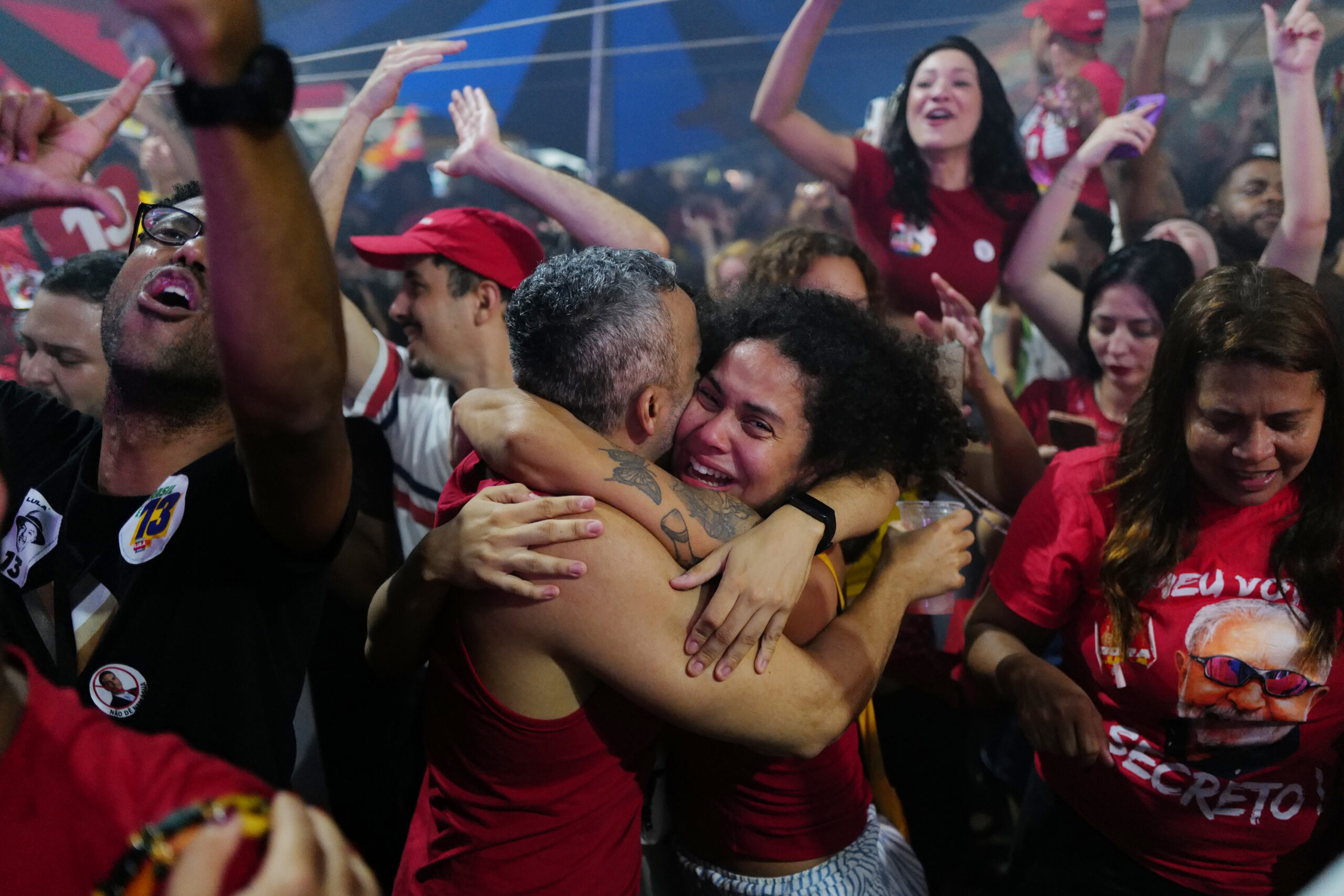
RIO DE JANEIRO (CN) — It was shortly before 9 p.m. Sunday when shouts of “Lula! Lula!” began echoing through the streets of Copacabana. Fireworks erupted, residents banged pots and pans from their windows, and others switched on red lights.“É tetra!” (“It’s the fourth!”), some shouted, in a celebration reminiscent of Brazil winning the World Cup.In the background, horns played the familiar tune of “Olê, olê, olê, olá, Lula, Lula,” one of the best-known chants from the president’s election campaigns.After trailing Senator Flávio Bolsonaro in the first round, President Luiz Inácio Lula da Silva secured a fourth term by winning Sunday’s runoff.Brazil’s Superior Electoral Court officially confirmed the result at 9:10 p.m. With 51.79% of valid votes against Bolsonaro’s 48.21%, Lula became the first presidential candidate since Brazil’s return to democracy in 1985 to win a runoff after finishing second in the first round.“This night does not belong only to the winning tickets. It belongs, above all, to Brazilian voters, the main protagonists of the elections and the beneficiaries of all the work carried out by the Electoral Justice system,” Justice Kassio Nunes Marques, president of the Superior Electoral Court, said.The reversal carried particular significance in Rio de Janeiro, the political birthplace of the Bolsonaro family. In the city, Lula went from 43.91% of the vote in the first round, against Bolsonaro’s 47.88%, to 51.54%, against 48.46%. Rio was one of only two Brazilian state capitals where the president managed to overturn the first-round result.João Feres, a professor at Rio de Janeiro State University’s Institute of Social and Political Studies, said Lula’s win did not follow the traditional logic of electoral campaigns centered on political alliances. He said mobilization both online and in the streetshelped bring voters who had stayed home in the first round to the polls.Abstention fell from 21.08% in the first round to 19.22% in the runoff, the lowest rate for a presidential runoff since 2006, according to the Superior Electoral Court.Lula gained 10.38 million additional votes between the two rounds, while Bolsonaro added about 3.7 million. The president finished the race with 64.25 million votes, compared with his rival’s 59.83 million.João Ricardo Matta, a professor of strategy and market intelligence at Fundação Getulio Vargas, attributed Lula’s comeback to higher voter turnout, a decline in rejection of Lula and Bolsonaro’s failure to win over supporters of defeated first-round candidates. According to a Quaest poll released Oct. 21, rejection of Lula fell from 53% to 47%, while Bolsonaro’s edged down from 54% to 52%, within the margin of error.Matta said Lula’s campaign changed strategies after the first round, stepping up digital mobilization, returning to the streets and focusing on voters’ everyday concerns.Congressman André Janones of the Sustainability Network party played a central role in that shift, creating the “Exército do Lula” (“Lula’s Army”) WhatsApp channel, which grew from around 60,000 to nearly 11 million followers in three weeks.“The achievement was turning engagement into action, something most digital campaigns fail to do,” Matta said.Bolsonaro, meanwhile, showed excessive confidence in victory and, according to Matta, damaged his image during the debates. During the final debate, broadcast by TV Globo two days before the runoff, Flávio mocked Lula’s physical disability by referring to his “nine fingers,” a reference to a finger the president lost in a workplace accident. Lula demanded an apology, which Bolsonaro eventually gave.Matta said Flávio’s mocking tone unsettled older voters and hurt his campaign.“Flávio dominated the conversation among his own supporters, while Lula reduced resistance among everyone else. And runoffs are won by doing the latter,” Matta said.Bolsonaro did not immediately acknowledge his defeat. On Sunday night, the senator announced he would seek to annul the election, arguing Supreme Court Justice Cristiano Zanin’s decision to extend voting until 7 p.m. had undermined equal conditions for voters.The extension followed complaints about insufficient public transportation in several cities. Bolsonaro’s campaign had also requested extended voting hours in municipalities affected by heavy rain and flooding. According to electoral court data, only 34,330 votes were recorded after 5 p.m., representing 0.03% of the total.On Monday, Bolsonaro backed away from his plan to seek annulment of the election and instead announced in a social media video that he would seek to disqualify Lula’s winning ticket over claims of abuse of political and economic power.In the same video, he said federal police had ordered him to surrender his regular and diplomatic passports under a ruling by Supreme Court Justice Alexandre de Moraes. He was also barred from leaving Brazil. The restrictions were imposed as part of a money laundering investigation.In his first speech after the victory, Lula gave the floor to Vice President Geraldo Alckmin before thanking voters, particularly young and elderly Brazilians who had participated in the mobilization in the final weeks of the campaign.Lula also thanked Janones for his role in the campaign and announced plans to expand public participation in government decisions and strengthen direct communication with Brazilians through digital platforms. He also called for regulating major technology companies, which he accused of trying to influence the election’s outcome.Rodrigo Stumpf González, a political science professor at the Federal University of Rio Grande do Sul, said he expects a realignment of Brazil’s political forces, with the traditional right regaining some of the influence it had lost to the more confrontational wing represented by the Bolsonaro family.González said Lula will struggle to pass legislation in a Congress dominated by conservative forces. However, with no prospect of seeking a fifth term, the president may focus more on his political legacy and use his electoral support as leverage in negotiations.“Lula is now beginning to think about his legacy, rather than merely managing the present,” González said.Courthouse News reporter Marília Marasciulo is based in Brazil.Subscribe to our free newslettersOur weekly newsletter Closing Arguments offers the latest about ongoing trials, major litigation and rulings in courthouses around the U.S. and the world, while the monthly Under the Lights dishes the legal dirt from Hollywood, sports, Big Tech and the arts.Additional Reads
How Lula overcame a first-round defeat to win Brazil’s presidential election
Full Article
Original Source
Read the full article at Courthousenews →KhanList aggregates and links to publicly available news content. We do not host full articles from third-party sources. Always verify important information with original sources.