
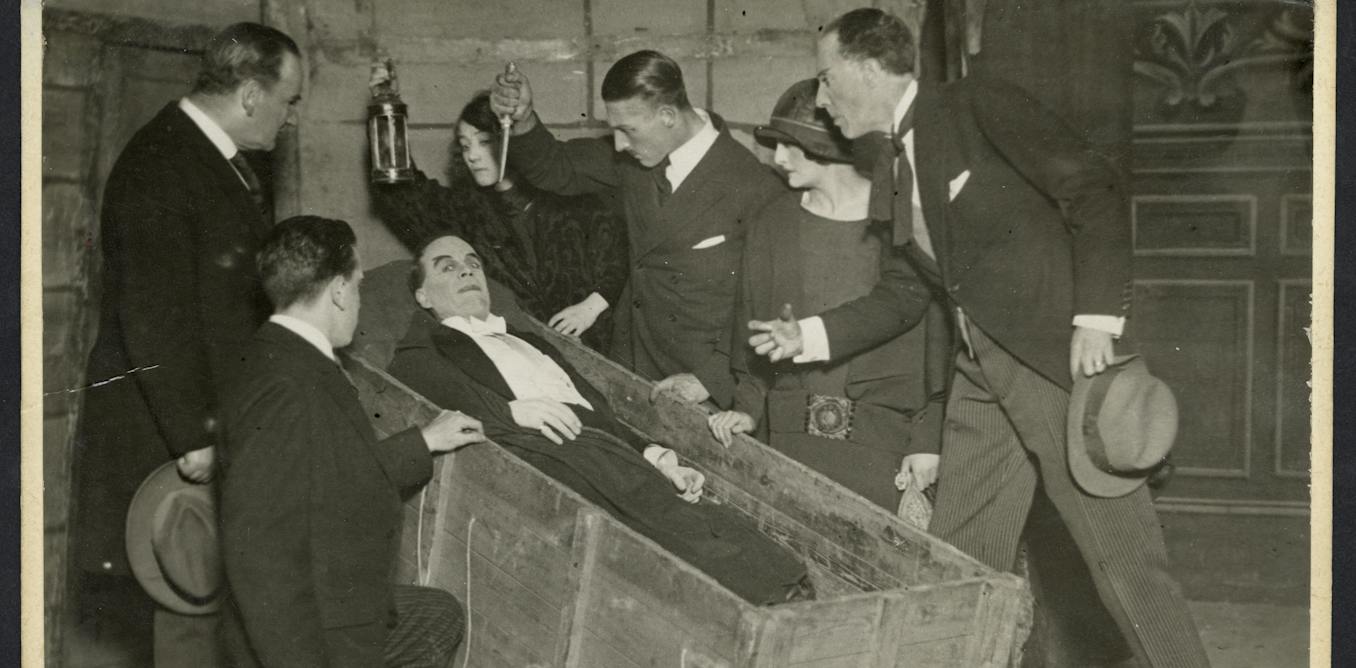
Long before modern medicine could name the invisible terrors ravaging Victorian Britain, the public found a face for contagion: the vampire. A new exhibition at the University of Leeds’s Treasures of the Brotherton Gallery, Quite Shameless: Cultural Reflections on the Vampire, explores how this supernatural predator became a stand-in for the period’s deepest anxieties about disease, contagion and contaminated air. The exhibition brings together manuscripts, books, prints, medical objects and theatrical materials, including items from the Bram Stoker collection. Throughout the 19th century, rapid industrialisation brought huge numbers of people into British cities, where poverty, overcrowding and fragile infrastructure triggered devastating outbreaks of disease. As such, people were deeply concerned with questions of health and sanitation. However, knowledge of germ theory was not fully established until the end of the century and, in the meantime, people believed disease was spread by bad smells known as “miasma”. Silent Highwayman by John Leech (1858). Science History Images In the summer of 1838, London experienced a heatwave that resulted in the “great stink”. The Thames was heavily polluted with rotting food, human waste and corpses of humans and animals. As temperatures soared, the river levels fell, leaving its contents to bake in the sun. The resulting cholera and typhoid epidemics were attributed to the terrible smell coming from the river, rather than the contaminated water supply. These fears inspired John Leech’s illustration Silent Highwayman, published in Punch magazine in 1858 and on display in the exhibition. The cartoon presents a grim reaper like skeleton rowing through the bodies of dead animals in the shallow waters of the Thames. The caption, “your money or your life” demands that the government invest in public sanitation or risk losing more lives to disease. Just as Leech presents disease through the personification of death, Bram Stoker did so through the character of the vampire. In his novel Dracula (1897), the titular vampire’s chambers contain a heavy miasma that is described by protagonist Jonathan Harker as “composed of all the ills of mortality and with the pungent, acrid smell of blood”. However, bad smells weren’t the only explanation behind the spread of disease in the late-19th and early-20th centuries. People were also quick to blame migrants, travellers and foreigners. ‘Back!’ by John Tenniel (1892). Photo 12 An example of this in the exhibition can be seen in John Tenniel’s illustration, “Back!”. Published in Punch during the cholera outbreak of 1892, the drawing personifies cholera as a spectral figure attempting to enter Britain on a ship from abroad. Britannia holds out her hand, refusing entry to the migrant cholera, to prevent the spread of the disease into the country. The cholera outbreaks of the 19th-century were a source of fear for their contemporaries. Over the course of the century, it is estimated that the disease killed about 140,000 people in the UK. Stoker grew up in the shadow of this fear. His mother, Charlotte Thornley Stoker, had witnessed a devastating cholera outbreak as a teenager in her hometown of Sligo, Ireland. In just six weeks, about 640 local people had died. The blame fell on travellers who were believed to have brought the disease into the town. In her memoir, Thornley Stoker recounted the horrific treatment of one of these travellers: One I vividly remember, a poor traveller was taken ill on the roadside […] [the people of Sligo] dug a pit and with long poles pushed him living into it and covered him up alive. These stories of migrants targeted by fearful communities were formative for the young Bram Stoker and likely influenced his writing. Like his mother’s experiences with Cholera, Stoker’s villain Dracula is a traveller who enters a country at a port town, bringing a deadly and inexplicable disease with him. And, just like the cholera epidemics of the 1800s, the “disease” of vampirism is fought against by medical doctors. Most notably, in the case of Dracula, the Dutch medical doctor Abraham van Helsing and his former student Dr John Seward. The trailer for Nosferatu (1922). The representation of vampires as both migrants and bringers of disease becomes even more explicit in F.W. Murnau’s 1922 silent movie, Nosferatu. In the film, Count Orlock (Max Schreck) travels from Transylvania to Germany on a ship infested with rats, bringing with him an unspecified disease known as “the great death”. While cholera was not spread by rats, the association between rats and disease was strong in the early-19th century mindset. The character design for Orlock is especially rodent-like, with elongated fangs resembling a rat’s prominent incisors. For people in the 19th century, the vampire provided a way to make invisible threats visible. By transforming the transmission of disease into a literal monster, vampires make an intangible fear tangible and perhaps most importantly, into something that can be confronted. Quite Shameless: Cultural Reflections on the Vampire is at the University of Leeds’ Treasures of the Brotherton Gallery. Tickets are free and the exhibition will run until May 29 2027. This article features references to books that have been included for editorial reasons, and may contain links to bookshop.org. If you click on one of the links and go on to buy something, The Conversation UK may earn a commission.
How London’s 1838 ‘great stink’ created the modern vampire
Full Article
Original Source
Read the full article at Theconversation →KhanList aggregates and links to publicly available news content. We do not host full articles from third-party sources. Always verify important information with original sources.