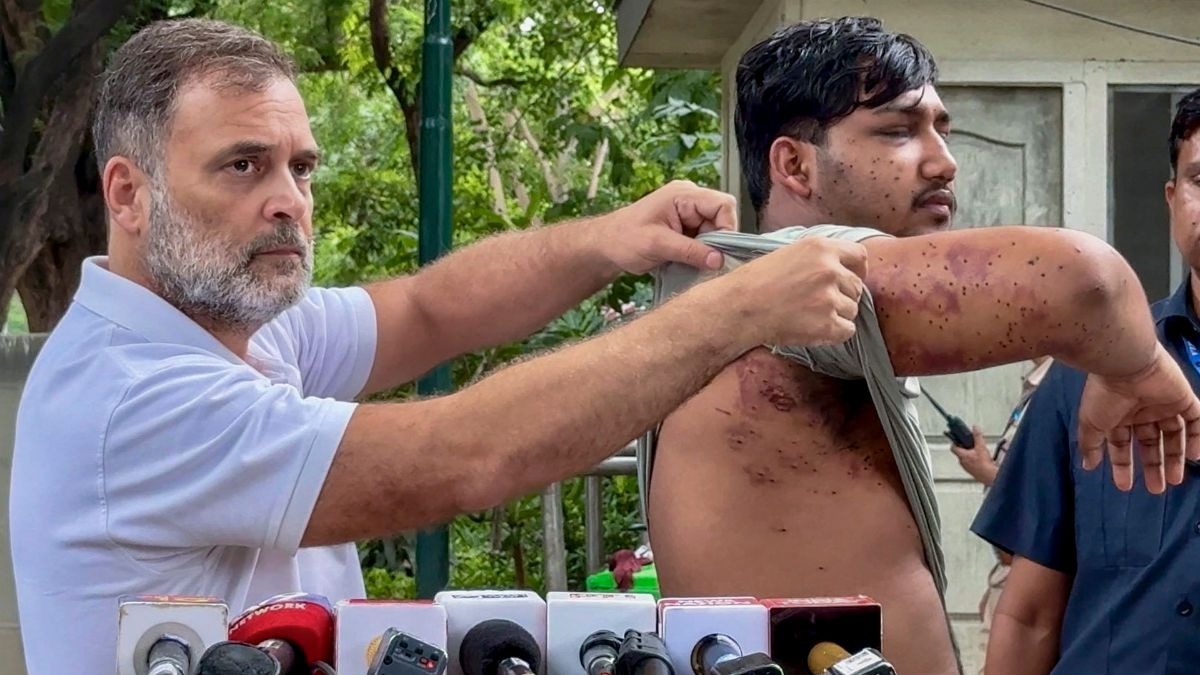
A less-lethal weapon is engineered to not break the skin, and a pellet is engineered to go through it. Here is the physics of why India's crowd-control shotgun sits in a different category altogether from the sponge rounds most police forces use. The pellet gun was used to fire at protesters in New Delhi during the CJP's march to Parliament.Rahul Gandhi meets a man injured by alleged pellet fire at the July 20 CJP march, as the weapon returns to the spotlight. A less-lethal round is built to stop at the skin. A pellet is built to go through it. (Photo: PTI)Take a mustard seed from your kitchen jar and hold it between two fingers. That is roughly the size of one pellet. It weighs almost nothing. You could throw it at someone all afternoon and never leave a mark.Now, put a few hundred of them into a cartridge and the arithmetic changes entirely.That is what some doctors in Delhi have been dealing with this week. They have not been dressing a wound, but counting them. Face, neck, shoulder, eye. Then deciding which pieces of metal can come out and which are safer left inside a young person for the rest of his life.Since July 20, when a Cockroach Janta Party (CJP) march towards Parliament ended with protesters in hospital and their medical papers recording pellet wounds, the country has been asking who fired what. India Today Digital's investigation revealed that pellet guns were used on protesters in New Delhi on July 20. Delhi Police has said it neither possesses nor uses pellet guns.The Central Reserve Police Force (CRPF) has begun an internal inquiry into whether personnel of its Rapid Action Force (RAF) did. Let the inquiry settle that. Underneath it sits a question nobody needs an inquiry about, and the answer is not complicated. A less-lethal or non-lethal weapon is engineered to stop at the skin. A pellet is engineered to go through it. That is the whole story, and everything below is why.WHAT MAKES A WEAPON LESS LETHAL, AND IS A PELLET GUN ONE?Most people assume less-lethal simply means weaker. It does not. It is a design standard, and it has one requirement. The weapon must hurt without going in.That is the test the pellet gun is supposed to have passed, so it is worth seeing what passing looks like.The task is a narrow one. A police officer needs to stop one advancing person, from a distance, without killing them. Most forces abroad do it with a sponge round.It is a single fat projectile, about as wide as a two-rupee coin, with a soft foam head, fired one at a time. Its impact is like being hit hard by a cricket ball. Built to stop at the skin, it leaves a serious bruise but takes the fight out of a person.Whether anything stops at the surface comes down to a single number, and you already understand it, because you have done the experiment.Press your open palm flat against your forearm and lean your weight in. Nothing happens. Now press with the point of a pin, using exactly the same effort. Blood.The push was identical. Only the area changed. Skin has a 50 per cent chance of being pierced between roughly 24 and 53 joules per square centimetre, a line sponge rounds are built to stay below and pellets are built to cross. (Infographic: Radifah Kabir) Scientists call this energy density, the energy divided by the area it lands on, measured in joules per square centimetre. The energy itself is half the object's mass multiplied by its speed, squared, which is why a scrap of lead lighter than a grain of rice stops being harmless once it is moving fast enough.Testing on human tissue by Bir and colleagues put the point at which skin has a 50 per cent chance of being pierced at roughly 24 to 53 joules per square centimetre, depending on the part of the body.The sponge round is engineered to sit below that line. Its broad, soft face spreads whatever energy it carries over a wide patch of you, so the number stays low no matter how hard it arrives.The pellet does the opposite. Two millimetres of dense metal landing on a few square millimetres of skin has almost no area to spread anything across, so the same modest energy is concentrated until it clears the threshold. At the distances these guns are fired at a crowd, it clears it comfortably.That is not a malfunction. It is what a small dense sphere does, every time.So the pellet gun is not a less-lethal weapon that occasionally penetrates. It is a penetrating weapon that has been given a less-lethal name.WHAT IS A PELLET GUN, AND HOW DOES IT WORK?The gun itself is unremarkable. A 12-bore pump-action shotgun, the sort a farmer might keep for birds. Bore simply means how wide the barrel is. Inside the cartridge sit hundreds of those mustard-seed spheres of lead alloy, called birdshot for the obvious reason.Every gun works the same way at heart. Something burns, and the gas it makes has to go somewhere.Pull the trigger and a spark lights a small charge of powder. It burns in a fraction of a second into far more hot gas than the space can hold, and the only way out is up the barrel. So it goes, and it takes the pellets with it. A single 12-bore cartridge carries hundreds of lead-alloy pellets, each about the size of a mustard seed, which begin spreading outwards the moment they leave the barrel. (Photo: Gen AI) They do not travel loose. They sit in a small plastic cup called a wad, and the gas pushes the cup like a piston, carrying the whole crowd out of the muzzle together. A few metres on, the air catches the cup, it falls away, and every pellet is on its own.That is where a shotgun parts company with a rifle. A rifle barrel has spiral grooves inside it, called rifling, which spin the bullet so it holds a line, the way a spinning ball flies truer than a wobbling one. A shotgun barrel is a smooth tube. No grooves, no spin, nothing holding anything to a line.So the pellets fan out the moment they are free, like water leaving a shower head, and they keep fanning out until they reach whoever is standing there.One pull of the trigger is not one object going to one place. It is hundreds, going their own way.WHY DO PELLET GUNS BLIND SO MANY PEOPLE?Because the eye is the most fragile thing we own and we carry it about uncovered.An eyeball is a small sphere of fluid, about 24 millimetres wide. The cornea in front is around half a millimetre thick. The retina, the light-sensitive film at the back, is roughly 0.2 millimetres, thinner than a newspaper page. No bone stands in front of any of it.Fluid cannot be squeezed smaller. So when something strikes the front of an eye, the pressure does not stop there. It travels through to the structures behind, which is why sight can be gone before the person has finished flinching. Leader of the Opposition in the Lok Sabha, Rahul Gandhi, interacts with the media alongside a victim of alleged pellet-gun firing during the Cockroach Janta Party (CJP) students' protest march of July 20, in New Delhi on July 24, 2026. (Photo: PTI) When the wall of the eye tears through its full thickness, ophthalmologists call it an open globe injury, and there is no worse grade. A study of 777 pellet-injured patients in the Indian Journal of Ophthalmology found a mean age of 22.3 years and open globe injury in 76.3 per cent of eyes. A follow-up study of 664 eyes recorded it in 67.9 per cent. For most of those young men the sight never came back.The wider record agrees. A systematic review in BMJ Open gathered 27 years of cases worldwide. Among 1,984 people injured by such projectiles, 53 died and 300 were permanently disabled, with head and neck strikes causing 49.1 per cent of the deaths.CAN A PELLET GUN BE AIMED AT A SINGLE PERSON?Procedure says aim low. After 2016, deflectors were fitted to muzzles and troops in the Kashmir Valley were told to fire towards the feet. Nobody doubts the instruction was meant sincerely.It cannot be obeyed. A shotgun does not send one thing somewhere. It throws a widening cone, and the cone keeps widening for as long as it travels. Add recoil, a crowd in motion, uneven ground, and pellets skipping off a road or a barricade in directions nobody chose.What is left is not aim. It is a spread of probabilities with people standing inside it.WHAT DO INTERNATIONAL STANDARDS SAY ABOUT PELLET GUNS?The world's benchmark is the United Nations Human Rights Guidance on Less-Lethal Weapons in Law Enforcement, published in 2020, and it reads less like a moral appeal than an engineering specification. A crowd-control projectile must be accurate enough to land within a circle 10 centimetres across at its intended range, and must be aimed at the lower abdomen or legs, never the head, face or neck.This is not only a lawyer's objection. It is an engineering one. A Hyderabad-based defence-technology engineer, who has worked on Indian military projects, speaking to India Today Digital on condition of anonymity, explained that the accuracy standard can be met by a single aimed projectile but not by a cartridge that releases hundreds at once. "While the centre of the pattern may be accurately aimed," he told India Today Digital, "the outer pellets can still strike people outside the intended target area." UN guidance requires a crowd-control projectile to strike within a 10-centimetre circle of its aim point, a test no multi-pellet cartridge can pass. (Infographic: Radifah Kabir/India Today) Then come the two sentences that end the argument. Multiple projectiles fired at once are inaccurate and cannot generally satisfy the requirements of necessity and proportionality. Metal pellets, such as those fired from shotguns, should never be used.The Omega Research Foundation, which catalogues police equipment worldwide, says it more bluntly. Ammunition holding many projectiles cannot be aimed, so police should not carry it.Which is why forces elsewhere send one object down the range at a time. A 40 mm sponge round. A foam baton round. A bean bag. One trajectory, one impact, one officer who can be asked afterwards where it went.WHY DOES INDIA STILL USE A MULTI-PROJECTILE SYSTEM?Not because anyone concluded it was sound.Pellet guns entered Indian crowd control in Kashmir in 2010, after live rifle fire killed around 120 people that year. They arrived as the gentler choice.Then Right to Information disclosures turned up something that startled even the people who went looking. The Bureau of Police Research and Development, the Home Ministry's own research wing, listed the recommended non-lethal equipment: water cannons, tear smoke, plastic bullets, tasers, pepper-ball launchers, laser dazzlers, net guns, stink bombs. Leader of the Opposition Rahul Gandhi with a victim of alleged pellet-gun firing at the July 20 Cockroach Janta Party (CJP) protest, as the weapon's use in the capital draws political scrutiny, in New Delhi. (Photo: PTI) Pellet guns were not on it. They had never been assessed for the job at all.On July 26, 2016, the Home Ministry appointed a seven-member expert committee under TVSN Prasad to find something better. PAVA chilli shells, STUN-LAC shells and tear smoke were placed ahead of pellets in the order of escalation. Forces reported PAVA was not moving determined crowds, and the shotguns stayed.In Rajya Sabha Unstarred Question 511, answered on February 7, 2018, the Home Ministry recorded 17 civilians killed by pellets between 2015 and 2017.Sixteen years on, the argument has reached the capital. The seed between your fingers has not changed at all. Only the speed we give it, and the name we agree to call it by.- EndsPublished By: Radifah KabirPublished On: Jul 25, 2026 11:50 IST
How lethal is a non-lethal pellet gun? Science behind injuries to protesters
Full Article
Original Source
Read the full article at Indiatoday →KhanList aggregates and links to publicly available news content. We do not host full articles from third-party sources. Always verify important information with original sources.