
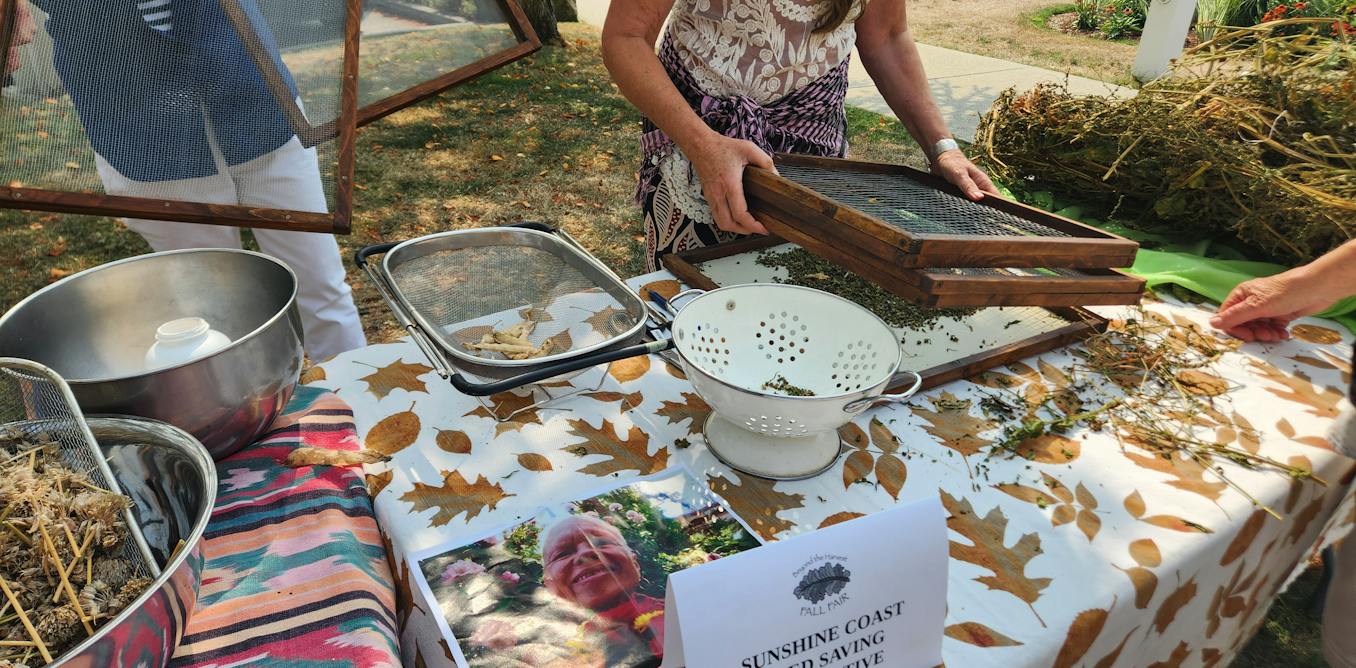
A viral 2017 poll claimed that seven per cent of American adults believe chocolate milk comes from brown cows. The results drew a lot of laughs, along with criticism of the poll’s accuracy. But nearly a decade later, the results still raise an important question: How much do people really know about where their food comes from and how it’s grown? Grocery prices are skyrocketing in Canada amid a series of crises, from the lingering effects of the COVID-19 pandemic to global conflict, climate change and cyberattacks on grocery chains. As these events disrupt food supplies, it’s time to revisit a skill set humans have valued for millennia — food literacy. Knowing how to grow, harvest, hunt, process and cook our own food can help us become more self-sufficient, and it starts with learning from the land. Our disconnection from food The disconnect between the food we eat and the land can be explained by the concept of distancing. It also involves complex power dynamics, financing and entities in the global food system that make our food hard to understand. Distancing shapes how we value our food, the Earth and the people who work in the food system. Indigenous scholars Linda Clarkson and Vern Morrissette, along with Gabriel Régallet, argue that when we are separated from the source of our sustenance, we lose sight of “our responsibility and our kinship to the Earth.” In essence, we collectively forget our responsibilities to the land. For many Indigenous communities, food can no longer serve as medicine in the way it once did because colonization and the residential school system turned it into a tool of control. These systems forcibly disrupted intergenerational knowledge transfer, removed people from their lands, stigmatized traditional food and knowledge and ruptured relationships that had sustained people for generations. While many initiatives now offer students and adults opportunities to learn traditional food knowledge, these efforts are not yet mainstream. Building resilience through land-based learning One approach to addressing collective forgetting and reclaiming food knowledge is land-based learning, an Indigenous approach to teaching rooted in understanding the land as a teacher. In our ongoing project, “Countering Collective Forgetting: The Role of Land Based Learning,” we showcase the important work of those who teach these skills and how they are often undervalued. Through hands-on teaching, land-based learning encourages adaptive knowledge often gained through the wisdom of Elders. Our research team recently reviewed 137 land-based learning studies. We found that Elder-led mentorship was the most prevalent approach to learning, appearing in 73 per cent of the studies. To showcase how land-based learning works in practice, we conducted our study on the unceded territories of the Sḵwx̱wú7mesh Úxwumixw (Squamish) and shíshálh (Sechelt) Nations in an area commonly known as the Sunshine Coast of British Columbia. This region is particularly vulnerable to drought, and residents rely on ferry services for 60 per cent of their food, with 40 per cent coming from private barges and transport. We participated in five land-based learning activities, hosted one learning circle and interviewed eight local land-based learning practitioners. These practitioners included seed savers, farmers, permaculturalists, Indigenous Knowledge Keepers, chefs, school teachers and outdoor educators. They comprised a mix of Indigenous and settler residents in their communities. Our initial findings suggest that food acts as a form of living memory, held and reproduced through stories, relationships and also through engaging with the land. Graphic recording results from the ‘Learning from the Land’ Learning Circle, Nov. 9, 2025, Sechelt, B.C. (Fuselight Creative), CC BY-ND The land is a teacher, healer During our learning circle, Alfonso Salinas, a shíshálh educator and cultural ambassador, opened the session with a song and prayer. He described how he was “taken under the wings” of Elders and of shíshálh Nation educator Candace Campo (xets’emits’a), co-founder of Talaysay Tours, a local Indigenous land-based learning and tourism company. On forest walks, Salinas learned how to use traditional plants and cedar as medicine. He shared his concerns about climate change and how invasive species are increasingly out-competing native plants such as salmon berries. His message was to never forget to teach the history of the land. Slocan Peas at a Seed Saving workshop in September 2026 in Sechelt, B.C. (Tammara Soma) One important piece of history shared by educators from the Sunshine Coast Seed Saving Collective during a seed workshop in September 2025 was that of the Japanese internment camps. They helped people remember and honour survivors by planting Slocan peas. Slocan peas are connected to Japanese Canadian families who were interred in the interior of B.C. during the Second World War. Slocan peas grew through a period of injustice, carrying a memory of adaption and resilience. Growing them is a form of healing. One educator who identified as Red River Métis shared that it’s hard to learn from the land when colonial policies continue to create barriers for Indigenous Peoples. Zoning rules, the reserve system and resource extraction projects all stand in the way. Finally, while many of the practitioners volunteered their time out of love, they also recognized this approach isn’t sustainable. Cost was a significant barrier for Robin, a settler who runs farm camps where kids from kindergarten to Grade 12 can learn how to grow, process and cook food. She said it was difficult to balance the need to create more affordable land-based learning programs while ensuring that practitioners can continue to teach. “Land-based educators should be paid fair wages,” she said. Participants learning how to cook at Farm Camp in March 2026 in Sechelt, B.C. (Morgan Game) Supporting traditional food knowledge Seeds, like knowledge, don’t stay viable forever. They have to be planted, harvested, saved and shared for the cycle to continue. Knowledge from land-based learning carries on the the same way, as each generation of learners teaches the next. That cycle can help counter collective forgetting in our food systems, but only if those who dedicate their hearts and time to it have the space, fair wages and support they need. If we want to close the gap between ourselves and the food we eat, land-based learning offers an important path. To keep traditional food knowledge alive and make our food systems more resilient, we must value the wisdom that allows food to serve as medicine. That work begins by reconnecting with the land and with one another.
How learning on the land is bringing back traditional food knowledge and healing
Full Article
Original Source
Read the full article at Theconversation →KhanList aggregates and links to publicly available news content. We do not host full articles from third-party sources. Always verify important information with original sources.