
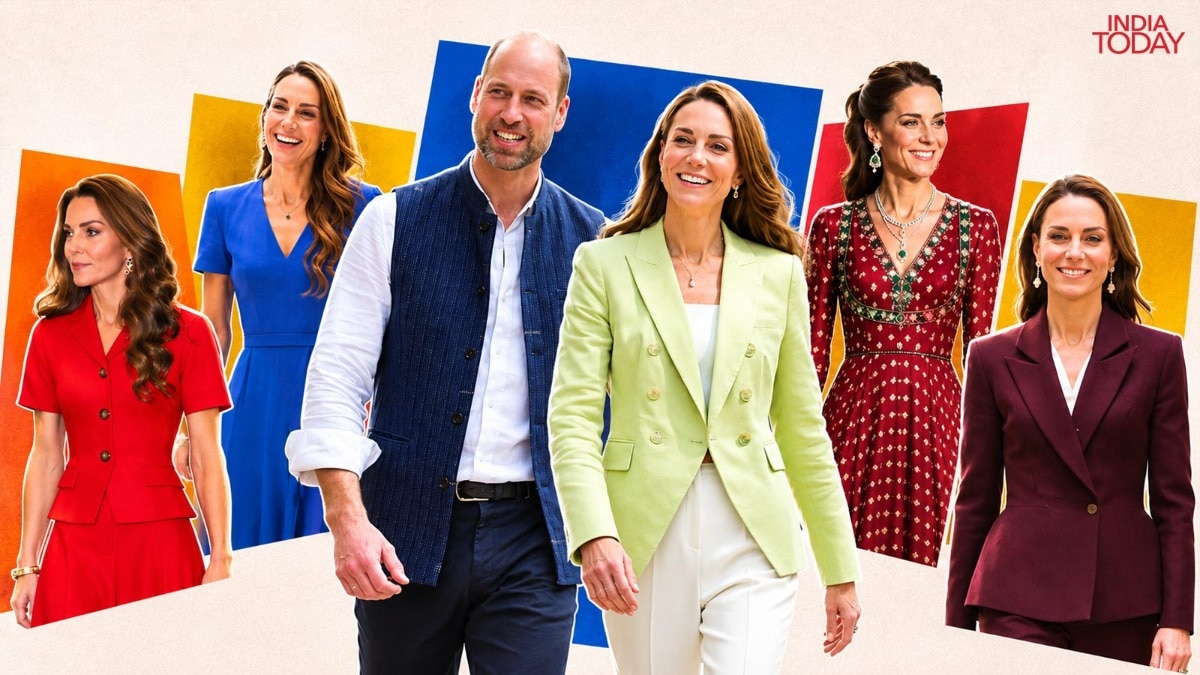
When Prince William and Kate Middleton arrived in India for their three-day visit, the fashion conversation was, predictably, expected to revolve around the Princess of Wales. After all, Kate has long mastered the art of diplomatic dressing, often acknowledging her host country through carefully selected designers, colours and accessories. But the first significant fashion moment of this visit came from an unlikely source: Prince William.For an engagement in Mumbai, which included a game of gully cricket with Sachin Tendulkar, William stepped out in a navy-blue Nehru jacket by Indian menswear label Kardo, worn over a crisp white shirt and dark trousers. It was a refreshing departure from his usual repertoire of suits and blazers, and a thoughtful nod to Indian menswear. Prince William on Day 1 in Mumbai (Photo: AP) The jacket also carried a story of Indian craftsmanship. As the brand shared with us, its handloom fabric was woven in Harali village, West Bengal, by artisans Netai Mana and Brojokishore Maity through a collaboration with Glocalweaves. The textile uses the traditional extra-weft technique, in which motifs are painstakingly woven into the cloth by hand, one pick at a time.And then came Kate's handbag. One of the most interesting fashion stories of the royal tour was not a designer dress or a piece of jewellery, but a structured, deep-brown handbag that Kate carried on three occasions. The bag was a bespoke version of the Small Hudson by British accessories label DeMellier, created in collaboration with SurpRice, an innovative plant-based material venture with strong Indian research and innovation links. Kate Middleton rewore her blue dress from Wimbledon and carried the special bag during her Mumbai metro journey (Photo: Reuters) What made the bag particularly special was its material. Rather than conventional leather, the one-of-a-kind accessory was crafted from rice straw and husks, agricultural by-products that are frequently discarded or burned. SurpRice transforms this waste into a leather-like material, offering a potential alternative to petroleum-derived synthetics. Kate first carried the custom DeMellier bag with a cobalt-blue Roksanda dress during a Mumbai Metro journey. It appeared again during her visit to the Chanakya School of Craft, where she wore a red Emilia Wickstead dress, and finally at her meeting with Prime Minister Narendra Modi.The repetition was noteworthy. Kate is known for rewearing clothes and accessories, but this was a particularly pointed choice for a trip centred on environmental innovation. The bag also offered a different interpretation of what it means to wear India. It wasn't a traditional craft or an Indian silhouette, but an example of the country's role in developing materials that could shape fashion's future.There was another, quieter Indian connection in Kate's accessories. During the visit, she brought back her lapis lazuli and diamond earrings by Jaipur-based jewellery house Amrapali, which she had previously worn during the couple's 2016 tour of India. Paired this time with her cobalt-blue Roksanda dress, they provided a subtle link between the two royal visits, a decade apart. Kate Middleton repeats her Amrapali earrings from 2016 India visit. Photos: AFP (left), Getty (right) But the biggest fashion moment was still to come.At the Earthshot Prize Awards in Mumbai, William and Kate both embraced Indian designers and Indian silhouettes, making their appearance one of the most striking examples of coordinated royal fashion diplomacy during the trip. Prince William and Kate Middleton wore Indian designers for the Earthshot Prize Award night. (Photo: PTI) Kate chose a red-and-green Anarkali by Delhi-based designer Mahima Mahajan. The ensemble, called Neelam, was crafted from handwoven silk georgette, with traditional Banarasi gold detailing, hand embroidery and glass-bead embellishments. Its rich vermilion colour was achieved using vegetable-based dyes.Mahajan's team worked to ensure the outfit was free of plastic embellishments, opting for glass beads rather than acrylic alternatives. Kate Middleton wore Mahima Mahajan's creation with sustaonbility woven into it. (Photo: AP) William, meanwhile, complemented her in a bespoke black bandhgala by Manish Malhotra. The high-collared formal jacket, finished with hand-embroidered buttons, was an Indian alternative to the conventional tuxedo.And for the final chapter of the tour, Kate turned to a very different expression of Indian design.For her meeting with Prime Minister Narendra Modi in New Delhi, the Princess of Wales wore a custom deep-plum pantsuit by Gaurav Gupta. The ensemble featured a sharply structured, peplum-style jacket with defined shoulders and a cinched waist, paired with coordinating trousers. Prince William and Kate Middleton concluded their three-day visit after meeting PM Modi (Photo:PTI) Kate completed the look with chocolate-brown Gianvito Rossi heels, Van Cleef & Arpels earrings and, once again, her bespoke DeMellier x SurpRice handbag.- Ends
How Kate Middleton and Prince William made Indian design part of their royal wardrobe
Full Article
Original Source
Read the full article at Indiatoday →KhanList aggregates and links to publicly available news content. We do not host full articles from third-party sources. Always verify important information with original sources.