
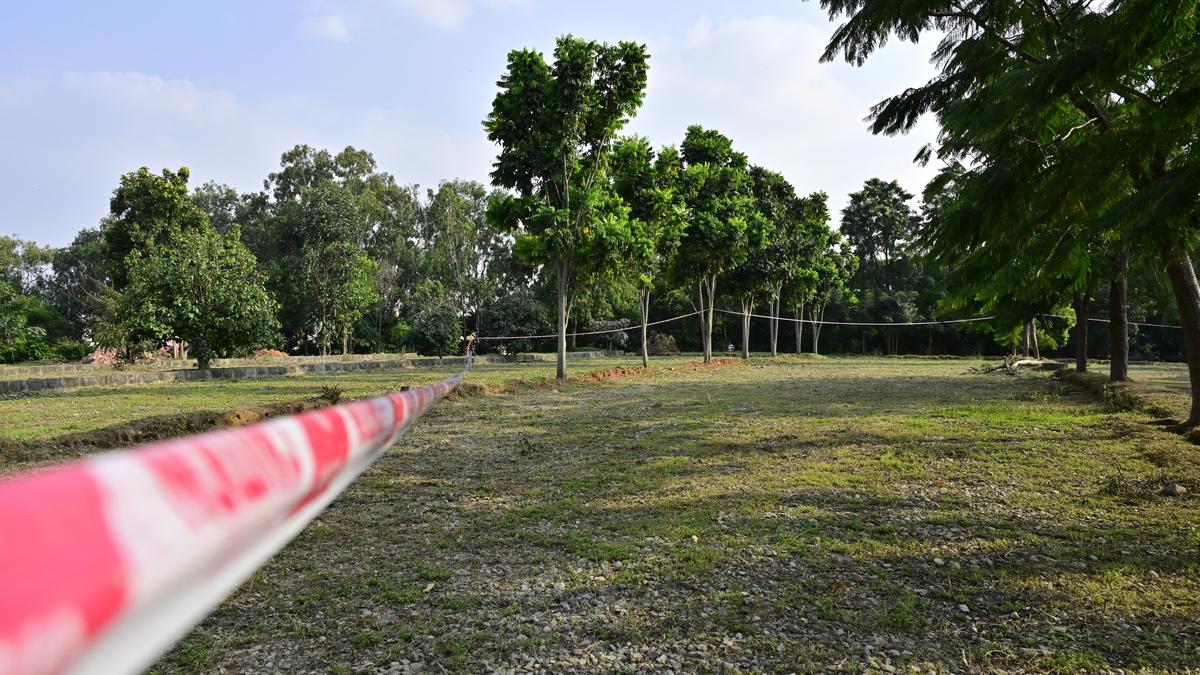
Story so far: The Karnataka government passed two bills — the Karnataka Government Parks (Preservation) (Amendment) Bill, 2026, and the Bengaluru Metropolitan Land Transport Authority (Amendment) Bill, 2026 (BMLTA) — in the recently concluded Monsoon Session.Both bills were passed without a single debate as the opposition alliance of the Bharatiya Janata Party (BJP) and Janata Dal (Secular) was vehemently protesting against the inclusion of scam-accused B. Nagendra in the newly inducted ministers.The bills are now being viewed in the context of the controversial Tunnel Road project, which is one of Chief Minister D.K. Shivakumar’s pet projects. The Parks Bill, in particular, has drawn substantial backlash from the public, civic activists, and environmentalists. In addition, progressive thinkers and Kannada writers have also issued statements urging the government to repeal the amendments. Pressure is now mounting from various sections of society.The groups opposing the project say that at the core of these amendments is an agenda to shield the Tunnel Road project, against which three Public Interest Litigations (PILs) are currently being heard in court. The PIL petitioners have alleged that the amendments defeat the points raised in the petitions.What does the new Park amendment seek?The amendment changes the Karnataka Government Parks (Preservation) Act, 1975, so that the State government can legally take or use a limited portion of land, which is 5%, inside protected government parks and gardens for public infrastructure and public-utility projects. The 1975 Act was originally designed to protect government parks and gardens from being diverted to other uses.Section 4 of the 1975 Act restricts the use or alienation of land covered by the Act. However, Section 5 was included to make “specific exceptions.” In the past, all these exceptions have been project-specific permissions written into the law.For example, the existing Section 5 lists six specific projects, including the use of Indira Gandhi Musical Fountain Park for road widening and Lalbagh for a metro station. Similarly, there have been additions related to Cubbon Park.So, historically, the section dealt with specific parcels and specific projects. The Parks Bill, in particular, has drawn substantial backlash from the public, civic activists, and environmentalists. | Photo Credit: Special arrangement What does the 2026 amendment change?The present amendment replaces that largely project-specific approach with a general statutory mechanism, under which a committee set up by the government itself will assess the need for alienation.The present amendment says that the government can use or alienate up to 5% of the total area of a park covered by the Act. “Alienation” can mean sale, lease, gift, exchange, and mortgage. However, there are restrictions on who can receive the land. The amendment says only the following can receive the land: a state government department, a statutory authority, a government company, or a local authority.So, the amendment will not allow the government to hand over park land to private developers or private companies. This is exactly where activists feel that it is being used to shield the Tunnel Road project.As a gatekeeping mechanism, the amendment makes it mandatory for a committee headed by an Additional Chief Secretary-level officer, along with officers and domain experts, to make recommendations before the government exercises the power to use 5% of the land.The committee will make recommendations, and only after considering those recommendations can the State government decide that the proposed use is in “public interest.” What the Bill does not specify, however, is what constitutes “public interest” and who determines whether something is in “public interest.”Another concern is that the term “public utility” is not clearly defined in the Bill. There are several unanswered questions in the form of loopholes: How is “public interest” defined? How is the area calculated where a park has already lost land? Can multiple projects cumulatively use the entire 5%? What happens to the land if the project is abandoned? Can leased land subsequently be transferred?What is its connection with the Tunnel Road project?The controversial Tunnel Road project needs about an acre of land in Lalbagh permanently and a few more acres temporarily during the construction period. In addition, there is a massive civic uproar against the project, with opponents claiming that it will have a severe impact on the city’s lakes and green cover, as well as historically important structures such as the 3-billion-year-old Peninsular Gneiss in Lalbagh.While both Mr. Shivakumar and B.S. Prahallad, technical director of BSMILE, the implementing agency, have assured on multiple occasions that Lalbagh will not face any impact, fears among people about the destruction of the historic botanical garden still linger. The same fear has resulted in frequent silent protests in Lalbagh.As soon as the Parks Bill passed through the Legislative Assembly and Legislative Council, citizens and activists were quick to draw connections, pointing out that the Bill, if it becomes an Act, would overcome the legal hurdles that the government could face in acquiring park land. The connection became more evident when the government also passed the BMLTA Bill, which essentially shields Tunnel Road projects from obtaining required permissions from competent agencies and could also help overcome major legal hurdles.What is even more concerning is that about 65 acres of park land could now be at risk, as the city has over 1,350 acres of park land. With the new amendment, the government gets the authority to use 5% of the land with only one layer of scrutiny.What is the BMLTA Act, and what is the amendment?First, the Bengaluru Metropolitan Land Transport Authority (BMLTA) Act, 2022, created an authority intended to coordinate Bengaluru’s urban transport system. Under Section 19, the BMLTA has the power to approve major urban transport projects and ensure that they are consistent with the city’s Comprehensive Mobility Plan (CMP).Section 19(2) says that a State government authority, agency, or department cannot start any public, private, or public-private partnership (PPP) urban mobility projects without prior approval from the BMLTA. Between 2022 and 2026, Bengaluru has seen projects being planned, initiated, and processed administratively, including Tunnel Roads, Sancharayukta, and the Hebbal Short Tunnel, whose total value is over ₹1.1 lakh crore. | Photo Credit: ALLEN EGENUSE J BMLTA approval is also required before seeking government financial assistance, including state budgetary allocations, externally aided funding, and central government-sponsored funding.Essentially, on paper, the BMLTA is supposed to act as a gatekeeper for major urban transport projects. So, what is the problem with the 2026 amendment?Essentially, there is a gap between the BMLTA Act coming into force in 2022 and the BMLTA Rules being notified in 2026. The government is now saying, through this amendment, that projects initiated during this gap period — between 2022 and 2026 — should not become legally questionable merely because the detailed BMLTA Rules had not yet been notified. The 2026 amendment, through Section 19(5), gives retrospective statutory protection to Bengaluru urban transport projects initiated between 2022 and 2026.During that intervening period, Bengaluru continued to see projects being planned, initiated, and processed administratively. This also includes Tunnel Roads, Sancharayukta, and the Short Tunnel at Hebbal, among others, whose total value is over ₹1.1 lakh crore.Earlier this year, the State government issued a draft of the BMLTA Rules, in which Rule 24 incorporated the savings clause, which also said that projects initiated between 2022 and 2026 would be exempted. However, this drew widespread criticism. Now, the clause is being made an amendment under Section 19(5). What is concerning is that about 65 acres of park land could now be at risk, as the city has over 1,350 acres of park land. | Photo Credit: MURALI KUMAR K How will it shield the Tunnel Road project?The Tunnel Road project has been opposed, and three PILs have been filed against it in court and are being heard. According to the petitioners, the strong contentions in these PILs concern BMLTA approval and the loss of green cover.The petitioners say the amendment is intended to accommodate the “sacrosanct projects” and could defeat whatever points they have raised in their petitions.Dattatraya T. Devare, an environmental activist who is also a petitioner, said that laws were now being amended to defend the case against the Tunnel Road project in the Karnataka High Court.“The petitioners have raised objections to the Tunnel Road project based on a review of the ambit of the existing laws. Now, such laws are being amended. This move is purely to escape from the petitions against both the long and short tunnels,” Mr. Devare told The Hindu.He further expressed concern that opposition to the proposed infrastructure projects was either being ignored or defeated through amendments, citing the recent reduction of buffer zones along drains to accommodate roads along the buffer zones.The move to amend the Bills is now being questioned, and several representations have been submitted to Governor Thaawar Chand Gehlot, expressing opposition and urging him to send the Bills back to the legislature. Retired bureaucrats such as A. Ravindra, former Forest Secretary A.N. Yellappa Reddy, and several others have opposed the amendments.
How Karnataka’s Parks and BMLTA amendments may shield Tunnel Road project | Explained
Full Article
Original Source
Read the full article at Thehindu →KhanList aggregates and links to publicly available news content. We do not host full articles from third-party sources. Always verify important information with original sources.