
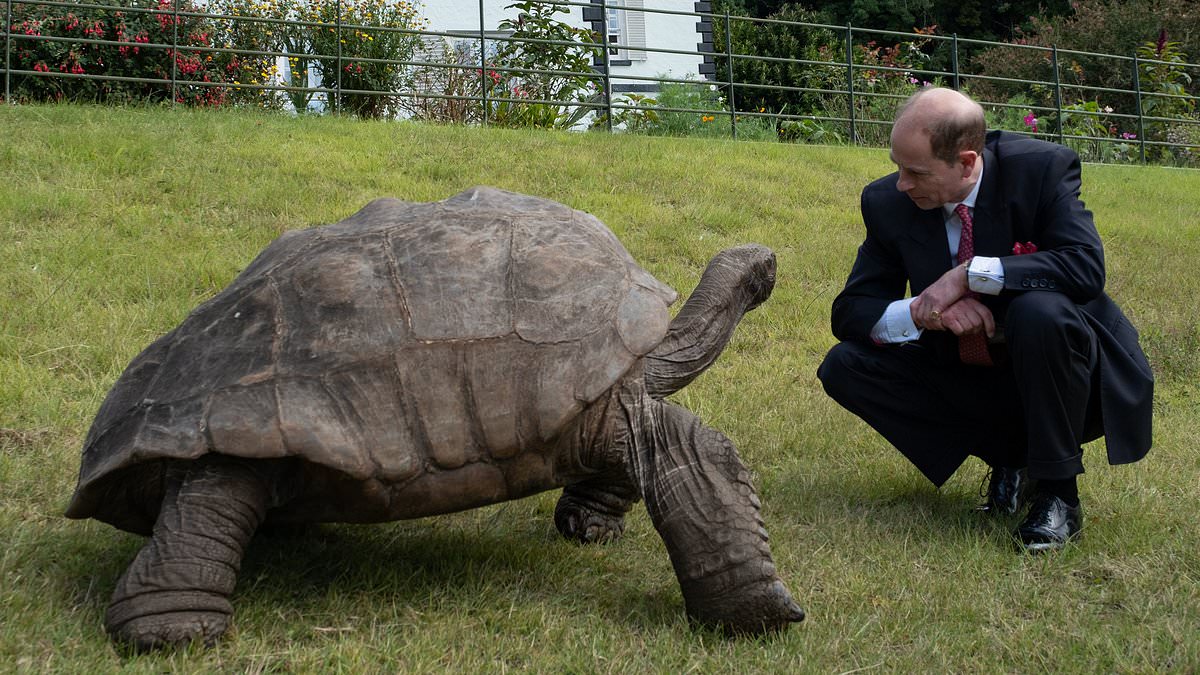
A giant tortoise approaching his 195th birthday may hold the secret to a longer life after scientists discovered parts of his body appear far younger than his remarkable age.Jonathan, the world's oldest known living land animal, was born before Queen Victoria came to the throne and has long spent his days on the remote South Atlantic island of St Helena.Now researchers have discovered signs that some of the biological machinery inside his cells appears remarkably youthful, despite his estimated age of 194.The findings could help scientists investigate how some animals resist the effects of ageing, although further research is needed to establish what they might mean for humans.And the beloved tortoise is still going strong after scammers falsely announced his death earlier this year in an apparent bid to solicit cryptocurrency donations. Scientists sequenced Jonathan's genome, his complete set of genetic instructions, using DNA collected from a cheek swab by his vet, Dr Joe Hollins. The results, published in the journal Science Advances, revealed genetic variants associated with repairing damaged DNA, regulating metabolism and protecting against cancer.But one of the most intriguing discoveries concerned his mitochondria, the tiny structures that supply cells with energy. Jonathan, the world's oldest known living land animal, was born before Queen Victoria came to the throne and has long spent his days on the remote South Atlantic island of St Helena Vet Joe Hollins, pictured left with Jonathan Prince Edward met the 194-year-old in 2024Declining mitochondrial function has been linked to ageing and age-related diseases.Researchers examined chemical tags on Jonathan's DNA that help regulate how his genes behave, comparing them with those of other giant tortoises.While many of these patterns resembled those found in older animals, the patterns associated with mitochondrial function looked more like those of much younger tortoises.Stephen Clark, a researcher on the project at the non-profit Kallel Foundation, told the Guardian: 'His mitochondria must be especially stable and that's an insight into longevity in general. It's important that the mitochondria are kept as pristine as possible.' Scientists have yet to establish whether these patterns help explain Jonathan's extraordinary lifespan, or how large a role they might play. The team also identified differences involving DNA repair and the maintenance of telomeres, the protective caps on chromosomes.DNA damage accumulates as organisms age, while telomeres become shorter, a process thought to contribute to ageing.Jonathan also shares some genes with other long-lived species, including naked mole rats, which can live to 40 and rarely develop cancer.Steve Horvath, a biologist who studies ageing at the University of California, Los Angeles, and an author of the study, told the New York Times: 'We almost never get to study an animal this old while it is still alive.'Obtaining Jonathan's DNA proved a delicate operation.Dr Hollins had to hold his head with a thick welding glove and carefully prop open his sharp beak to swab the inside of his cheek.An initial attempt produced a sample covered in half-chewed carrot, one of the tortoise's favourite snacks.Researchers were not allowed to take blood because of the risk of infection, and the saliva sample had to leave the island by boat.Jonathan lives in the grounds of Plantation House, the official residence of St Helena's governor, around 1,200 miles off Africa's west coast.His exact birth date is unknown, but he was already fully grown when he arrived on the island in 1882, suggesting he was at least 50. The tortoise welcomed the future Queen Elizabeth II, as well as George VI and the Queen Mother, to the British overseas territory of St Helena in 1947, pictured He was brought to St Helena from the Seychelles in the 1880s and lived on the grounds of Plantation House, the official residence of the island's GovernorJoin the discussionShould scientists try to unlock animal secrets to extend human lifespans, or let nature take its course?What's your view?That puts his estimated birth year at 1832, before Queen Victoria took the throne and before Charles Darwin visited the Galapagos Islands. In April, a fake account on X posing as Dr Hollins claimed Jonathan had died.The post spread widely, but the real vet exposed the deception and said the account was asking for cryptocurrency donations.St Helena's governor, Nigel Phillips, also checked on Jonathan after being contacted by the Guardian and found him asleep beneath a tree.Despite cataracts and the loss of his sense of smell, Jonathan continues to enjoy life, retaining excellent hearing and a strong libido.When Dr Hollins took over his care in 2009, the tortoise was struggling to forage and had a soft, crumbling beak.Regular hand-feeding helped him regain weight and develop a hard beak within six months to a year.Scientists caution that his protected surroundings, fresh vegetables and veterinary care could also help explain his exceptional age.But his biology offers promising avenues for further investigation.Steve Austad, a biologist at the University of Alabama at Birmingham, told the New York Times: 'Each of these long-lived species has some kind of special trick. And some of those may turn out to be relevant to human aging.'
How Jonathan the giant tortoise can offer clues on helping humans live longer... as he's set to celebrate his 195th birthday
Full Article
Original Source
Read the full article at Dailymail →KhanList aggregates and links to publicly available news content. We do not host full articles from third-party sources. Always verify important information with original sources.