
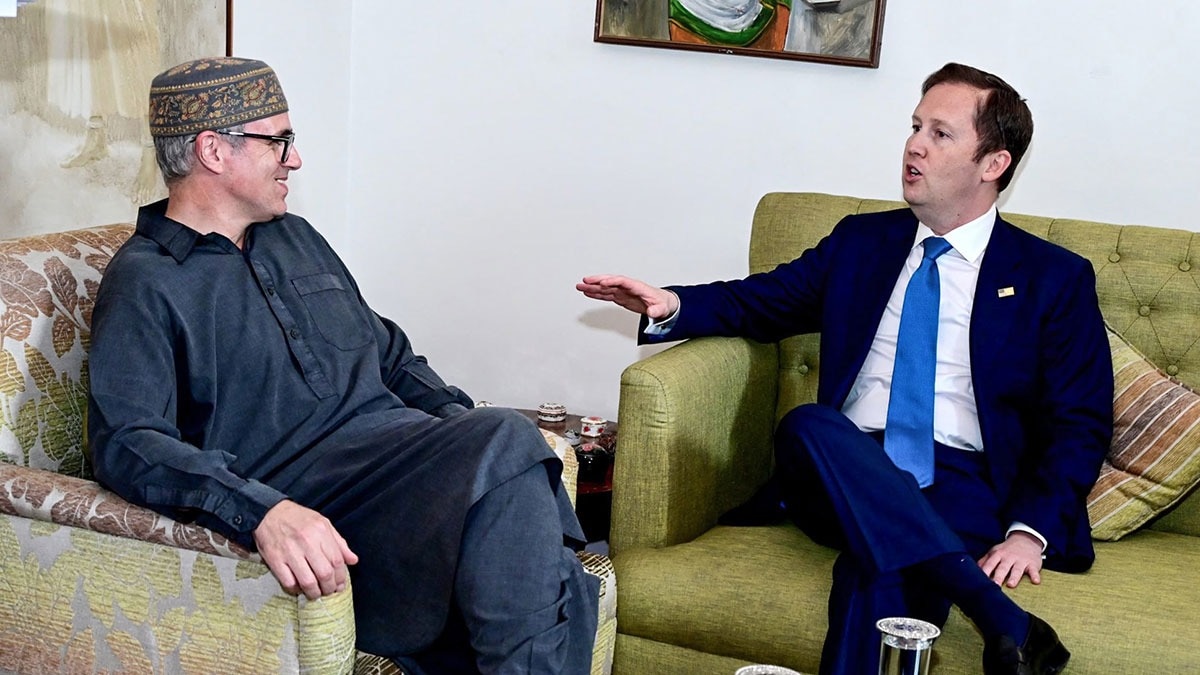
Why Congress blamed the Centre, CM Omar Abdullah stayed neutral while the PDP termed such tours as "curated"It was US ambassador to India Sergio Gor’s first visit to Kashmir since he assumed charge as well as the first standalone trip by a serving high-profile American diplomat to Jammu and Kashmir since the abrogation of Article 370 of the Constitution and withdrawal of the region’s special status in 2019.Soon after arriving in Srinagar on August 19, Gor stirred a diplomatic firestorm. After his meeting with J&K chief minister Omar Abdullah, he publicly described Kashmir as “an important part of India” and praised security improvements in the region. The remarks, made alongside Abdullah, were widely read as US endorsement of India’s position on Kashmir.The statement carried added weight because Gor also serves as US president Donald Trump’s special envoy for South and Central Asia. A rattled Pakistan reacted by issuing a demarche and summoning US charge d’affaires Natalie Baker in Islamabad. Pakistan also termed Gor’s comments as “factually incorrect” and “irresponsible”.Experts say the United States has traditionally maintained that issues between India and Pakistan should be handled bilaterally. New Delhi too has consistently rejected third-party mediation on Kashmir. It is rare for US diplomats in the region to publicly take such a clear position. Both India and Pakistan have long viewed the vocabulary used by Western powers, particularly the United States, on Kashmir as external validation of their respective claims. J&K Pradesh Congress Committee president and MLA Tariq Hameed Karra read Gor’s statement as a sort of diplomatic failure of the Union government. “I don’t know why he (Gor) should have said this. J&K has been an integral part of India and will continue to be so. The importance he is trying to give to J&K is a failure of the present dispensation [at the Centre]. After the 1971 Simla Agreement, none of the countries intervened, and it is only during the BJP regime that we are seeing third-party interventions,” Karra said.“We don’t need to be told [about J&K’s importance], as if it is for the first time,” he said, claiming that many decisions were being forced upon the people of the region as part of a “colonial style of functioning”.Abdullah declined to engage with Karra’s criticism. “The Congress has a point of view. They are the largest Opposition party. They are entitled to it. I am not going to get into a war of words over this,” he said.As part of sightseeing and cultural stops, the US ambassador took a shikara ride on Dal Lake and visited Pari Mahal, the Mughal era monument overlooking it. He interacted with Kashmiri artisans and handicraft workers at a crafts showroom in Nishat.Beyond the high-profile and publicised meeting with Abdullah, Gor kept his formal engagements limited and did not meet Opposition leaders. This drew strong criticism from the Peoples Democratic Party (PDP). It also marked a clear departure from earlier visits by Western diplomats, who typically meet a cross-section of political and civil society voices, including Opposition figures and, in the past, separatist leaders (most of whom are now deceased or in jail).“Before 2019, whichever diplomats used to come here, they used to meet people from every school of thought. They would meet people from different sections of society—tourism, trade, travel. Then they would carry back their own opinion,” PDP president Mehbooba Mufti said.She claimed that post-2019 visits by foreign dignitaries had become “curated”. “They come, meet nobody else except the chief minister and lieutenant governor, have a shikara ride and leave,” she said.Mehbooba said she agreed with Abdullah that the resolution of J&K’s issues lay with New Delhi, not Washington. However, she expressed disappointment that the chief minister had apparently not conveyed local concerns about US and Israeli actions against Iran and other Muslim countries, which she said affected the situation in J&K.Abdullah had earlier made clear that he would not discuss internal matters of J&K with Gor, insisting that it was for India, not America, to resolve the region’s issues. He has intensified his demand for restoration of statehood to J&K, which was bifurcated into the Union Territories of Jammu and Kashmir and Ladakh in 2019.After concluding his Srinagar visit, Gor flew to Leh for a two-day tour. A meeting with lieutenant governor of Ladakh Vinai K. Saxena did not take place as the latter was out of the region. This was the first visit by a high-level US diplomat to Ladakh since it became a Union territory, and against the backdrop of the prolonged military standoff between India with China following the 2020 Galwan military clashes.A much-speculated meeting between Gor and the Tibetan spiritual leader, the Dalai Lama, who is camping in Leh, did not happen either. The ambassador visited Thiksey Monastery, one of the biggest Buddhist monasteries in the region, near Leh. Otherwise, Gor’s engagements and cultural visits in Leh were conducted away from the cameras.Subscribe to India Today Magazine- EndsPublished By: Shyam BalasubramanianPublished On: Aug 24, 2026 18:49 IST
How J&K parties are reading US envoy Sergio Gor's Kashmir visit
Full Article
Original Source
Read the full article at Indiatoday →KhanList aggregates and links to publicly available news content. We do not host full articles from third-party sources. Always verify important information with original sources.