
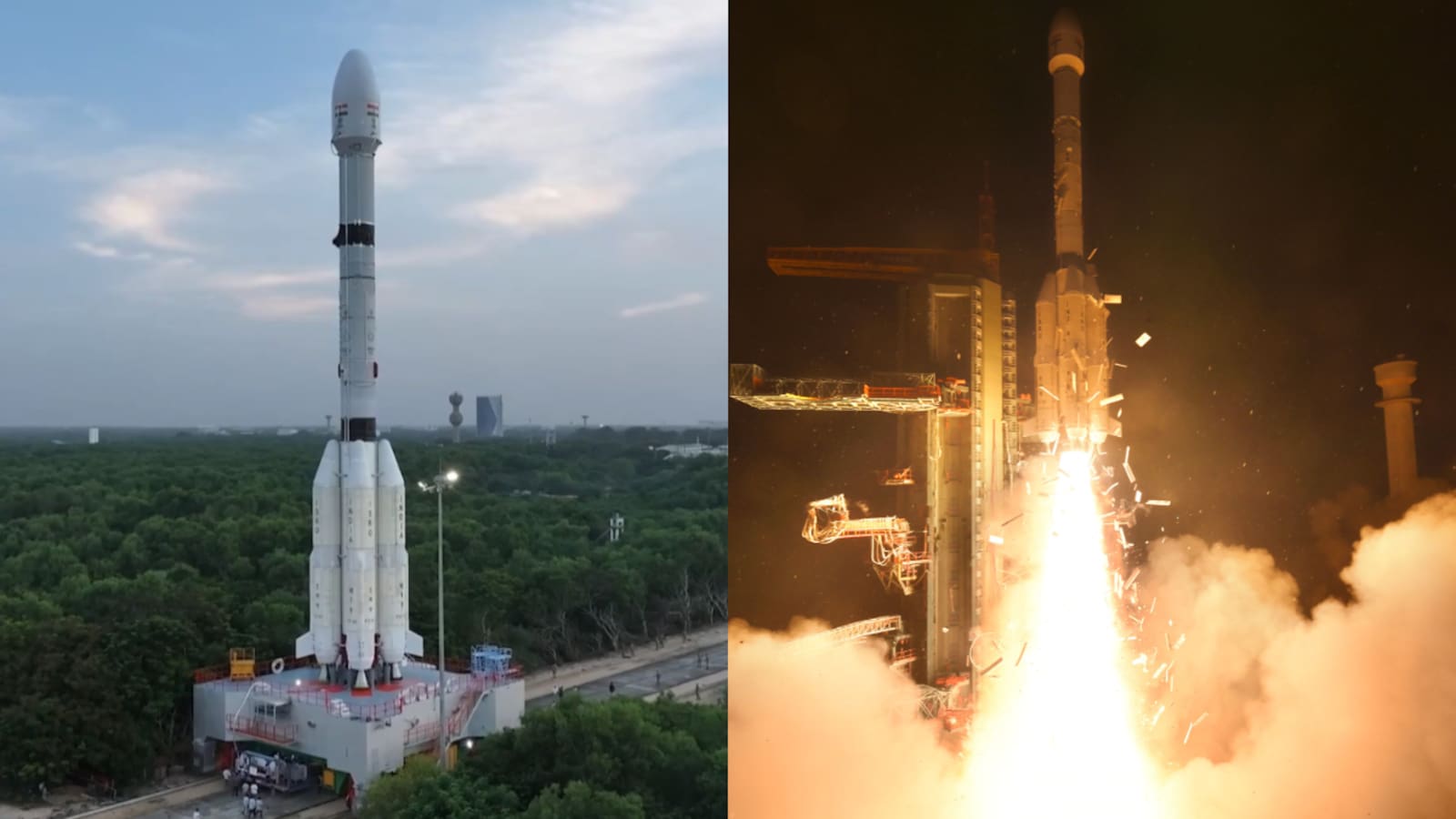
At the stroke of 2:55 AM in the morning on September 4, when most of India was fast asleep, a different story was unfolding on the island of Sriharikota in Andhra Pradesh. Inside mission control rooms, launch complexes and tracking stations spread across the country, nearly 16,500 Indian Space Research Organisation scientists, engineers and support personnel were battling fatigue, pressure and expectations. Just 19 minutes later at 3.14 AM, they had every reason to celebrate.There were smiles and handshakes all around.Science minister Dr Jitendra Singh hailed it as 'Another giant leap for India in Space! Kudos to Team ISRO on the successful launch of GSLV-F17/EOS-05. EOS-05 is a state-of-the-art Earth Observation satellite and India's first imaging satellite from Geosynchronous Orbit, enabling advanced imaging across visible, infrared, multi-spectral and hyperspectral bands.'Another giant leap for India in Space!Kudos to Team @isro on the successful launch of GSLV-F17/EOS-05.EOS-05 is a state-of-the-art Earth Observation satellite and India's first imaging satellite from Geosynchronous Orbit, enabling advanced imaging across visible, infrared,… pic.twitter.com/1HHJrWM7ze— Dr Jitendra Singh (@DrJitendraSingh) September 3, 2026India's space agency returned to the launch pad after a bruising phase marked by back to back failures of its trusted Polar Satellite Launch Vehicle (PSLV) rocket. This time there was relief, applause and renewed confidence as the Geosynchronous Satellite Launch Vehicle, GSLV-F17, successfully carried the EOS-05 Earth observation satellite toward its destination in space. The mission was far more than another launch. It was a statement that ISRO still possesses the resilience to recover, regroup and rebound from setbacks.The success assumes even greater significance because it came at a time when questions were being asked about India's launch capability. The Polar Satellite Launch Vehicle or PSLV, long considered ISRO's workhorse, suffered consecutive failures, in 2025 and January of 2026. Those setbacks forced ISRO into a painstaking investigation process.— ISRO (@isro) September 3, 2026The PSLV fleet remains grounded while engineers continue tests and corrective actions before clearing it for flight. It should also answer that no sabotage was involved in earlier failures, rockets are temperamental and that is why it is still called 'rocket science' and one reason why only a handful of nations attempt rocket launches regularly. This was the 107th launch of a large rocket from Sriharikota.In such circumstances, the burden shifted to the GSLV Mk II, affectionately and sometimes nervously called ISRO's "naughty boy."The nickname was earned honestly. In 19 launches, the rocket has experienced six failures. Its journey has been turbulent and often dramatic. Yet paradoxically, this same rocket has become one of the most important symbols of India's technological independence.The story goes back to the early 1990s when India desperately needed cryogenic engine technology to launch heavier communication satellites. Cryogenic engines, which use super cooled liquid hydrogen and liquid oxygen, are among the most advanced propulsion systems in rocketry.India initially sought assistance from Russia. However, geopolitical pressure and technology denial regimes led by the United States complicated the transfer. Russia eventually supplied a limited number of cryogenic engines but not the full technology that India wanted. The message was clear. India could buy rockets but should not learn how to build them.The setback could have crippled India's long term ambitions. Instead, it triggered one of the most remarkable indigenous development efforts in the history of the Indian space programme. ISRO scientists spent 20 years mastering an extraordinarily difficult technology. Numerous failures, delays and disappointments followed, but India persisted.That perseverance transformed the GSLV Mk II into a jewel in ISRO's crown. Every successful flight today stands as a reminder that technology denial failed to stop India's march into space.Friday's success therefore carried emotional significance. It was not merely another GSLV mission. It was a celebration of self-reliance and scientific persistence.The memories of failure were still fresh. In August 2021, ISRO attempted to launch GISAT-1 aboard GSLV-F10. The satellite was intended to provide continuous monitoring from a high orbit. But disaster struck when the indigenous cryogenic upper stage failed to ignite properly. The mission was lost and India's dream of an eye in the sky had to wait.EOS-05 is essentially the fulfilment of that unfinished dream.This time, the rocket performed as planned. The satellite began its journey toward geosynchronous orbit, nearly 36,000 kilometres above Earth. From that remarkable vantage point, EOS-05 is expected to provide something India has long lacked: continuous surveillance of a fixed region.Conventional Earth observation satellites orbit much closer to Earth and repeatedly pass over an area. They provide snapshots. EOS-05 promises a continuous movie.From its perch high above the planet, EOS-05 will continuously watch the Indian subcontinent, surrounding oceans and strategically sensitive regions. It is expected to monitor cyclones brewing in the Bay of Bengal, floods unfolding in real time, forest fires, agriculture, environmental changes and infrastructure development.For security agencies, the satellite offers another valuable asset, DK Singh, the new Director of the UR Rao Satellite Center in Bengaluru where the satellite was made, calls EOS -5 as 'another eye in the sky'.The importance of the mission was evident at Sriharikota. Senior representatives from the Indian Navy and Indian Air Force were present to witness the launch. The satellite's strategic value extends well beyond civilian applications. Continuous observation capability can strengthen maritime awareness, improve disaster response and contribute to national security.The launch also highlighted the continuing relevance of the heritage GSLV Mk II in an era increasingly dominated by newer launch vehicles.Only last year, the same family of rockets successfully launched NISAR, the NASA-ISRO Synthetic Aperture Radar satellite. Widely regarded as the world's most expensive civilian Earth imaging satellite, NISAR demonstrated the reliability and capability of the GSLV platform for high value missions.Now EOS-05 has added another important milestone, the 2376 KG heavy satellite is healthy and it got a better than expected orbit and will be shifted to its final geostationary orbit in the coming days.ISRO Chairman Dr V Narayanan captured the agency's philosophy with a simple observation: "The reward for hard work is more work." Who called it a 'great achievement thanks to the open work culture at ISRO'.His words reflect the reality facing the organisation.This success provides confidence, but there is little time for celebration. ISRO still has an ambitious schedule ahead. Six more launches are planned during the current financial year. Most importantly, India remains focused on its biggest human spaceflight challenge.The first un-crewed Gaganyaan mission is targeted before the end of the year. It will be a critical step toward sending Indian astronauts into orbit aboard an Indian spacecraft launched from Indian soil.The successful GSLV-F17 mission therefore serves multiple purposes. It restores confidence after recent failures. It validates a launch vehicle that has travelled a difficult and controversial path. It revives a satellite mission that collapsed in 2021. And it equips India with a long awaited capability to keep a constant watch on its territory and surrounding regions.For a programme built on determination and resilience, the symbolism could hardly be stronger.At dawn on September 4, while much of the nation was only beginning to wake up, ISRO had already completed one of its most important assignments of the year.The naughty boy had grown up.And on this rainy morning, he behaved like a smart boy indeed.
How ISRO's 'Naughty Boy' Rocket Delivered A Big Win For India
Full Article
Original Source
Read the full article at Ndtv →KhanList aggregates and links to publicly available news content. We do not host full articles from third-party sources. Always verify important information with original sources.