
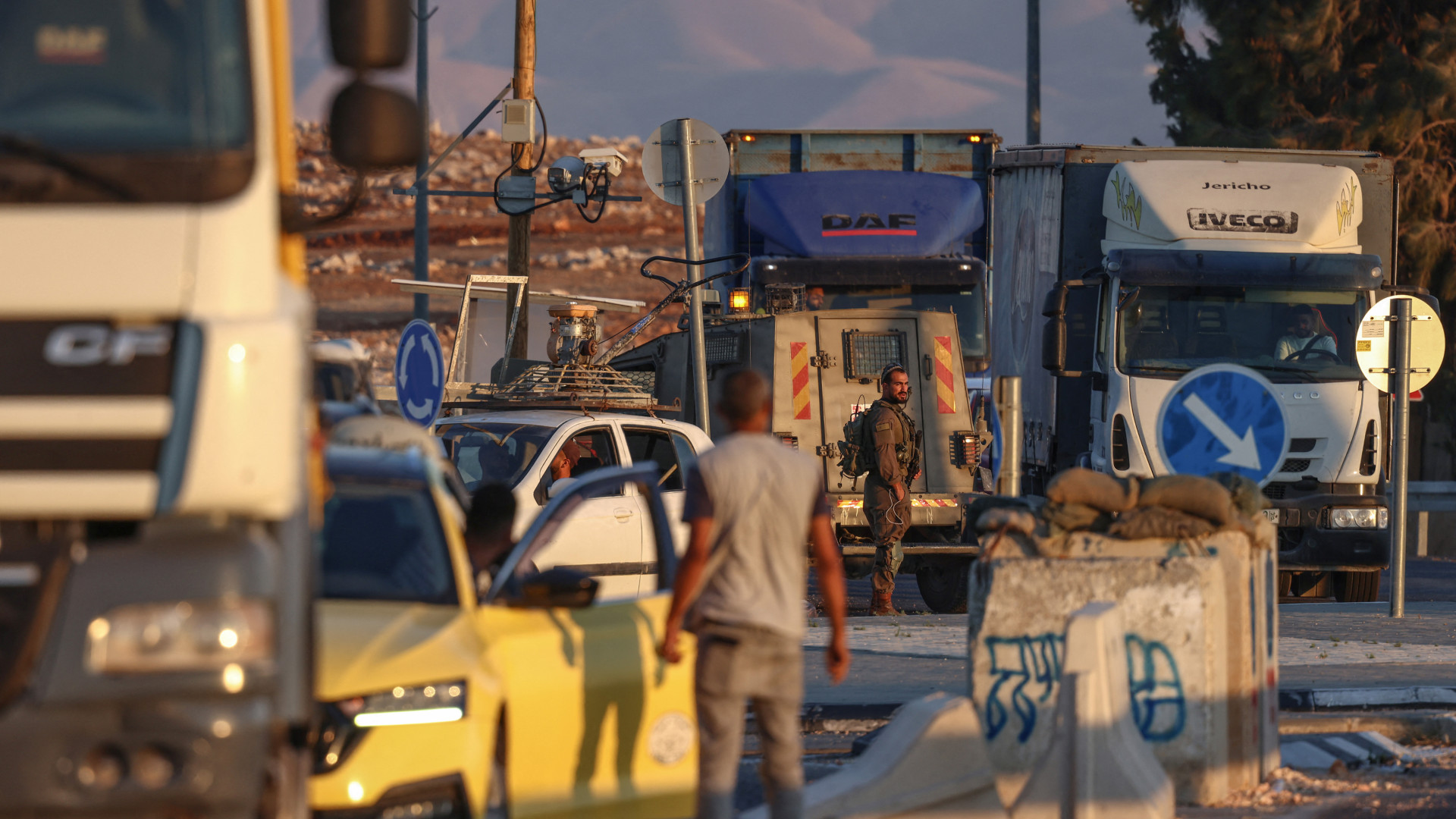
Every afternoon at exactly 4pm, a calculated military decision transforms the exits of Ramallah and al-Bireh into an open-air gridlock of vehicles piled nose to tail, idling engines and mounting frustration. What Israeli authorities continue to market to the world as temporary "security measures" - the iron gates, concrete barriers, earth mounds and armed checkpoints choking the occupied West Bank - has long since metastasised into a deliberate, institutionalised apparatus of spatial segregation and racial discrimination. This architecture of control does not exist to neutralise genuine threats. It operates to clear shared arterial roads for Israeli settlers at the exact hour Palestinian civilian movement reaches its daily peak. By subordinating the basic right of an indigenous population to travel through its own land, the system grants permanent priority to one group while punishing another for the simple act of trying to commute home after a day's work. According to comprehensive field documentation compiled by the United Nations' humanitarian office, Ocha, and the human rights organisation B'Tselem, the landscape of the occupied West Bank is carved up by more than 900 fixed and intermittent movement obstacles. New MEE newsletter: Jerusalem Dispatch Sign up to get the latest insights and analysis on Israel-Palestine, alongside Turkey Unpacked and other MEE newsletters They comprise permanently manned military checkpoints, partial ones, remote-controlled iron gates, earth mounds, roadblocks and trenches, which restrict and dictate the daily lives of 3.4 million Palestinians. Ocha counts 232 iron gates alone, at least 120 installed in 2025, and the Palestinian commission that monitors the wall and settlements now puts the total at 942. Within the immediate vicinity of Ramallah and al-Bireh alone, some 160 of these closure points exist, a count exceeded only in Hebron, acting as constant choke points along the transit corridors that connect the governorate to the north, east and south of the West Bank. To the south, Palestinian vehicular movement is funnelled through Qalandia, Jaba and the northern Jerusalem access routes, where dense local traffic intersects with bypass highways engineered to connect Israeli settlements to population centres inside the separation wall. What was originally justified under the flimsy pretext of defence has evolved into a calculated instrument of systemic discrimination and population management To the north, the critical arteries pass through the Ein Siniya and Atara checkpoints, the Yabrud junction and the Beit El checkpoint, known locally as the DCO after the Israeli military's District Coordination Office beside it. The Israeli separation wall, 85 percent of which runs inside the West Bank, and its interlocking network of checkpoints have long ceased to function as anything like a border. Operating deep inside occupied territory, they actively reshape geography to annex settlement blocs, isolate Palestinian communities in fragmented enclaves and re-engineer public space. By dictating who may travel, when, and along which permitted bypasses, the system establishes a permanent hierarchy of spatial privilege. What was originally justified under the flimsy pretext of defence has evolved into a calculated instrument of systemic discrimination and population management. Punishing the victims The mechanics of this structural discrimination are felt with devastating consistency each afternoon on every side of the Beit El (DCO) checkpoint. Before October 2023, this strategic crossing operated on a 24-hour basis, a fact documented by field monitors. The army closed it outright after 7 October 2023 and reopened it to Palestinian traffic in June 2024, as Israeli settlers stoned cars at the gate and demanded that it remain closed to us. The head of the Beit El settlement council called the reopening "folly". Crossings that were once open around the clock now close during the morning and evening rush hours. At the DCO, under arbitrary military mandates, the checkpoint is abruptly closed to Palestinian vehicular traffic in both directions at 4pm sharp, remaining shut until 9pm to clear the roadway for settlers. This timing is neither random nor dictated by the physical capacity of the road. It coincides precisely with the period when thousands of workers, students and residents attempt to exit Ramallah and al-Bireh to return to their surrounding towns and villages. Simultaneously, this window sees increased traffic from Israeli settlers travelling along the same regional arteries. As olive harvest nears, Palestinian farmers urgently need international protection Read More » Rather than addressing the primary source of tension on these corridors, where armed Israeli settlers have frequently intercepted, stoned and attacked Palestinian vehicles under cover of night, the occupation authorities consistently resort to collective punishment. By shutting down the checkpoint to Palestinian drivers at 4pm, the military clears the thoroughfare, allowing settlers to travel with total freedom and speed, unencumbered by the presence of Palestinian commuters who might otherwise share the road and create perceived congestion. The security narrative collapses under field analysis. When a vital transit artery is arbitrarily closed, the vehicular flow does not dissipate; it is forcibly redirected onto narrow secondary roads. This creates cascading bottlenecks across adjacent checkpoints, compounding the regional crisis and leaving an entire population's daily existence tethered to unpredictable military decrees. The same decrees now operate on a larger scale. For a week from 25 September, over the Jewish holiday of Sukkot, Israel sealed the West Bank; the Atara and Ein Siniya checkpoints and the gates of Nabi Saleh and Taybeh were closed; and at Jaba, commuters spent the night in their cars. On 27 October, every entrance to Ramallah was shut, and new checkpoints were set up on the alternative roads residents use to get around them. The micro-physics of humiliation The systematic suppression of Palestinian movement is executed not only through outright road closures, but through the deliberate, micro-calculated elongation of transit times at active checkpoints. Passing through a military checkpoint is rarely a straightforward verification process; it has been crafted into a tedious, multi-stage ritual designed to exhaust, delay and demoralise. A driver approaches the stop line, comes to a complete halt and is instructed to switch off the engine. They must exit the vehicle in all weather conditions, walk towards an armed soldier positioned behind armoured glass or concrete blocks, and present their identification card and vehicle registration. Once these are handed back, the driver is instructed to return to the vehicle, only to be ordered onto a secondary inspection zone. There, their details may undergo computer verification, photographic logging or extended background checks. Only after this repetitive sequence is completed can they restart the vehicle and drive off. Even under ideal conditions, a single inspection lane bogged down by these contrived bureaucratic hurdles can process no more than 12 to 15 vehicles an hour. When thousands of cars are forced into single-file inspection channels, administrative friction multiplies into mile-long queues and hours of wasted time. Beyond the immense economic toll of lost labour hours and fuel, these checkpoints frequently become sites of casual cruelty and entertainment for bored, emboldened soldiers. The systematic normalisation of petty humiliation converts basic daily travel into an exercise in psychological attrition, designed to reinforce a status of total subjugation. This macro-structure of fragmentation and control is not merely an analytical concept; it is a deeply personal, lived reality. During my regular trips between Ramallah, where I live, and my birthplace, the village of Qira in Salfit governorate, the physical and emotional weight of these checkpoints becomes strikingly personal. What should be a straightforward 40-minute drive through my home landscape has become an unpredictable gauntlet of military barriers, iron gates and sudden shutdowns. Each journey requires navigating a landscape of constant uncertainty, where minor procedural delays or arbitrary gate closures can turn a routine commute into an hours-long ordeal. This manufactured hardship is shared by hundreds of thousands of Palestinians across the West Bank, serving as a constant daily reminder of an institutional directive aimed at making everyday life as exhausting and precarious as possible. 'De facto sovereignty' In February 2023, weeks after Israeli Prime Minister Benjamin Netanyahu returned to office at the head of a far-right coalition, his government handed Bezalel Smotrich, the finance minister and himself a settler, civilian authority over the occupied West Bank, including settlement planning and the Civil Administration that rules Palestinian life. The gates multiplied. Since October 2023, B'Tselem has counted more than 200 new checkpoints, and the Association for Civil Rights in Israel has told the High Court that some of the roadblocks were first erected by settlers, with the army taking them over afterwards. Meanwhile, the roads are being rebuilt for the settlers. In July 2025, Smotrich announced 918 million shekels ($275m) for West Bank roads, including bypasses so that Israeli motorists can avoid Palestinian towns. "This is how you do de facto sovereignty," he said. In May 2026, the government added $270m for roads linking 20 settlements and outposts. The settlers who use those roads have never been more violent. The 397 settler attacks Ocha logged in October were the most it has recorded in any month since it began counting in 2006. In defence of Israel's Jewish settlers in the West Bank Read More » Human Rights Watch counts 107 Palestinian communities fully or partly displaced since January 2023. B'Tselem, in its September report on the West Bank, calls a closed gate "an instrument" of dispossession and elimination. International legal frameworks and human rights documentation unequivocally classify these measures not as legitimate defensive precautions but as severe violations of the fundamental right to freedom of movement. The International Court of Justice found the wall contrary to international law in 2004 and Israel's continued presence in the occupied Palestinian territory unlawful in 2024. What is marketed under the sanitised label of "security policy" is nothing less than an institutionalised system of apartheid, as Amnesty International and B'Tselem have both documented. It is the direct expression of an Israeli Zionist racist mentality that views Palestinians not as human beings with equal rights to their own land, but as an inconvenience to be cleared away. While this apparatus of control generates immense daily suffering and fuels a justified, burning anger, it ultimately fails in its primary ambition. The occupation may choke our roads, steal our hours and turn simple commutes into gruelling daily battles, but it will never erase our presence or break our resolve. We will suffer, we will rage, but we will not leave. Every Palestinian who waits through the bottlenecks returns home to their village and remains rooted on their ancestral land, turning the simple act of staying into an unyielding refutation of quiet displacement. The views expressed in this article belong to the author and do not necessarily reflect the editorial policy of Middle East Eye.
How Israel has engineered a system of apartheid on West Bank roads
Full Article
Original Source
Read the full article at Middleeasteye →KhanList aggregates and links to publicly available news content. We do not host full articles from third-party sources. Always verify important information with original sources.