
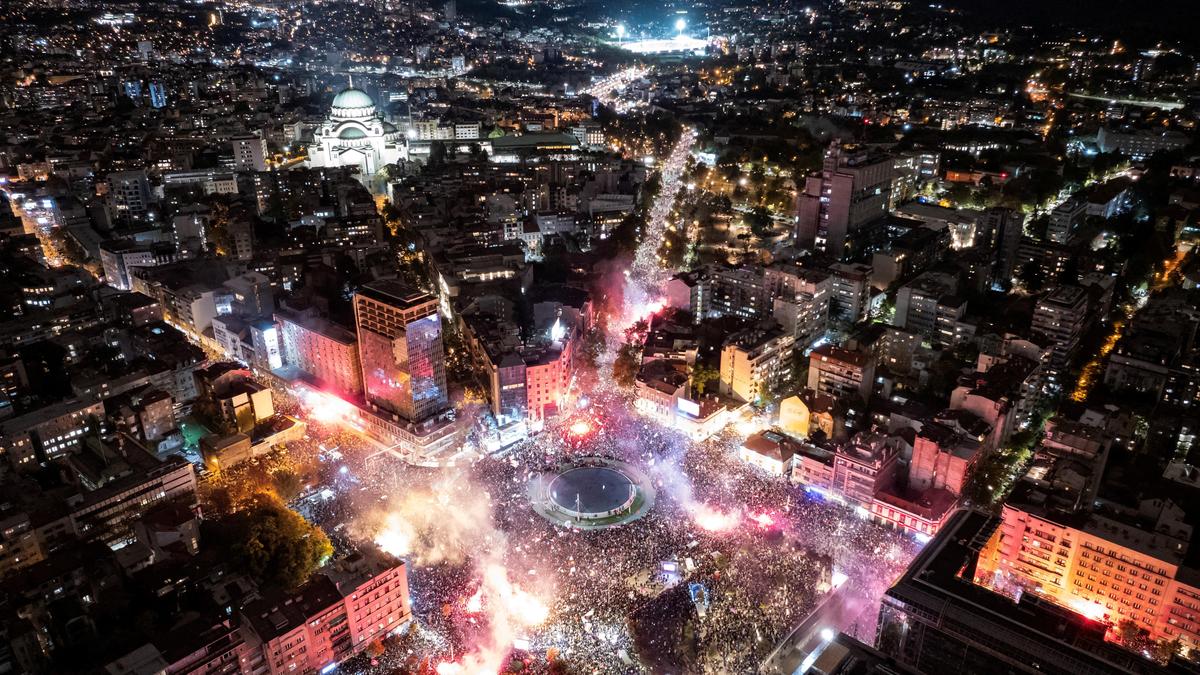
Supporters of the electoral list "Student List - Students Win" attend a final campaign rally at Slavija Square in Belgrade, Serbia on October 22, 2026. | Photo Credit: Reuters The story so far: As Serbians go to polls on Sunday (October 26, 2026) in an election to the 250-member parliament, speculation and forecasts have converged on two entities. On one side is Aleksandar Vucic, a radical nationalist who has held power for more than 12 years moving from Prime Minister to President and heads the prominent Serbian Progressive Party (Srpska Napredna Stranka or SNS). On the other side stands a leaderless group of students, academics, and other professionals seeking to take down what it alleges to be a corrupt regime which opposition members and international groups have flagged for taking an authoritarian turn. While Mr. Vucic has dismissed the group as a tool of ‘foreign powers’ and appealed for Serbian unity ahead of the polls, the ‘Students Win’ movement draws encouragement from the mass dissatisfaction towards the government and the recent fall of Mr. Vucic’s ally Victor Orban in neighbouring Hungary and is driven by the momentum built with nearly 2 years of protests and campaigns. What led to the ‘Students Win’ movement? While Mr. Vucic’s term, as Prime Minister from 2014 to 2017 followed by two terms as President, saw allegations of authoritarianism with widespread censorship and crackdowns on dissent, the immediate cause behind the students’ movement was the collapse of a concrete canopy of a railway station in the city of Novi Sad in November 2024 killing 16 people. Improper modifications and unsound construction were blamed for the incident along with allegations of severe corruption prompting protests around the country.An escalation occurred weeks later when students and professors of the Faculty of Dramatic Arts in capital Belgrade were attacked during a demonstration allegedly by an SNS mob. Students and academics across the country came in solidarity with their peers after the physical assault on peaceful protesters and launched mass blockaded over the absence of proper police action against the attackers. Over the following months, the movement grew with protests, marches, and blockades as sporadic violence and police action on the protesters earned more supporters for the cause with over 3 lakh citizens taking to the streets in Belgrade in March 2025.The movement put forward a set of six demands, including the publication of documents regarding the construction of Novi Sad station and action against assaulters of the Belgrade academics. The movement says authorities had made multiple promises to fulfil the demands but failed to follow through.How did the protest turn into an electoral showdown? The lack of accountability from the elected representatives and executives led to the group entering electoral politics. While the movement had called for snap parliamentary protests during the protests in 2025, it was Mr. Vucic’s desire to hold on to power that ultimately led to the coming election. With just months to go in his second term as President, the head of the Serbian state, and the possibility for a third term denied by the constitution, Mr. Vucic called snap elections to the parliament in hopes of switching back to being the Prime Minister and heading the government in an equally powerful role. The Students Win, however, is not contesting the election as a typical political party. The movement has always opted to keep distance from the traditional parties and claims to be a decentralised, leaderless system with democratic principles depending on plenums, consultations, debates, and votes for decision making. Election to the Serbian parliament is held in a single national constituency with a proportional representation system where contesting parties get seats allocated based on their vote share after laying out a list of 250 candidates. Students Win has come up with the ‘Students List’ with 250 names for parliament drawn up from the plena with many lesser-known names and no clear Prime Ministerial candidate. The movement’s website lays open for any and all volunteers to take up any role they feel fit in the run up to the elections, with tasks including door-to-door canvassing, operating call centres, observing polling station, transporting campaign materials, and delivering food and water. It has also put forward an 11-point reform programme for the country which includes eradicating corruption and freeing the media among plans for the economy and healthcare.What are the forecasts for the election? The only poll published ahead of the election, by New Serbian Political Thought, gave the Students List a minor advantage with 44.5% votes in favour against 42.7% for Mr. Vucic’s SNS. However, analysts have expressed concerns over a leaderless party forming a government. Sympathisers of Mr. Vucic, meanwhile, have come down hard on the students’ movement, opting to delegitimise the support the group claims to have garnered with its intensive and personalised campaign by calling it baseless and questioning the political and administrative experience of the new entrant. Mr. Vucic has gone all guns blaring against the movement, terming it an attempt by nameless external actors to destabilise the country in a ‘foreign-funded coup’, doubling down on the claims towards the end of the election campaign. “They tried to destroy our country on an external order”, he said at the final pre-election meeting in Belgrade on Thursday even while making a call for reconciliation to his political opponents. Opposition parties, however, have acknowledged the momentum generated by the movement, as some parties chose to stay away from the election while others put out a smaller list for polls. With youth movements making a wave around the world, including in India, the outcome of the Serbian election will be keenly observed by optimistic youngsters and ruling powers alike. A victory for the Students List will open possibilities for movements that do not require a popular face that could end up becoming a personality cult. But the challenge for the group, if victorious, would be to keep its decentralised and democratic identity intact in a parliamentary system that requires fixed roles and the inevitable positions of power. Published - October 23, 2026 09:29 am IST
How is a leaderless group challenging the Serbian President? Explained
Full Article
Original Source
Read the full article at Thehindu →KhanList aggregates and links to publicly available news content. We do not host full articles from third-party sources. Always verify important information with original sources.