
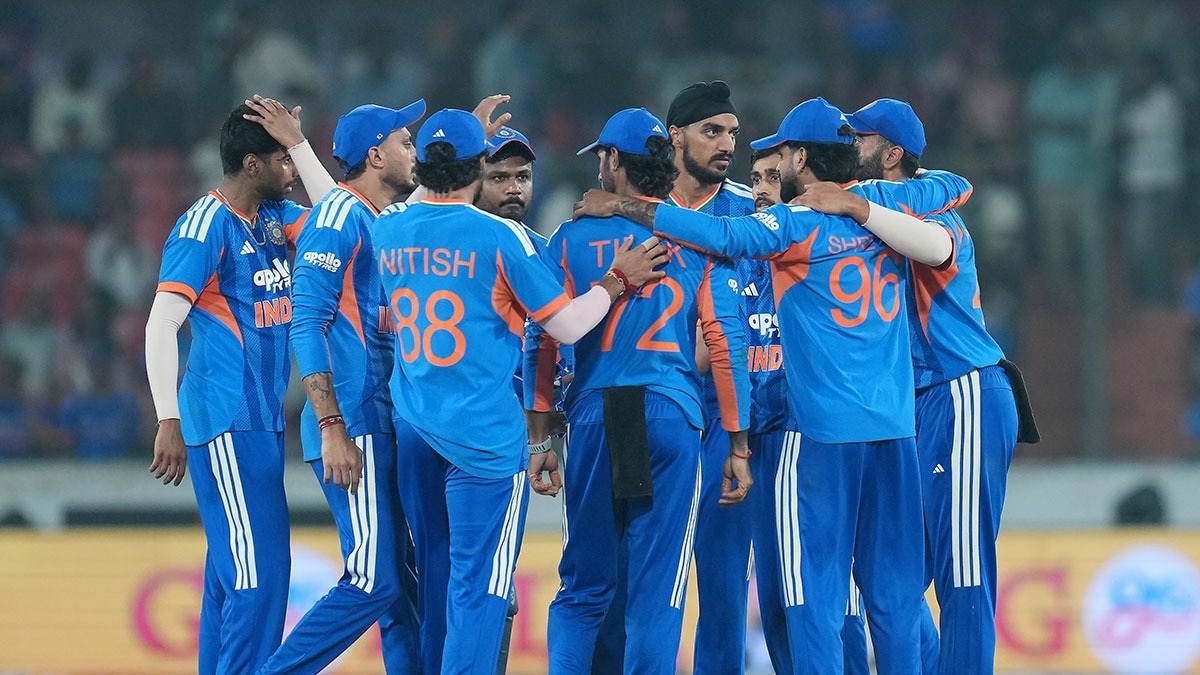
The final T20 International match was washed out by rain, but it left India with a worry that the weather could not wash away. The fifth T20I at Bengaluru ended without a result, leaving the five-match series against the West Indies tied 2-2. India had made 118 for five in 7.4 overs when the rain finally had the last word.Perhaps it was no less than relief. India’s bowlers were spared the trouble to answer the questions raised by the first four matches.The numbers are difficult to ignore. In the four matches that produced a result, West Indies scored 171, 252, 209 and 247. In three of them, they crossed 200, scoring more than 10 runs an over. Across those four innings, West Indies amassed 879 runs—12 more than India’s aggregate of 867. The series was level, but India’s batting had repeatedly been asked to compensate for a bowling attack that was struggling to control the game.That is the real concern: India’s batting is masking a worrying bowling problem. The first match in Lucknow, on October 6, was the exception. West Indies were bowled out for 171 in 19.1 overs, with India winning by eight wickets. Naman Dhir announced himself with three for 31, while Axar Patel took two for 26 and Kuldeep Yadav two for 33. Arshdeep Singh also took a wicket. India restricted West Indies to 44 for three in the powerplay and never allowed the innings to develop into the kind of assault that would become familiar later in the series.Then came Ranchi.On October 9, India posted a formidable 249 for five. It was the sort of total that should have allowed a bowling attack to dictate terms. Instead, West Indies chased it down in just 18.3 overs, finishing at 252 for four at a remarkable 13.62 runs an over. Shai Hope made 102 from 45 balls, Sherfane Rutherford 84 from 37, and the chase was completed with nine balls to spare.The bowling figures tell the story. Mayank Yadav took three wickets but conceded 36 from his three overs. Arshdeep gave away 45 in four. Kuldeep conceded 53 in four, while Axar was taken for 63 in just 3.3 overs. Shivam Dube went for 30 from two, and Naman conceded 25 from two. The problem was not one expensive spell. It was the collective inability to slow the scoring rate.Ranchi should have been treated as an aberration. Indore suggested otherwise.India again posted 223, but this time West Indies finished on 209 for seven. India won by 14 runs, and Arshdeep’s three wickets—including the early dismissal of Shai—were decisive. Yet West Indies still scored at 10.45 an over. Arshdeep took three for 44, Naman two for 39 and Axar one for 33.India won, but this was hardly complete control. The bowlers had defended 223 rather than strangled a chase. There is a difference.And then came Hyderabad.On October 14, West Indies batted first and made 247 for three in 20 overs. Shai produced an extraordinary unbeaten 102 from 50 balls, and West Indies scored at 12.35 an over. India, chasing 248, could manage only 223 in 19.3 overs and lost by 24 runs.The question was not how India’s batters failed to chase a difficult target. They had simply been beaten by an opposition that had scored too freely.The Indian bowling figures were revealing. Mayank was hit for 52 runs in four overs, as was Arshdeep, while Nitish Kumar Reddy conceded 39 in three and Axar 45 in four. Naman’s solitary over cost 19. Only Prince Yadav, with 36 from four overs, managed an economy rate below 10 among the principal bowlers.The pattern is now clear. India’s bowlers have not been uniformly poor. They have been inconsistent and, too often, unable to control the rate of scoring when conditions favour the batsmen.That distinction matters. T20 bowling is not simply about taking wickets. It is about controlling the shape of an innings. A bowler does not necessarily have to produce a wicket every over; sometimes the job is to concede six or seven rather than 12, force the batsman to take a risk, and create pressure for the bowler at the other end. India have repeatedly struggled to do that against the West Indies.The most striking evidence is the progression: 171 all out, 252 for four, 209 for seven, 247 for three. One good bowling performance was followed by three increasingly uncomfortable examinations.India’s batting has made the problem easier to overlook. India scored 172 for two in Lucknow, 249 for five in Ranchi, 223 in Indore and 223 in Hyderabad. Yet the bowling attack could not consistently turn those totals into control. Ranchi was the most dramatic example. Hyderabad was the most telling. India made 223, but it was West Indies who had already established the terms of the match by scoring 247 for three.This is where the absence of Jasprit Bumrah becomes impossible to ignore. The original squad comprised Arshdeep, Mayank, Prince, Kuldeep, Axar and other options, but not India’s premier fast bowler. The question is not whether Bumrah would have automatically prevented 247 or 252—that would be impossible to establish. It is whether his absence has exposed how heavily India’s bowling structure depends on having a world-class bowler capable of creating pressure irrespective of conditions.A great bowler does more than take wickets. He gives the captain an escape route. When a partnership begins to accelerate, there is someone to whom the captain can turn. When 60 are needed from six overs, there is someone capable of making the batters think twice. When a pitch is flat and the ball is disappearing, there is someone who can change the rhythm of the innings.India have not consistently found that player in this series. Mayank has the pace, but pace alone cannot guarantee control. Arshdeep has become India’s principal left-arm seamer and remains an important wicket-taking option, but he too has been expensive at times. Kuldeep can change games with wickets, as he did in Lucknow, but his 53-run spell in Ranchi showed the risks when the conditions and match-up go against him. Axar’s experience and control are valuable, but even he was taken apart in Ranchi.And then there is the question of experience. The selectors’ decision to bring back Bhuvneshwar Kumar for the fifth T20I after Arshdeep suffered a shoulder injury in Hyderabad was telling. Bhuvneshwar returned to the T20I set-up after almost four years. The move suggested that, when the attack needed an experienced seamer, India still had reason to look backwards. The fifth match was eventually washed out, so we never saw whether the move would have made a difference.This raises another question: why not Mohammed Shami? It should not be a simplistic demand to bring back Shami just because India’s bowlers have had a bad series. T20 cricket is a specialist discipline, and reputation cannot substitute for current fitness, rhythm or a clearly defined role. But if India are looking for an experienced fast bowler who can provide another dimension to the attack, Shami’s credentials at the highest level make the question legitimate.The larger issue, however, is not one man’s selection. It is whether India have a sufficiently robust bowling plan for high-scoring T20 cricket.The West Indies batters have shown that simply trying to take wickets is not always enough. There are moments when the attack has to defend space rather than attack the stumps; when a boundary is less damaging than losing a wicket to a misdirected delivery; when the objective must be to reduce the scoring rate before searching for the breakthrough.India’s bowlers have sometimes appeared caught between attack and containment. With the final match washed, that question is left hanging. India’s batters were denied another opportunity to produce a big score. The bowlers were denied another opportunity to repair the damage of Ranchi and Hyderabad. The series therefore ends level, but the numbers leave India with something more uncomfortable than a drawn contest.West Indies scored more runs than India across the four completed matches. They crossed 200 three times, scoring more than 10 an over. And India won two of those four games largely because its batting produced enough runs to survive the pressure.That cannot become a permanent strategy. India’s batting can win shoot-outs. It cannot be expected to win them every night. If the team is to dominate T20 cricket rather than merely survive it, then the bowling attack needs to find a way to control the game when the batsmen cannot produce 220.The rain may have ended the series. It did not wash out the question.Subscribe to India Today Magazine- Ends
How India's batting masks a bowling problem
Full Article
Original Source
Read the full article at Indiatoday →KhanList aggregates and links to publicly available news content. We do not host full articles from third-party sources. Always verify important information with original sources.