
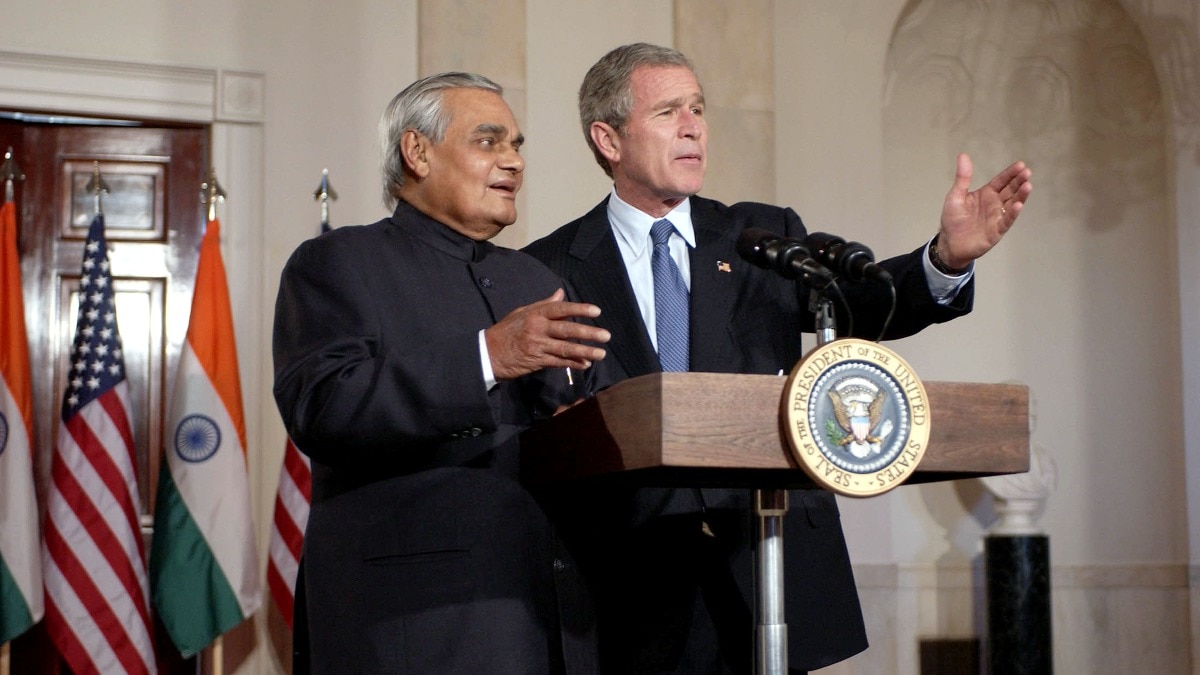
US President Donald Trump has signed the Lindsey O Graham Sanctions Bill into law, effectively giving him the power to impose tariffs of up to 100% on countries trading with Russia. The move leaves India, which sources more than half of its crude oil imports from Russia, exposed to potentially severe trade barriers in its largest export market. This, however, is hardly the first time India has found itself under the shadow of US sanctions.Exactly 25 years ago, New Delhi came out on top after facing a similar set of punitive measures imposed by Washington.The story goes back to the late 1990s, when India was in the midst of a heady transformation. The country was rapidly liberalising its long stagnant economy and opening up to the world. Economic growth was on the upswing, driven by strong foreign investment and growth of the IT and services sector. On the global stage, New Delhi's once all-weather ally, the USSR, had been consigned to history, and India was in the midst of a rapprochement with the West, especially the US.Then in 1998, the administration of then-US President Bill Clinton slapped a sanctions package on New Delhi that banned almost all foreign aid, financial assistance, military cooperation and technology transfer in a bid to clip India's ambitions to become a nuclear power. But if the sanctions were an attempt to make New Delhi toe the Washington line, they failed. On September 22, 2001, President George W Bush waived his predecessor's sanctions. As fresh US sanctions loom over New Delhi, the 1998 episode offers a useful reminder of how New Delhi dealt with Washington's pressure a quarter of a century ago.THE NUCLEAR TEST BEHIND AMERICAN SANCTIONSOn May 11, 1998, at 3.45 pm, three underground nuclear detonations were carried out at an Indian Army firing range in Rajasthan's Pokhran as part of Operation Shakti (also called Operation Pokhran-II), with then-PM Atal Bihari Vajpayee shortly thereafter announcing that India was now a full-fledged nuclear power. But while the news of the tests might have made Buddha smile, it wasn't the case in Washington DC. Caught completely unawares, America's reaction to India's entry into the nuclear club was one of disbelief and anger. According to the US State Department Archives, then-President Clinton had stated that he was "deeply disturbed by the nuclear tests", and that they were contrary to the goal "of building a safer 21st century"."This action by India not only threatens the stability of the region, it directly challenges the firm international consensus to stop the proliferation of weapons of mass destruction," Clinton had further added.An American response was thus inevitable, and it came on May 13, 1998. That day, Clinton informed the US Congress that he had imposed sanctions on India, under Section 102 of the Arms Export Control Act, also known as the Glenn Amendment Act. The aims of the sanction package, according to the State Department Archives, were to force New Delhi, among other things, to not "deploy or test missiles or nuclear weapons", and "cut off fissile material production for nuclear weapons".SANCTIONS CUT OFF FOREIGN ASSISTANCE, BLOCKED WORLD BANK FUNDING TO INDIAThe 1998 American sanctions led to the termination of all US foreign assistance except humanitarian and food aid. This cut off about $21 million in economic development assistance and $6 million earmarked for a greenhouse gas phaseout programme, as per official US government data.The US also opposed loans from global institutions such as the World Bank and IMF, blocking $3-4 billion in funding for India's infrastructure and development projects. Washington also committed American banks and government agencies to deny New Delhi any and all new loans and credit lines, except those to be used in purchasing food and agricultural commodities.Additionally, the sanctions suspended the sale of defence hardware, services, and foreign military financing under the Arms Export Control Act, directly impacting potential arms deals and cooperation.SANCTIONS FAILED TO DENT INDIA — IT GREW STRONGER OVER THE YEARSIn 1998, India was in the midst of a sweeping economic liberalisation programme, with reforms opening up the economy to greater foreign investment and international trade. The transformation began after the 1991 balance-of-payments crisis, when India received substantial financing from institutions such as the IMF and World Bank while undertaking wide-ranging structural reforms.The American sanctions, thus, did have some effect. The suspension of sales of military equipment and financing was felt during the Kargil War the following year. And the blocking of funding via the World Bank and the IMF led to delays in several infrastructure and even military projects (such as the HAL Tejas project). Exports to the US also saw a dip that year.New Delhi, however, stayed the course. Then-PM Atal Bihari Vajpayee, addressing Parliament on May 27, 1998, defended the tests as a matter of national security. "The touchstone that has guided us in making the correct choice was national security," he told the Lok Sabha, insisting that India's new nuclear weapons were "weapons of self-defence" intended to ensure that the country was not subjected to "nuclear threats or coercion".Asked whether the American sanctions could impact India's economy, he told India Today Magazine, "Sanctions cannot and will not hurt us. India will not be cowed down by any such threats and punitive steps. India has the sanction of her own past glory and future vision to become strong in every sense of the term."And in many ways, India did become stronger despite the sanctions.GDP growth averaged around 6.5% in the mid-1990s due to market reforms, and by the time sanctions were imposed, the economy was stable at about 5.8%. By 2003, just 5 years after the US sanctions, India's GDP was growing by 7.8% annually. India's trade links with the world remained robust.New Delhi also diversified its trade partners during this period. The US continued to import billions of dollars' worth of textiles and gemstones while exporting machinery. The European Union imported textiles, leather, and chemicals, in return for exporting industrial equipment. Russia supplied defence hardware and bought Indian pharmaceuticals and tea. The UAE and Saudi Arabia exported oil while importing gems and rice. Japan and China also remained active partners, trading in electronics, textiles, and chemicals.In fact, then-Finance Minister Yashwant Sinha would later tell news agency PTI in 2001, "As far as the Indian economy itself was concerned, except for certain defence supplies, sanctions had no meaning."INDIA CONTINUED TO ENGAGE WITH THE US, LED TO SANCTIONS WAIVER BY BUSHMore importantly, despite being hit with sanctions, India kept up engaging with the US, enabling a gradual thaw in ties. US President Bill Clinton, who imposed the sanctions in the first place, turned up for a bilateral visit in 2000, the first such trip made by an American President to India since 1978.Finally, on September 22, 2001, exactly 25 years ago, US President George W Bush waived the sanctions, opening the door to economic and military aid. New Delhi-Washington DC ties would continue to grow over the years, boosted by India's support in the global fight against terrorism post-9/11. Finally, in 2008, the signing of the Indo-US nuclear deal by PM Manmohan Singh and President Bush saw Washington finally recognise India as a responsible nuclear power.A quarter of a century later, India and the US are even more intertwined than ever. The US remains the largest destination of Indian exports, accounting for 19.78% of all shipments in financial year 2025-26, while bilateral trade reached an estimated $239.6 billion in 2025.It is this massive export market under threat from US sanctions. A blanket 100% tariff would render Indian goods thoroughly uncompetitive in the American market. This is because New Delhi prioritises energy security for its 1.4 billion citizens, even if it means buying Russian crude.The lesson from 25 years ago is that India must continue to prioritise its own interests rather than bend to pressure from the US. But it must also continue engaging constructively with America. The experience of 2001 shows that even after a period of intense disagreement, sustained engagement can help rebuild ties and create a path out of confrontation.- EndsPublished By: Shounak SanyalPublished On: Sep 22, 2026 06:30 IST
How India turned US sanctions into a dud 25 years ago, forced their withdrawal
Full Article
Original Source
Read the full article at Indiatoday →KhanList aggregates and links to publicly available news content. We do not host full articles from third-party sources. Always verify important information with original sources.