
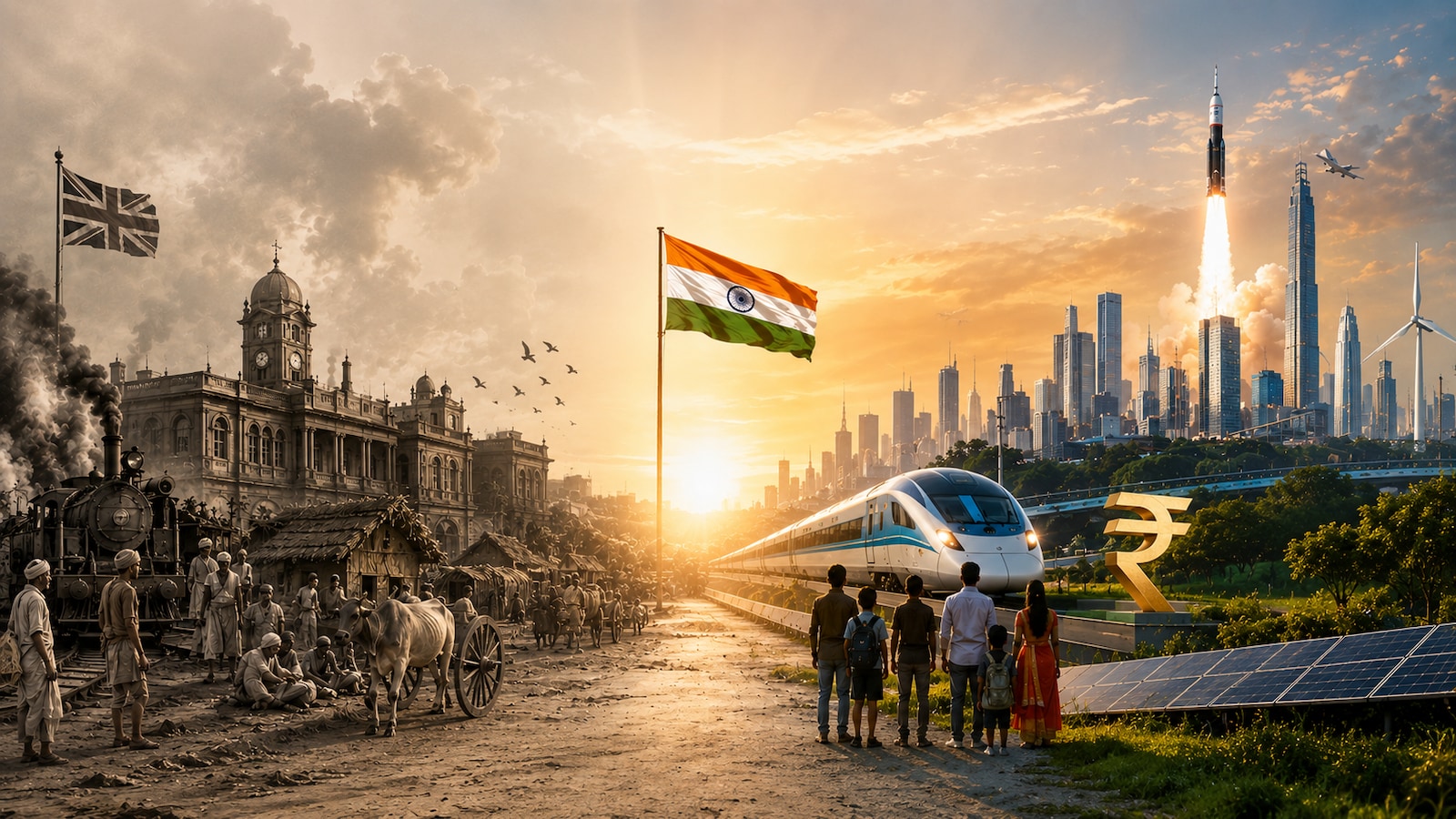
New Delhi: India's standard of living was close to the global average before the British Raj took firm control of the country. However, over the following decades, Indians witnessed a significant decline in economic well-being. While it took time after Independence for the economy to stabilise, growth accelerated sharply following the economic reforms of the early 1990s.India's GDP per capita stood at 83% of the global average in 1820, during the late Mughal period. It fell to 55% by 1870 and further to 32% in 1940, according to the Maddison Project Database 2023 by the University of Groningen.The disruptions associated with Partition and the challenges of nation-building kept income levels subdued for several decades after Independence. A decisive turnaround came with economic liberalisation in the early 1990s, which unlocked higher growth and increased integration with the global economy. By 2025, India's GDP per capita had recovered to 46% of the global average, according to data compiled by Our World in Data.World's Fastest-Growing Major EconomyIndia is not only growing rapidly but is also projected to remain the world's fastest-growing major economy. The IMF's July 2026 World Economic Outlook estimates India's GDP growth at 6.4% in 2026, ahead of China (4.6%), Brazil (2.4%) and the United States (2.3%).India's Rising Weight In The Global EconomyIndia's share of global GDP has risen steadily over the past four decades. From accounting for just 1.6% of the world economy in 1980, India now contributes around 3.3% and is expected to exceed 4% by 2030, according to IMF projections. This growing economic footprint has strengthened India's influence in global trade, geopolitics and international policymaking.World's Sixth-Largest EconomyIndia is among the world's largest economies, not only by population but also by economic size. According to the IMF's April 2026 estimates, India's nominal GDP stood at $4.15 trillion in 2025, making it the world's sixth-largest economy. Japan and the United Kingdom, ranked fourth and fifth respectively, remain only marginally ahead. Japan's economy was valued at $4.38 trillion, while the UK's stood at $4.26 trillion.India's Export Story Took Off in the New MillenniumIndia's growing economic strength is increasingly reflected in its export performance. From supplying PPE kits and medicines during the Covid-19 pandemic to emerging as a key manufacturing and services hub, India has expanded its presence in global markets.India's share of global merchandise exports increased from just 0.61% in 1970 to 2.52% today. Notably, the country's share remained below 1% until 2003, highlighting the scale of the transformation seen over the past two decades.Government initiatives such as Atmanirbhar Bharat, Startup India and production-linked incentive (PLI) schemes have further supported the expansion of India's export ecosystem.What Lies Ahead?Nearly eight decades after Independence, India's economy has not only recovered from the setbacks of the colonial era but has also emerged as one of the key drivers of global growth. As its share in global GDP, trade and investment continues to rise, India's economic resurgence is becoming increasingly difficult to ignore. Nevertheless, the next challenge for India is to translate rapid growth into higher incomes and broader prosperity.
How Independence Revived India's Hollowed Economy After British Rule
Full Article
Original Source
Read the full article at Ndtv →KhanList aggregates and links to publicly available news content. We do not host full articles from third-party sources. Always verify important information with original sources.