
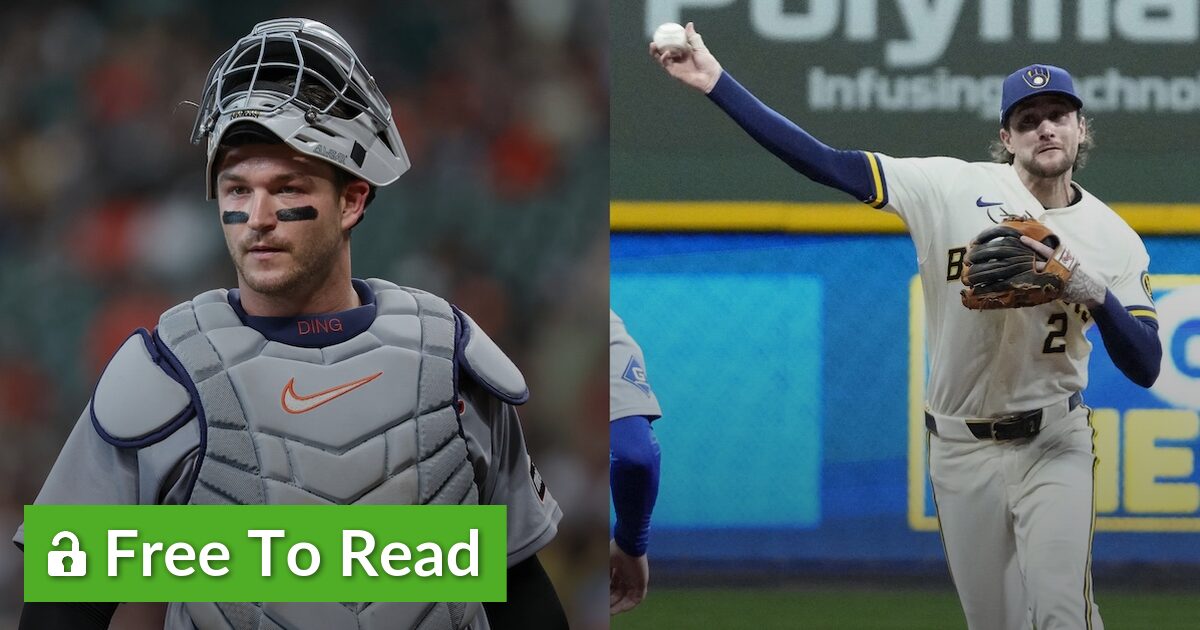
Troy Taormina and Michael McLoone, Imagn Images For the third consecutive year, I voted for the Fielding Bible Awards, Sports Info Solutions’ annual recognition of the best defenders in major league baseball. They’re a Gold Glove equivalent for the majors as a whole, created by SIS and John Dewan in 2006. A panel of video scouts and baseball experts vote for five players at each spot; there are also awards for the best multi-position defender, the defensive player of the year, and the defensive team of the year. The awards will be released this Thursday, October 22, and this article will be updated to note the winners once they’re announced. Voting for any award is a prestigious honor, and voting on this panel has great personal import to me. Over the years, the panelists have included basically every writer who got me into baseball statistics when I was younger. Bill James, Peter Gammons, the founder of Strat-o-Matic – you get the idea. It’s a group I’m honored to be a part of, and I take my voting responsibilities very seriously. To that end, I spent some time this year updating my previous voting methods. Let me walk you through it. Earlier this year, MLB Senior Data Architect Tom Tango did some work on blending multiple defensive systems together. I had actually landed on a similar method after discussing my inaugural ballot with Tom two years ago, but there’s never a bad time for a refresh. I started with Tom’s approach, added in Baseball Prospectus’ DRP as an additional number, and created blends for each position group based on how well each metric tracked itself year-to-year, as well as how well it predicted other metrics from one year to the next. Of note, I moved around my infield weights a bit, increasing the importance of DRS; it has narrowly been the best metric in the post-shift-ban world, a change in defensive rules meaningful enough for me to strongly prefer sampling from it for my initial rankings. That blended rank gave me an preliminary order for each position. From there, I used my own expertise and judgment to move players up or down the list. I tried to have a light touch here; regardless of what vibes or the eye test say, I’m not putting Jose Altuve on my second base ballot when the models say he’s the worst defensive second baseman in the league, though admittedly he was also pretty bad by the eye test. I considered past defensive value because single-season defensive statistics are noisy, but I only used that as a tiebreaker; I’m voting for the players who played the best defense this year, not the players who have been the best recently. As I note every year, I think this process does a good job of combining the best information that publicly available defensive systems can produce with a critical, evidence-focused eye on the game. I watch a ton of baseball, and I also spend quite a bit of time thinking about both how to measure player skill and the limits of doing so. I’m just talking my own book here, but I really do believe this is the best way I can determine who played the best defense in the majors this season. So without further ado, let’s look at my infield ballot. Catcher 1. Dillon Dingler 2. Joe Mack 3. Brandon Valenzuela 4. Luis Torrens 5. Adley Rutschman A tip of the cap to Patrick Bailey, who I voted for in both previous editions of this award, but he wasn’t one of the best defensive catchers in baseball this year. Dingler was the clear top guy for me, and the models thought so too. He was head and shoulders above the field statistically, and watching him play is basically an instruction manual for good fundamental defense. He’s a wonderful blocker and also controls the running game well thanks to a huge throwing arm. He’s mastered the new-school art of tailing his throws towards first base to give fielders a good tagging lane. How afraid of Dingler are opposing baserunners? They ran on him about as many times in 995 innings as they ran on his backups in 400 fewer innings of work. Oh, and he was the best receiver in baseball this year for good measure. Does that sound like something you might be interested in?You Aren't a FanGraphs MemberIt looks like you aren't yet a FanGraphs Member (or aren't logged in). We aren't mad, just disappointed. We get it. You want to read this article. But before we let you get back to it, we'd like to point out a few of the good reasons why you should become a Member. 1. Ad Free viewing! We won't bug you with this ad, or any other. 2. Unlimited articles! Non-Members only get to read 10 free articles a month. Members never get cut off. 3. Dark mode and Classic mode! 4. Custom player page dashboards! Choose the player cards you want, in the order you want them. 5. One-click data exports! Export our projections and leaderboards for your personal projects. 6. Remove the photos on the home page! (Honestly, this doesn't sound so great to us, but some people wanted it, and we like to give our Members what they want.) 7. Even more Steamer projections! We have handedness, percentile, and context neutral projections available for Members only. 8. Get FanGraphs Walk-Off, a customized year end review! Find out exactly how you used FanGraphs this year, and how that compares to other Members. Don't be a victim of FOMO. 9. A weekly mailbag column, exclusively for Members. 10. Help support FanGraphs and our entire staff! Our Members provide us with critical resources to improve the site and deliver new features! We hope you'll consider a Membership today, for yourself or as a gift! And we realize this has been an awfully long sales pitch, so we've also removed all the other ads in this article. We didn't want to overdo it. In case you didn't read all that, here's the short version. Membership includes:✓Ad-free browsing✓Unlimited FanGraphs & RotoGraphs articles✓Historical & platoon projections✓Leaderboard & player-page stat heatmaps✓One-click data exports✓Customizable player-page dashboards✓Dark & Classic site modes✓Weekly Members-only mailbag✓FanGraphs Walk-Off, your year in review✓Optional homepage photo removal✓Gift articles to non-Members✓Full postseason coverage Mack was a pleasant surprise for me this season. I didn’t know a lot about him before his debut, but he put on a show throwing down to second base; he led baseball in the number of runners he threw out while stealing despite only playing 783 innings behind the plate. He threw them out at a high rate, too, despite some lackluster work holding runners on by the Marlins pitching staff. Mack also blocks and receives well – there are a lot of good defensive catchers these days – but his command of the running game is the skill that earned him my vote here. Valenzuela was nearly as good throwing despite similarly little help from his pitchers, and he was a great receiver to boot. But he looks awkward blocking balls in the dirt at times, which pushed him behind the two well-rounded catchers at the top of the list. Finally, Torrens and Rutschman are squarely behind that top trio for me, but they both deserve some recognition for having very solid defensive seasons. Torrens has been great for a few years now, while Rutschman bounced back after a few lackluster seasons behind the plate, but both of them are good across the board. They’re each in the top 10 of Statcast’s blocking, throwing, and receiving leaderboards, which shows off their well-rounded game, and I wouldn’t be shocked to see one of them win the award next year because they don’t have many holes in their game. First Base 1. Matt Olson 2. Ty France 3. Christian Walker 4. Vladimir Guerrero Jr. 5. TJ Rumfield This was a two-way race at the top for me, and I went back and forth for a while before settling on Olson. He’s a prototypical first baseman – huge, rangy, surehanded, and even bats lefty, if you’re into that kind of thing. He also plays a ton of innings. He’s the platonic ideal of a first baseman, in other words, and he played up to his usual standard this year. The systems love him. The eye test loves him. I clearly love him – I had him first last year as well. This year, though, I at least had to think about it. France was a worthy contender for the top spot. For the second season in a row, he’s been stellar at first, and despite being short for the position, he’s one of the best in the game at scooping errant throws. He’s also incredibly rangy, and he made a lot of good plays charging bunts and weakly-hit balls this year. Spectacular work from a guy whose defense was once a weakness. Walker’s best defensive days might be behind him, but a decline from his formidable peak still leaves him as one of the best in the business. I went back and forth on putting Guerrero on here because this is the first year he’s graded out as a good defender and the eye test is mixed, but this was about as low as I felt I could put him given the numbers. Finally, Rumfield is another entry in the hulking and rangy first baseman category, and I really enjoyed watching him corral errant throws, particularly high ones, from the left side of the infield all year. Second Base 1. Brice Turang 2. JJ Wetherholt 3. Brandon Lowe 4. Nasim Nuñez 5. Nico Hoerner Second base is stacked at the moment. Four of the five guys on this list would be above-average shortstops, though I think they’re even better suited for the keystone. Turang is the poster boy for this; his throwing arm is unremarkable at second base and might be a little light for shortstop, but that just doesn’t matter much given the way he’s deployed. He’s comically rangy, combining a great first step with blistering acceleration that makes it seem like he knew where the ball was going before the bat did. He’s particularly good charging to his left and making off-platform throws to first, but honestly, he’s just good at everything. I would have put him in the top spot even if my blended leaderboard didn’t have him first, but it does; per the computers, he’s first by a fair margin. Wetherholt was a clear second for me. Most of what I said about Turang is true of him as well. He briefly shifted over to short when Masyn Winn was injured, but he’s better suited for second, where his range and instincts combine to make up for middling arm strength. I’d suggest watching him play if you haven’t. It’s smooth, soothing almost; he’s never in a hurry, but he’s always on time, regardless of where he needs to end up. He’s particularly adept at plays where he loses sight of first base and has to re-establish it before throwing; that’s a tough play for most second basemen, but he seems to have eyes in the back of his head at times. I watched more clips of Lowe’s fielding than any other player on the ballot because I considered him a poor defender for most of his tenure in Tampa Bay. But the tape says the same thing as all three of the systems I used: At least in 2026, he was just great. I couldn’t perceive his limited range very much, because he was making tough plays in all directions regularly. Could a bunny hop really make all that difference? I’m skeptical, but it sure seems to have helped a lot, and perhaps Lowe just needed a little more range to make his sure hands sing. It’s a good reminder that the Rays don’t have a monopoly on helping players improve; they’re famous for their development, but sometimes a guy just needs to hear new voices. Finally, Nuñez and Hoerner are conventionally great, and I’ll have more on Nuñez in part two of this ballot. If you like watching elite defenders, check those two out. Hoerner won this award last year and could easily do so next year; the competition is just very tough at the moment. Shortstop 1. Masyn Winn 2. Taylor Walls 3. Bobby Witt Jr. 4. Geraldo Perdomo 5. Dansby Swanson I’m quite confident that I don’t have any team bias in my evaluation of baseball, but I’ll readily admit that I have a bias towards shortstops with cannon arms, a byproduct of watching reels of Andrelton Simmons highlights when I was younger. Winn is Simmons’ spiritual successor; he might not have the ridiculous range and seeming precognition that Simmons showed at his best, but he too warps the way shortstop defense works, because timing changes when you can throw this hard. Plays that just aren’t possible for most shortstops open up for Winn. His internal clock can run a little slower than everyone else’s because the force of his throws shaves fractions of a second off of the time between when he releases the ball and the first baseman catches it. It shows up in his ability to charge and gather before throwing on weakly hit balls, and also in his ability to turn double plays; the Cardinals get plenty of extra outs every year because Winn just muscles the ball over so much faster than every other shortstop. Walls has a polarizing case, and it’s one that drives home the importance of getting multiple perspectives. DRS thinks he’s the best shortstop in the game by some distance. DRP thinks he’s the best by a hair. FRV thinks he’s below average. I come down closer to “he’s elite,” and I think there’s something interesting in the FRV numbers. Walls converts chances into outs at a higher rate than any other shortstop in baseball. But FRV also thinks he has the easiest chances in baseball, which is why they have him as basically average. I guess I’m just willing to give him more credit for “converts the most chances” even though it’s definitely true that not all plays are created equal. In any case, the reason I collect and blend a ton of metrics is because they won’t always agree, and in my raw rankings, Walls was a hair behind Winn and solidly ahead of Witt in third. Speaking of, Witt is obviously great too, in a way that I imagine I don’t need to explain too much; he’s fast, smart, and strong-armed. Perdomo and Swanson are longtime good defenders who both had good seasons this year, but they aren’t capable of the same incandescent brilliance as that top trio. I also considered Andrés Giménez, Otto Lopez, and Mookie Betts for this spot; they’re all in the same tier as Perdomo and Swanson for me. I’d be happy to have any of them as my shortstop, and I bet they’d all contend for the top spot if they shifted down to second base, but right now, the three W’s of Winn, Walls, and Witt are head and shoulders above the rest. Third Base 1. Matt Chapman 2. Alex Bregman 3. Caleb Durbin 4. Maikel Garcia 5. Brooks Lee I might be the only person with Chapman in first place on my ballot, because he only played roughly half a season this year. But what a magnificent half season it was! Chapman is one of the greatest third base defenders of the 21st century, and he played like it when he was on the field this year. I wouldn’t exactly call Chapman a graceful defender, but he uses his physical talents to the utmost. He has a big arm and he’s very quick, which means he gets to the ball quickly and recovers well even if he can’t field it instantly and cleanly. To be fair, he does usually field it instantly and cleanly – he just can get outs even if things go wrong. That kind of burly defense had him first in DRS this year despite a huge innings deficit on the rest of the leaders, and in terms of per-inning value, he was head and shoulders above the rest of the field, a defensive titan limited to fewer innings than normal. I was impressed enough by Chapman’s form to rank him first despite his paltry innings total, but Bregman and Durbin were great in their own right. They’re actually very similar defenders, and I expect one of the two of them to win the award this year. They have relatively modest throwing arms for third, but they’re elite all-around defenders who simply play themselves into positions where they have enough strength for their throws. It’s no coincidence that both of them are capable of playing other infield spots. All three defensive systems love them both; in fact, by my blend, the top three fielders here were in a statistical tie for first place, and I would hardly blame anyone for voting for Bregman or Durbin. Garcia got my fourth place vote for turning in a lesser version of Chapman’s season. He’s inarguably elite, and a strong contender for this award in every full season he plays, but he missed half of the 2026 season, which left him short on counting stats. He’s a great defender, but he didn’t blow me away like Chapman did, hence his lower placement. Lee excelled after the Twins slid him over from shortstop. He struggled moving to his right and throwing against the grain, but that’s not really an issue at third. He looks much better to me when the play is in front of him, and he made a ton of tough charging plays in addition to showing great range when leaving his feet, a skill that’s most important at third. I’m extremely excited to see how he does next year with a whole offseason of practice at a spot where he already looks solid. Later this week, I’ll go through my outfielder, pitcher, multi-positional defender, defensive player of the year, and defensive team of the year votes. I hope you’ve enjoyed reading about the first half of my ballot as much as I enjoyed filling it out.
How I Voted for the 2026 Fielding Bible Awards: Infield
Full Article
Original Source
Read the full article at Blogs →KhanList aggregates and links to publicly available news content. We do not host full articles from third-party sources. Always verify important information with original sources.