
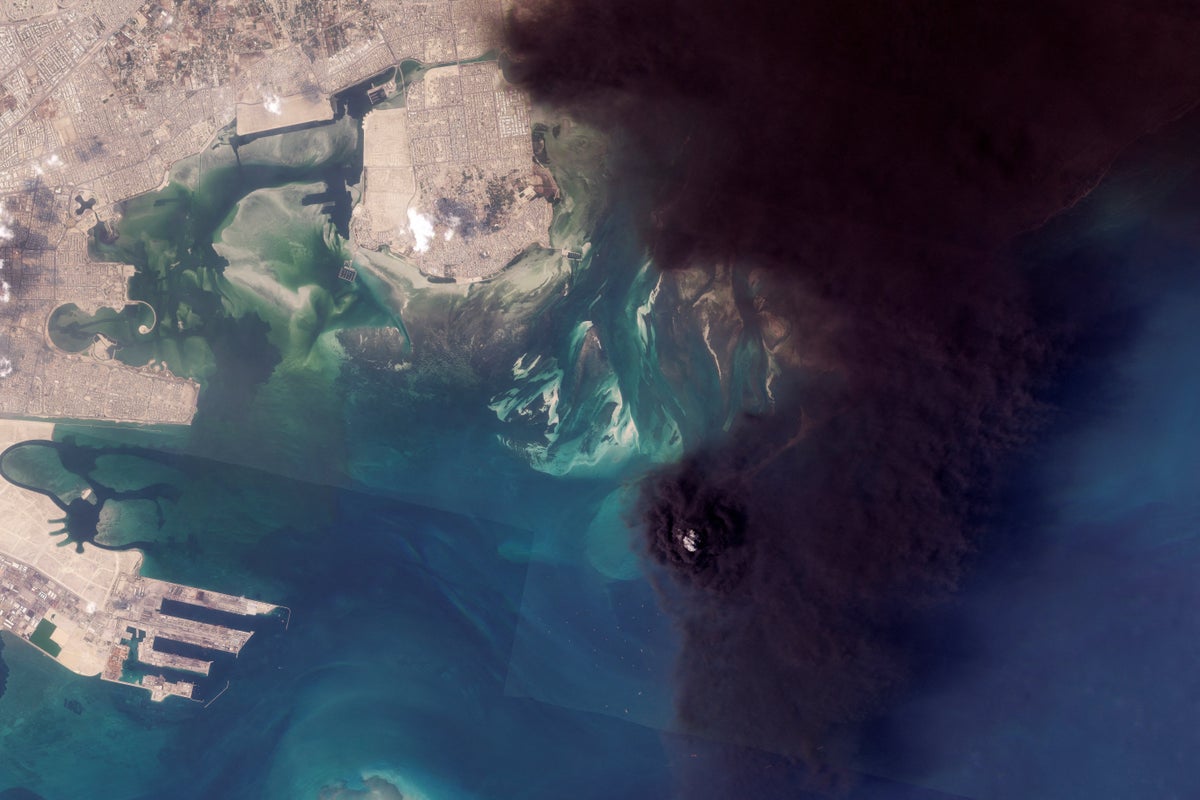
Loud explosions rocked the Saudi capital Riyadh early on Thursday amid escalating hostilities between the kingdom and Yemen’s Houthi rebels.Deadly strikes on Saudi airports, oil infrastructure and office buildings continue to cause major daily disruption, threatening trade, travel and civilians caught up in the conflict.To the east, the US war with Iran to the east is effectively at an impasse despite Washington blockading Iranian ports and Tehran exerting steady pressure over the Strait of Hormuz, driving up energy prices around the world.Riyadh is now preparing to postpone the region’s main metals and mineral conference due to the fighting, according to the Financial Times, in what would be another major blow to Saudi business and reputation.A large smoke cloud billowing over Saudi Arabia's Ras Tanura oil refinery after a claimed Houthi attack, on November 25 (Reuters)Organisers of the Future Minerals Forum have reportedly told speakers that they may need to push the event back from January, highlighting the expectation that the conflict could linger for several more months.Past attendees told the newspaper that they would have almost certainly pulled out anyway, citing the perceived risk from the conflict.That comes despite Donald Trump saying this week that his related war with Iran is only funded until January, after which the Democrats could try to limit further action.In the meantime, the Houthis, who are backed by Iran, continue to wage an effective campaign against US ally Saudi Arabia with strikes that have disrupted oil production and forced the cancellation of foreign flights.Major Saudi events cancelledDisruption from the war has also seen the kingdom postpone or cancel major events, including football’s AFC Asian Cup and the flagship investment conference, the Future Investment Initiative (FII), in a blow to efforts to secure business and tourism.Riyadh was supposed to host FII in late October but only days before announced it was postponing the conference until next year, following deadly attacks on the kingdom.A firefighter sprays water on a fire at a factory in Hodeidah, Yemen, November 17 following a claimed Saudi strke (Reuters)The event, informally known as ‘Davos in the Desert’, is a state-backed annual event that has for nearly a decade been used to showcase Saudi Arabia’s investment plans in a bid to attract outside financing.That decision followed a series of deadly Houthi attacks on King Khalid International Airport in Riyadh in early October that killed at least 17 people and injured more than 300.Houthis capture areas on Red Sea coast Fighting with the Houthis has intensified since the group captured strategic areas along Yemen's Red Sea coast in September, advancing towards the Bab el-Mandeb Strait, a key global shipping route for Gulf oil producers.That has effectively strengthened Iran’s position, further squeezing the ability of its neighbours to export petroleum and diesel.Meanwhile, the Houthis have forged an advance on the seat of Yemen’s internationally recognised government in Aden, coming within 60km of the city and forcing the Saudi coalition to redeploy forces.Security forces run a checkpoint as security is tightened amid concerns of Houthi forces drawing closer in Aden, on November 19 (Reuters)Since fighting resumed in Yemen in July in parallel with the wider Iran war, the Houthis have rapidly advanced in Yemen, seizing territory from the government and its allies.Aden, now the target of Houthi missile and drone strikes, had previously not seen major hostilities since street battles in 2015, soon after the government fled Houthi-run Sanaa and made the port city its base, but it is now being hit by missile and drone strikes.“Rockets are being fired into this city in a frightening way. People are in a state of constant anxiety,” said Tariq Abdul Rahman, a former soldier living in Aden with his family.Government forces inside the city, perched around an extinct volcano jutting into the Indian Ocean, have set up checkpoints, pulled in reinforcements, dug trenches and set up earth barricades on roads to the front line, residents and military officials say.Flames burn at a facility belonging to Saudi oil giant Aramco south of Riyadh on October 3, 2026. (AFP/Getty)Saudis dismiss military commanderReflecting Houthi progress, Saudi Arabia earlier this month dismissed the commander of overseeing its coalition forces after they were forced to abandon their push to recapture key regions along the Red Sea coast in order to help protect Aden.The fighting has displaced hundreds of thousands of people, with many now surviving on meagre aid handouts in small tarpaulin camps in the hills around Taiz, Yemen's third-largest city, now besieged by the Houthis.The Houthis only on Wednesday threatened to widen their attacks to the Saudi port of Jeddah and all other ports on the Red Sea coast if Riyadh hit the Yemeni port of Hodeidah.After the statement, the Saudi-led coalition struck at Hodeidah and destroyed a number of targets in the Yemeni governorates of Saada and Amran.
How Houthi attacks are causing chaos in Saudi Arabia as Kingdom postpones another major conference
Full Article
Original Source
Read the full article at Independent →KhanList aggregates and links to publicly available news content. We do not host full articles from third-party sources. Always verify important information with original sources.