
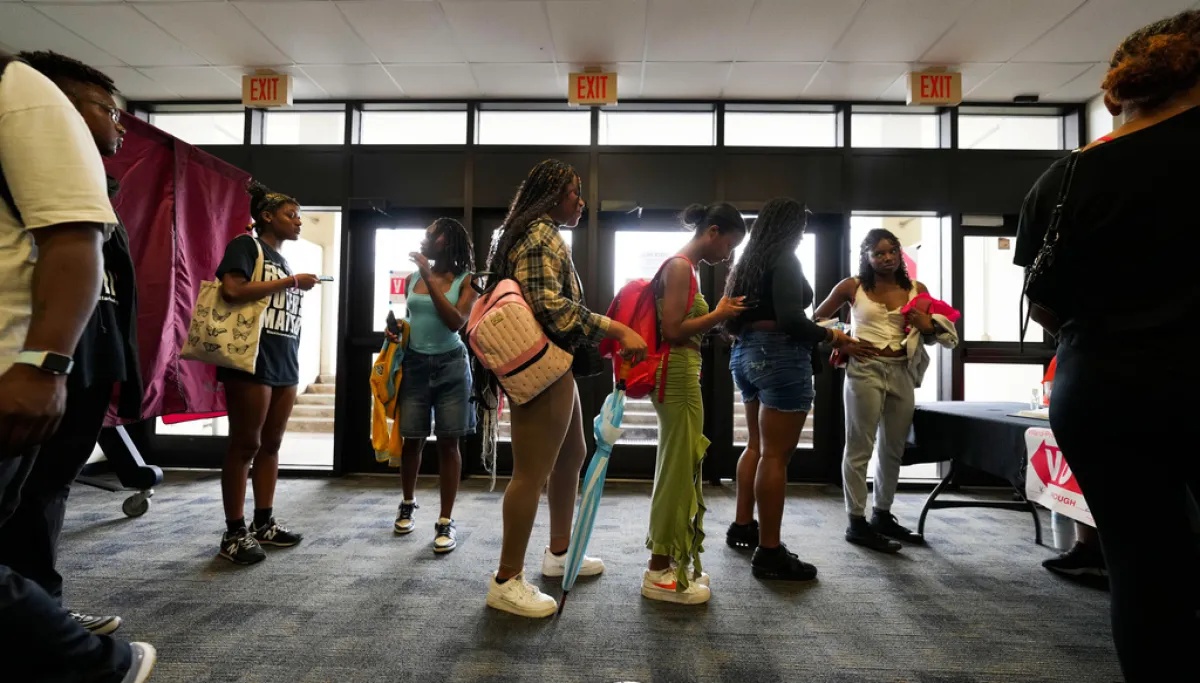
House Democrats are looking to an inaugural program to supercharge college voters in key races for the Nov. 3 elections and flip the script against Republicans this cycle after the youth vote in 2024 helped send President Donald Trump back to the White House.The Democratic Congressional Campaign Committee has overhauled its college and university campus outreach after conceding it was “largely uncoordinated or limited to basic voter registration drives” in years past.The party has spent the past several months enacting a more structured organizing program, details of which have not been previously reported, in coordination with battleground candidates to target 21 college campuses nationwide. For the first time, DCCC is using paid fellowships to help drive peer-to-peer persuasion on campuses that go beyond traditional get-out-the-vote tactics. The group declined to reveal how much campus fellows can make. “What we’re really trying to put a lot of effort in is being able to not take these votes for granted, that we’re showing up and having these hard, tough persuasion conversations,” DCCC National Organizing Director John Mahon told the Washington Examiner in an interview.House Democrats are eyeing eight battleground districts in particular, where they say campus voting could make the biggest difference. Seven are seats held by Republicans and just one by Democrats, presenting crucial pickup opportunities in the party’s bid to take back the lower chamber.Among the Democratic challengers is Will Lawrence, who’s facing first-term Rep. Tom Barrett (R-MI) in Michigan’s 7th Congressional District that includes Michigan State University. Lawrence, a 36-year-old millennial, cited the Iran war and affordability as among the main reasons young voters, particularly men, should reject Trump and Republicans this go-around. Youth voters aged 18-29 favored former Vice President Kamala Harris over Trump by 4 points in 2024, but those who prioritized the economy and jobs — the demographic’s top issue — sided with Trump by a 24-point margin, according to an analysis from Tufts University.“Trump and [Secretary of War] Pete Hegseth don’t give a damn about us. They want to take advantage of us,” Lawrence said in an interview. “They want to send you off to fight out a war on the other side of the world for no reason, and they’re not fighting to build housing you can actually afford. They’re rolling out the red carpet for Silicon Valley to develop AI for the purpose of taking your job.”The other top districts on the DCCC’s target list are Maine’s open 2nd District controlled by Democrats that includes the University of Maine and Bates College; Nevada’s open 2nd District controlled by Republicans that includes University of Nevada Reno; Rep. Eli Crane (R-AZ) in Arizona’s 2nd District that includes Northern Arizona University; Rep. Mariannette Miller-Meeks (R-IA) in Iowa’s 1st District that includes University of Iowa; Kentucky’s open 6th District controlled by Republicans that includes University of Kentucky; Rep. Bill Huizenga (R-MI) in Michigan’s 4th District that includes Western Michigan University; and Montana’s open 1st Congressional District held by Republicans that includes University of Montana.Students line up to vote at a campus polling place at Southern University in Baton Rouge, La., on Election Day, Nov. 5, 2024. (AP Photo/Gerald Herbert) Voter participation among college and youth voters, aged 18-29, has varied in recent cycles but remains elevated in comparison to historical figures.Just over half, 53%, of eligible college students voted in the 2024 presidential election, according to data from Tufts University. That was less than the 66% in 2020 but more than the 52% in 2016 and 45% in 2012. The 2024 figure was higher than the university’s estimate of all youth voter turnout for ages 18-29 in that cycle, which was 47%.But those numbers drop significantly in off-year midterm elections. The 2022 midterm elections saw an estimated 23% turnout for all voters aged 18-29, lower than the 28% in the 2018 midterm elections but higher than the 13% in the 2014 midterm elections.CAN COLLEGES INCREASE DISMAL YOUTH VOTE TURNOUT?For these midterm elections, a Harvard youth poll suggests Democratic youths are far more motivated to cast ballots than their GOP peers, but plans to vote from the overall demographic are below levels heading into the 2018 and 2022 midterm elections.“What is different is recognizing that there is really a big difference between putting in the work and organizing on the ground rather than relying heavily on outside spending ads and parachuting people in before election night,” said Mahon, the DCCC organizing director.
How House Democrats revamped their college outreach in a bid to win back youth voters
Full Article
Original Source
Read the full article at Washingtonexaminer →KhanList aggregates and links to publicly available news content. We do not host full articles from third-party sources. Always verify important information with original sources.