
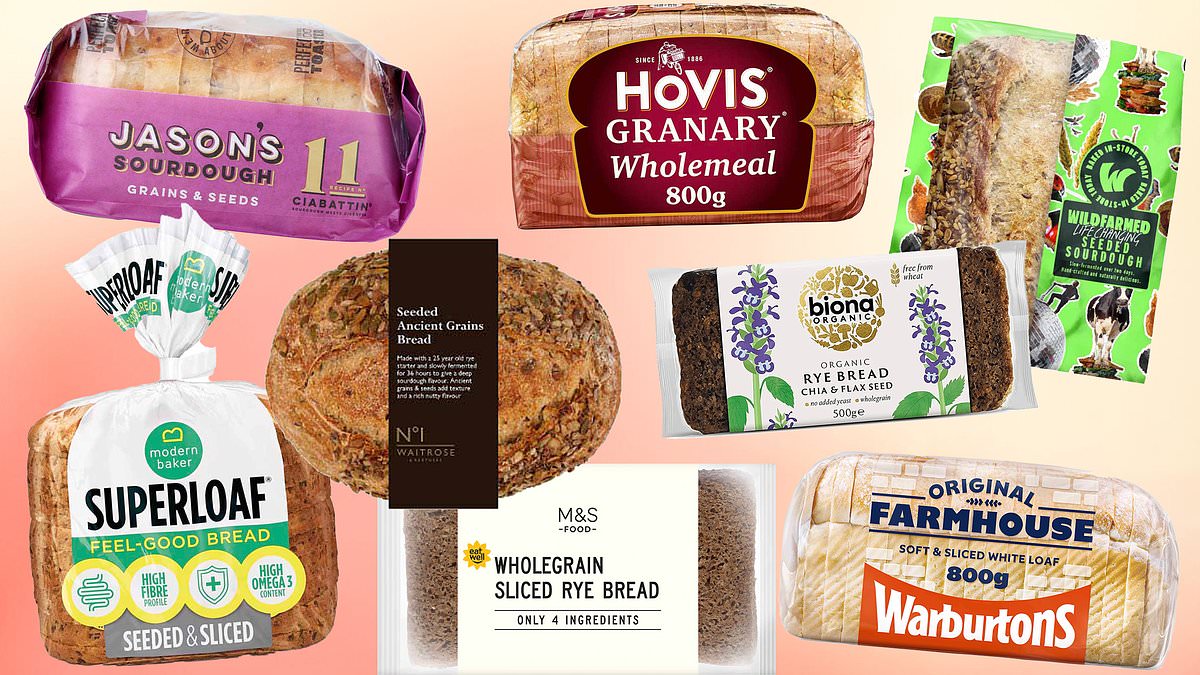
It's one of the country's favourite food groups, with few things as satisfying as a perfectly toasted, buttery slice of bread.Not just good for the soul, bread can also be an efficient way to increase your fibre intake amid a rise in awareness about the benefits of consuming 30g a day - in addition to eating enough protein and staying hydrated. But not all supermarket loaves are baked equally, according to nutritionist Ann Garry. 'As a practical rule of thumb, I would look for around 6g or more of fibre per 100g, ideally with wholegrains near the top of the ingredients list,' the CEO at Health Coaches Academy told the Daily Mail, explaining how she selects the best bread. 'For blood pressure, salt is another figure I would check. Adults are advised to have no more than 6g of salt a day,' she added. Analysing over 30 variants - including seeded rye, sourdough, and gluten-free - Ann scored breads from brands like M&S, Waitrose, Aldi, Co-op, Biona and Asda to reveal a surprising list of the best and worst options you can buy. From the £1.40 budget option that pleasantly surprised Ann to the 62-calorie household staple that's deceptively unhealthy, this is how you should be sifting the wheat from the chaff. Analysing over 30 variants that included seeded rye, sourdough, and gluten-free, nutritionist Ann Garry scored breads from brands like M&S, Waitrose, Aldi , Co-op, Biona and Asda to reveal a surprising list of the best and worst options you can buyBiona Organic Chia & Flax Seed Rye Bread - 5/5Ann: 'Wholegrain rye is the main ingredient and it provides an exceptional 11g of fibre per 100g – more than a third of the recommended daily amount.'The flax and chia seeds provide additional fibre and predominantly unsaturated fats, while the carbohydrate content is lower than many standard wheat breads. It is a substantial, high-fibre loaf that is likely to be very satisfying.'What holds it back slightly is the 1.2g of salt per 100g and relatively modest protein at around 6g, but overall the nutritional profile is excellent.'It is also worth remembering that rye contains gluten, so this bread is not suitable for people with coeliac disease, even though wheat is not its main grain.M&S Only 4 Ingredients Wholegrain Sliced Rye Bread - 4.8/5 Ann: 'This is another excellent choice, with 10.2g of fibre per 100g and wholegrain rye as the first ingredient. It is also one of the lowest-energy breads here at 190 calories per 100g, although I would not choose a bread on calories alone.'It sits just behind the Biona loaf because its protein is fairly modest at 5g per 100g and it does not have the additional chia and flaxseed. Salt is 1.2g per 100g. What I particularly like is the simplicity of the composition: wholegrain rye, water, salt and yeast.'Warburtons 12 Pulses, Seeds & Grains Protein Power - 4.8/5 Ann: 'This is the highest-protein bread in the line-up at 15.9g per 100g, alongside a strong 6.9g of fibre. Wholemeal wheat flour is the first ingredient and it also contains lentils, beans, seeds, oats and rye.'The pulses are a particularly worthwhile addition because they contribute both protein and fibre rather than simply relying on a sprinkling of seeds for nutritional appeal.'Salt is relatively modest for bread at 0.9g per 100g and saturated fat remains low. If someone wants an everyday loaf that combines wholegrains, fibre and substantially more protein than most breads, this is an excellent option.'Modern Baker Superloaf - 4.7/5 Modern Baker's Superloaf costs £2.40Ann: 'This is one of the most nutritionally balanced breads in the line-up, with 7.5g of fibre, 10g of protein and a useful omega-3 content per 100g. Salt is also comparatively low at 0.78g.'The ingredients list is longer than that of a traditional sourdough, but this is a good example of why I would not judge a food simply by the number of ingredients it contains.'A short ingredients list does not automatically make a product nutritionally superior. Here, the finished bread provides a genuinely strong combination of fibre, protein and seeds.'Duchy Organic Seeded Sourdough - 4.5/5Ann: 'The sunflower, pumpkin and linseeds add fibre, protein and predominantly unsaturated fats, contributing to a bread with 7.2g of fibre and 11.4g of protein per 100g.'Salt sits just below 1g per 100g, and saturated fat remains low. The seeds should also make this a more satisfying and nutritionally substantial choice than a plain white sourdough.'Organic is an additional feature, but nutritionally I would be much more interested in the wholemeal flour, fibre and seed content.'Aldi Village Bakery Wholemeal - 4.4/5 Ann: 'This is a brilliant example of why you do not need to spend £4 or £5 on a loaf to get a strong nutritional profile. It provides just over 6g of fibre and nearly 12g of protein per 100g.'Wholemeal flour retains substantially more of the grain's fibre than refined white flour, making this a good everyday way of increasing wholegrain and fibre intake.'Salt is also comparatively good at 0.82g per 100g. For the price, this is one of the strongest everyday choices in the list.'Hovis Granary Wholemeal - 4.3/5Ann: 'This is a very good everyday supermarket loaf, with 6.8g of fibre and 10.6g of protein per 100g. Wholemeal flour forms the base, with malted wheat and rye adding some additional grain variety.'The fibre makes a useful contribution towards the recommended 30g a day and gives this a considerable nutritional advantage over most standard white breads.'Salt is just under 1g per 100g, which compares reasonably well with many breads. Again, this demonstrates that you do not need an expensive artisan sourdough to get good nutrition from a loaf.' Promise Chia & Quinoa Gluten-Free Loaf - 4.3/5 Ann: 'For a gluten-free bread, 12.8g of fibre per 100g is outstanding. Gluten-free breads can sometimes rely heavily on refined starches and provide relatively little fibre, so this is a real strength.'Psyllium, chia and quinoa contribute to the high fibre content, which is valuable for bowel health and fullness. What holds it back is the protein, at only 4g per 100g, while tapioca starch, rice flour and potato starch still form a substantial part of the base.'For anyone who needs a gluten-free diet, this is a strong option, but it is a useful reminder that "gluten-free" does not automatically mean nutritionally superior. Fibre and the overall composition still matter.' Wildfarmed Seeded Sourdough - 4.2/5 Wildfarmed's loaf retails for £4Ann: 'This is a good seeded sourdough with 6.6g of fibre, low saturated fat and very little sugar. The seed mix adds fibre, micronutrients and predominantly unsaturated fats, making it nutritionally more substantial than a plain white loaf.'Protein is a reasonable 8.1g, and salt reaches 1g per 100g. Overall this is one of the better sourdough options.'Co-op Bakery Seeded Farmhouse - 4.2/5Ann: 'This is one of the strongest mainstream supermarket loaves in the ranking. At around 7.1g of fibre per 100g, it comfortably qualifies as a high-fibre bread, while protein is also good at around 9.3g per 100g.'The seed content is useful, but for me the standout is the overall fibre content.'Salt is also comparatively low at around 0.7g per 100g, which is a particular positive in something you might eat every day. It performs better nutritionally than several much more premium breads.' Waitrose No.1 Seeded Ancient Grains Sourdough - 4/5Ann: 'This performs well, with 6.1g of fibre and 9.9g of protein per 100g, along with rye, khorasan, quinoa, millet, oats and seeds. The combination of grains and seeds provides some useful variety while saturated fat remains low.'I would not get too carried away by the words "ancient grains", however. Refined wheat flour is still the first ingredient and some of the headline seeds are present in relatively small amounts.'It is a good bread, but the marketing sounds a little more impressive than the quantities involved.'Exceptional by ASDA Sunflower & Pumpkin Seed Loaf - 4/5 Exceptional by ASDA sells its sunflower and pumkin seed loaf for £1.60Ann: 'This contains a genuinely meaningful quantity of seeds, with 11 per cent sunflower and 3 per cent pumpkin seeds, helping it provide 6.1g of fibre and 12g of protein per 100g. 'The seeds explain why total fat is higher at 12g per 100g, but saturated fat is only 1.4g; so much of that fat is coming from the predominantly unsaturated fats naturally present in seeds.'At 301 calories per 100g, it is one of the more energy-dense breads, but I would not mark it down heavily for that. Those calories also bring protein, fibre and nutrient-rich seeds.'Sainsbury's Wholemeal Sourdough - 4/5 Ann: 'Wholemeal flour is the first ingredient here and it provides an impressive 10.9g of protein per 100g. The fibre is 4.6g per 100g, which is useful, although noticeably below the strongest wholemeal, rye and seeded breads in this ranking.'It is a good option, but the word "wholemeal" does not automatically make every wholemeal bread equally high in fibre, which is why checking the actual number is worthwhile.'Jason's Grains & Seeds - 4/5Ann: 'This provides a strong 10.7g of protein, with 4.7g of fibre and comparatively low salt at 0.84g per 100g. The linseed, sunflower seeds and sprouted spelt add some useful nutritional variety and saturated fat is very low.'What keeps it from scoring more highly is that refined wheat flour remains the first ingredient and the fibre is good rather than outstanding.'Bertinet Bakery Malted Wheat Sourdough - 4/5 Bertinet Bakery's £2.30 malted wheat loaf ranked somewhere in the middle Ann: 'This is a straightforward sourdough with 4.7g of fibre and 8.6g of protein per 100g. It is also very low in saturated fat and contains very little sugar. The malted wheat, wholemeal wheat, emmer and spelt provide a broader grain mix than a basic white loaf.'It is a good bread, although its fibre content does not quite compete with the wholegrain rye and higher-fibre seeded loaves at the top of the ranking.'Kingsmill 50/50 - 3.5/5Ann: 'This is a useful halfway option for somebody who prefers the softer texture of white bread but wants more fibre. At 4.7g of fibre per 100g, it offers considerably more than most standard white loaves and also provides 9.4g of protein while remaining low in saturated fat.'It does not match a genuinely high-fibre wholemeal, rye or seeded loaf, but if the alternative is ordinary white bread it can be a very practical nutritional step up.'Wildfarmed Sourdough - 3.5/5 Ann: 'This is a relatively simple sourdough with 4.1g of fibre and 7.9g of protein per 100g. Fat and saturated fat are very low and salt is just under 1g, so there is nothing particularly concerning nutritionally.'However, the seeded version provides more fibre and a more nutrient-dense overall profile, so I would choose that one if comparing the two.'Irwin's Together Brown Soda Bread - 3.5/5Ann: '"Brown bread" can sound automatically healthier, but the word brown itself tells you relatively little – I would look at the ingredients and fibre.'This provides 4.2g of fibre and 7.9g of protein per 100g, which is respectable rather than exceptional.'Salt is reasonable at 0.9g and saturated fat is low. If maximising wholegrains and fibre were the priority, I would choose one of the higher-fibre wholemeal or rye breads above it.'Allinson's Sourdough Seeds & Grains - 3.5/5Ann: 'The 24-hour fermentation and seed-and-grain blend sound impressive, but the final fibre figure is only 3.3g per 100g. On the positive side, salt is one of the lower figures here at 0.7g per 100g and saturated fat is very low.'For a bread marketed so heavily around seeds and grains, however, I would have hoped to see more fibre.'GAIL's Potato & Rosemary Sourdough - 3/5 Ann felt GAIL's potato and rosemary sourdough is pricey without having an 'exceptional fibre or protein profile' Ann: 'At more than £5 a loaf, the nutritional profile is surprisingly ordinary. It provides 3.7g of fibre and 7.2g of protein per 100g. Potato makes up 21 per cent, but that does not make it a particularly high-fibre bread. Salt is also slightly above the 1g mark at 1.1g per 100g, although saturated fat is very low.'You are primarily paying for flavour, ingredients and craftsmanship rather than an exceptional fibre or protein profile.'GAIL's Sourdough - 3/5Ann: 'This has a simple nutritional profile and very little fat, but fibre is only 3.6g and protein 7.4g per 100g. Salt is relatively high compared with many of the breads here at 1.2g per 100g, which is worth considering if bread appears several times during your day.'It may be traditionally made and taste excellent, but if you are paying a premium because you assume sourdough is automatically nutritionally superior, the figures do not support that. An inexpensive supermarket wholemeal loaf can provide substantially more fibre.'Jacksons Multigrain Brown Bloomer - 3/5Ann: '"Multigrain" sounds healthy, but it does not mean the same thing as 'wholegrain'. This contains wheat, barley and oats and provides a strong 11g of protein, but fibre is only 3.7g per 100g.'It is also relatively high in total fat for bread at 9.8g per 100g, although saturated fat is considerably lower at 1.7g.'The protein is useful, but several cheaper wholemeal breads provide considerably more fibre, and that would be a more important consideration for me when choosing an everyday loaf.'Jason's No.1 The Great White Sourdough - 3/5Ann: 'This is another sourdough with a relatively simple ingredients list and good protein at 9.7g per 100g.'The main limitation is the fibre at only 3g per 100g, putting it much closer nutritionally to other white breads than to the high-fibre wholegrain sourdoughs.'Sourdough fermentation changes the bread, but it cannot replace the fibre removed when the whole grain is refined.Waitrose Soft White Toastie - 2.2/5 Waitrose's £1 white toastie bread did not have enough fibre, Ann said Ann: 'This is very low in fat and saturated fat, but fibre is only 2.5g per 100g. With 47.9g of carbohydrate and relatively little fibre, it lacks one of the main nutritional advantages provided by wholegrain bread.'There is nothing wrong with enjoying white toast, but again for an everyday loaf there are very easy swaps that can provide two, three or even four times as much fibre.'A representative for Waitrose told the Daily Mail: 'Whether you love a rich, slow-fermented sourdough, a dense rye, or a soft white loaf for the ultimate buttery toast, we want to give our customers more choice. We’re also passionate about making healthy choices effortless.'That’s why we were the first supermarket to set a clear goal to boost fibre in our breads - pledging to increase high-fibre sales by 25 per cent by 2030, without compromising on taste.'Hovis Soft White - 2/5Ann: 'The fibre is just 2.4g per 100g, less than half the amount found in many of the wholemeal and seeded options here. Protein is reasonable at 8.7g and saturated fat is low, so I would not describe this as an 'unhealthy food' in isolation.'The issue is really one of opportunity: if bread is something you eat every day, a wholegrain loaf allows that everyday food to contribute considerably more towards your fibre intake.Warburtons Original Farmhouse - 2/5 Ann: 'This provides only 2.3g of fibre per 100g alongside around 45g of carbohydrate. Protein is reasonable, and saturated fat is low, but its predominantly refined-grain base means it provides much less fibre than the breads towards the top of the ranking.'It is perfectly fine occasionally, but there are more nutritious choices for an everyday loaf.'Sainsbury's Toastie Thick Sliced White - 1.5/5 The £1 white toastie bread from Waitrose did not have enough fibre, Ann said Ann: 'This contains just 2.1g of fibre per 100g alongside almost 48g of carbohydrate. Salt compares relatively favourably at 0.79g and the fat content is low, but neither compensates for the very low fibre content.'Same goes here: if this were someone's regular bread, changing to a wholemeal or higher-fibre option would be a very simple way of increasing fibre intake.'Warburtons Original Toastie - 1.5/5 Ann: 'This is another conventional white bread where the principal nutritional weakness is fibre. It is low in saturated fat and provides some protein, but refined wheat flour forms the base and the fibre contribution is small.'For someone who loves white bread, even moving to a 50/50 loaf could be an easy way of improving the nutritional profile without making a dramatic change in taste or texture.'Warburtons Danish Lighter White - 1.5/5Ann: 'The 62-calorie figure per slice looks impressive, but that is largely because each slice is small and light. Per 100g it contains 239 calories, which is not dramatically different from many other breads.'I would not choose bread primarily according to how few calories are in one slice. The more useful figure for me is fibre, at only 2.1g per 100g. Fibre, wholegrain content, salt, portion size and what you eat with it provide a much fuller picture.'Co-op Bakery White Toastie - 1/5Ann: 'This has the lowest fibre figure in the line-up at just 1.8g per 100g. Protein is reasonable at around 9g, and salt is not exceptionally high, but the main nutritional limitation is the very low fibre content.'Like most UK white bread, the wheat flour also contributes fortified micronutrients, but fortification does not replace the fibre removed when the grain is refined.'If this is your everyday loaf, moving to wholemeal or even a 50/50 bread would be one of the easiest ways to increase your daily fibre intake without having to change the rest of the meal.'The Daily Mail understands that 97 per cent of Co-op's own brand products met their salt reduction targets, with 95 per cent of their own brand products also meeting their calorie reduction target.
How healthy is YOUR favourite supermarket loaf? Nutritionist ranks breads from Hovis, Waitrose and Warburtons - and a 62-calorie staple that isn't actually good for you
Full Article
Original Source
Read the full article at Dailymail →KhanList aggregates and links to publicly available news content. We do not host full articles from third-party sources. Always verify important information with original sources.