
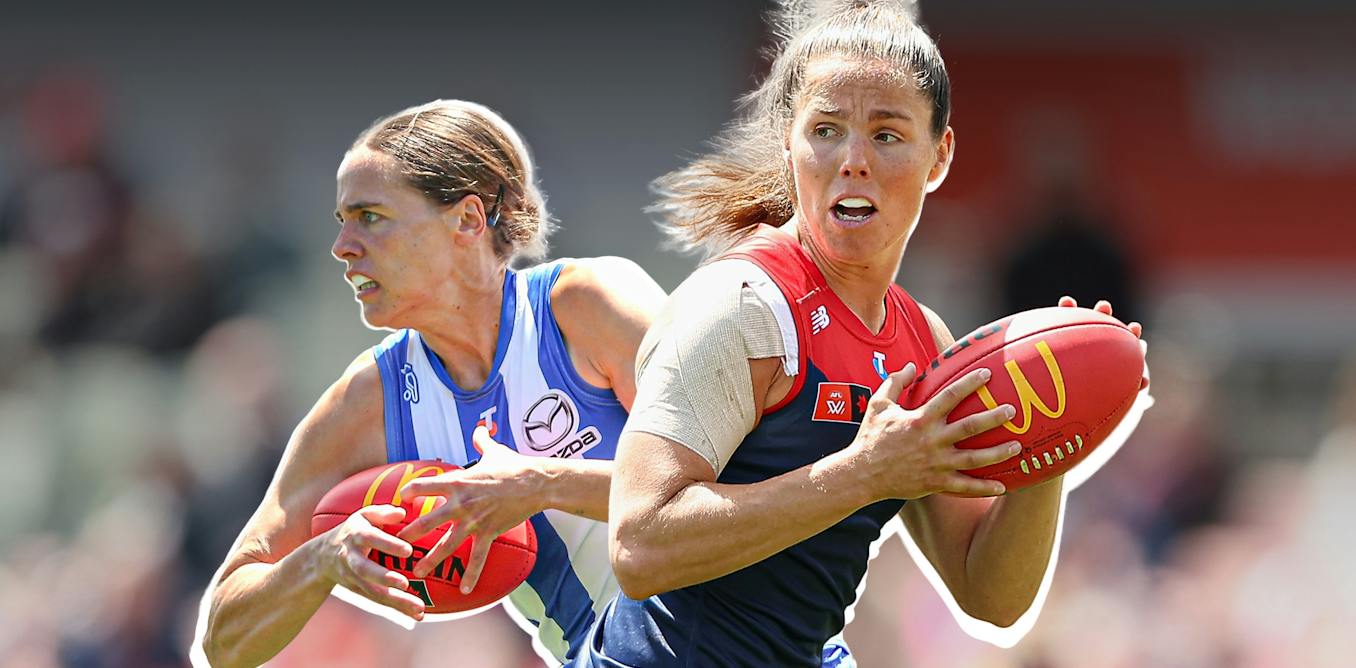
Tonight’s AFLW grand final might appear to be an impossible task for Melbourne as the Demons try to upset the league’s powerhouse: two-time reigning premiers North Melbourne. North is the deserved favourite, but the Demons should have some optimism, having secured a grand final berth after a stunning comeback against Geelong, then beating Carlton in last weekend’s preliminary final. Yet Melbourne’s task is enormous: the Kangaroos have lost just once since the 2023 Grand Final (their 32-game winning streak was broken by Hawthorn in September). The Roos are striving to become the first team in AFLW history to win three flags in a row. The match at Ikon Park is officially a sell-out, with 13,000 fans ready to cheer on a blockbuster decider. Robert Duong and Rob Prezioso/AAP How have North Melbourne become so good? North Melbourne goes into this match with an unchanged side as it tries to make history. But how have the Kangaroos become so dominant in recent years? On the field, many regard their midfield as the best in the business, with captain Jasmine Garner and star midfielder Ash Riddell leading the way. However, North Melbourne has become a powerhouse thanks to strong, consistent, supportive club structures for the AFLW program that promote sustained excellence and success. This includes a 2010 partnership with the University of Melbourne, preceding the AFLW competition by six years. AFLW commentator Chyloe Kurdas recently told the ABC the Kangaroos’ partnership with Melbourne University – whose players train at North Melbourne’s home base at Arden Street – helped lay the foundation. She said: It’s the groundwork North Melbourne did in 2009, 2010 to invest in the really early days, even before AFLW was on the radar. They used a lot of that intel to build a culture that was ready for women and girls to come into the game at a professional level. This early and genuine commitment to women’s football development, along with its investment in women’s leadership across the club, has been lauded. Although a couple of hours will determine the premiership decider, North Melbourne’s journey to the top has been achieved through longstanding, sociocultural and structural club initiatives. What about the Demons? Melbourne was one of the pioneers of AFLW, and the Demons were pace-setters in the competition’s early days. They regularly played finals and won the 2022 premiership. For the grand final, veteran Lauren Pearce returns as ruck, having missed the preliminary final due to illness. Icon Tayla Harris will play her 100th match – a remarkable achievement with the shorter AFLW season length. Reaching this milestone takes the best part of a decade, so a grand final for Harris’ 100th match is a fitting occasion. Similar to North Melbourne, the Demons’ sustained success over the competition’s history makes them a well-deserving contender. They have lost just twice in 2026. The psychology of favouritism – and being an underdog Most agree North Melbourne is the team to beat. Within the locker rooms, it won’t be said out loud, but it will be known. There are many pressures that come with being favourite, including the assumption of winning as default. In other words, the goal can become “don’t lose”. When winning is a baseline expectation, it can bring caution, hesitancy and doubt. How do favourites cope in big matches? The Kangaroos will likely be promoting a focus on usual processes that have got them to this point. They will be sticking to routine and preparing to be genuinely challenged. Their preparation has likely included picturing setbacks before they happen and rehearsing how to respond. Indeed, multi-sensory practices such as imagery, self-talk and attentional practices are believed to enhance performance. Perhaps surprisingly, Melbourne is likely adopting the same approach. However, its challenge includes building belief and preparing for the occasion, as opposed to handling expectation. For both teams, the message will be centred on self-belief and belonging – that the players are deserving of this opportunity. Dealing with uncertainty is vital The grand final boasts many elements of a classic showdown. Underdog and heavyweight. Return of a club leader. A possible fairytale celebration for an icon of the sport. That external noise may generate interest, but the players will pay little attention. Science tells us they’re correct to ignore these narratives and focus purely on their preparation, their teammates and their club. Still, optimal preparation is unlikely to decide the outcome of the match. Success in high performance sport is context-specific and largely unpredictable. And what we know about psychology among women athletes is evolving due to historical under-representation. Of course, this is an uncomfortable reality for elite athletes who train, prepare, and live in sporting systems that often associate rigidity, routine and preparation as cornerstones of excellence. And in many circumstances they can be. But a grand final brings about a context so unique – high stakes, sell-out crowds, and for many, a career pinnacle – that it is challenging to apply any traditional theory regarding approach to performance. As a psychologist, elite athlete mental health researcher and retired AFLW player, I do propose one view. Among all the unpredictable factors that shape tonight’s grand final, the one that may matter most may be how well players recognise, embrace and accept uncertainty. The team that accepts the unpredictability of the occasion and responds to it without trying to change it will likely emerge victorious.
How have the Kangaroos become such an AFLW powerhouse? And can the Demons upset them in the grand final?
Full Article
Original Source
Read the full article at Theconversation →KhanList aggregates and links to publicly available news content. We do not host full articles from third-party sources. Always verify important information with original sources.