
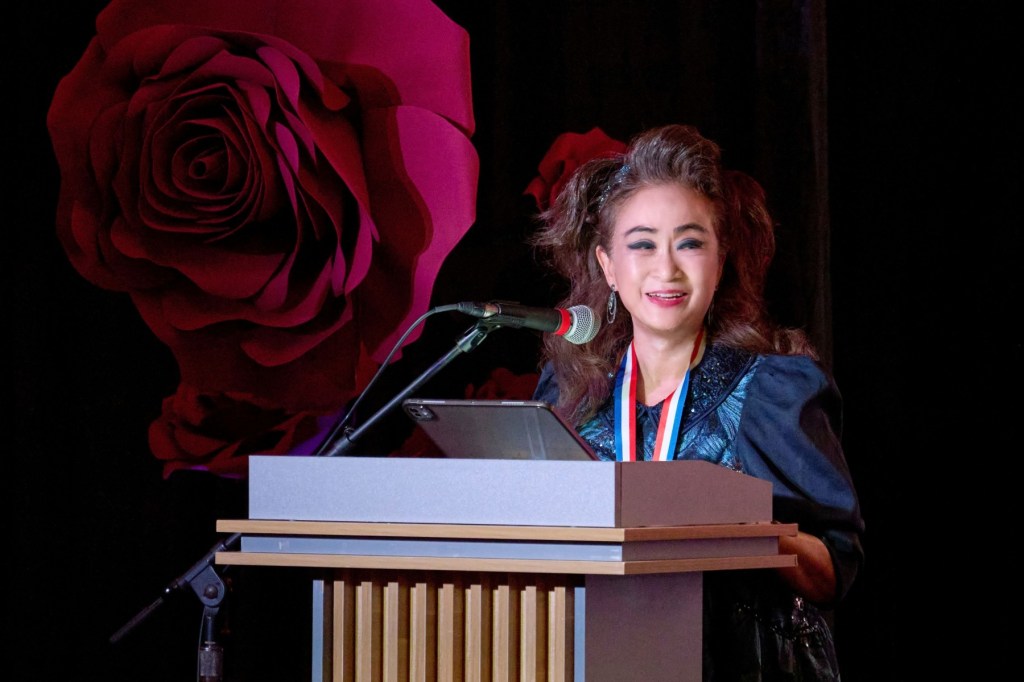
CJ Group Vice Chair Miky Lee has received the Centennial Medal of Lifetime Achievement from the Asian Hall of Fame during an awards ceremony in Los Angeles, which took place on Nov. 5. The honor shows how Lee has steadily built major milestones for both Korean film and K-pop over the years. The Asian Hall of Fame is a cross-cultural educational and research institution dedicated to recognizing Asian and Indigenous legacy, early-career achievement and interracial collaboration. In a given year, the Centennial Medal of Lifetime Achievement goes to only a handful of people, and recipients are chosen from figures who have built decades of global achievement and influence in fields such as culture, arts and entertainment. That sets the medal apart from the annual Class Inductees, which comprise a larger group of people. Related The award carries particular weight because it recognizes Lee’s role over the past 30-odd years as a bridge between Korea and the world. Throughout her career, she has widened the base for the global spread of Korean content and exchange between cultures. Billboard Korea takes a look back at what Lee has done to help build K-pop’s global infrastructure, and at what the Centennial Medal of Lifetime Achievement means. A key figure who reshaped the K-pop landscape While Lee’s name is familiar in the film world, she stated during her acceptance speech in Los Angeles on Nov. 5 that music was the starting point. “And me? I simply loved music,” she said, adding that music “has been at the heart of everything we’ve built in culture.” Lee is the figure who created and developed K-pop’s anchor points, building on music platforms that span broadcasting, distribution and live performance. The origin of the “K-survival audition,” a cradle for K-pop talent On July 24, 2009, Mnet’s Superstar K first went on air, raising the curtain on Korea’s first modern survival audition show. It went on to produce a long list of standout stars, and countless audition programs followed the show’s model. Lee had been the one to initially suggest that Mnet look into a program of its own after she had taken note of American Idol in the U.S. In 2016, Mnet’s Produce 101 carried the audition format over into idol survival and set off another craze. The Produce series went on to launch I.O.I, Wanna One and IZ*ONE. Boys Planet series gave rise to ZEROBASEONE and ALPHA DRIVE ONE, and I-LAND2 produced izna. Related The stage didn’t stop at Korea. In Japan, the PRODUCE 101 JAPAN series formed JO1, INI and ME:I, and KO1KEYZ debuted through 2026’s PRODUCE 101 JAPAN SHINSEKAI. Today, CJ ENM’s local label business in Japan is broadening its scope beyond audition-linked groups, extending to the development of Japanese boy band DXTEEN. The “K-audition universe” and “K-star development system” that Lee set in motion are still evolving. Next up is GIRLS PLANET 2027, a global girl group project in partnership with Universal Music Group’s REPUBLIC Collective. The show is targeting a 2027 premiere, and the two sides will collaborate on everything from production to the debut group’s global activities. Superstar K is also set to return next year with its first new season in 11 years, drawing attention from music fans. From Korea’s first music video awards to the Dolby Theatre: the MAMA AWARDS The MAMA AWARDS have long been one of the award shows K-pop fans both in Korea and abroad can’t help but look forward to. The show started out as the Mnet Video Music Awards, Korea’s first music video awards. The show combines Mnet’s stage production capabilities with artists’ talents to deliver visuals and performances that are talked about long afterward. Related The show’s signature slogan, “Music Makes One,” has become a signal that gets K-pop fans’ hearts racing at the end of each year. Lee invoked the term in her acceptance speech, saying, “‘Music Makes One.’ That was the dream. And the fans brought it to life.” After bringing music fans from around the globe together, the MAMA AWARDS expanded to stages across Asia. In 2024, the show planted its flag for the first time at Hollywood’s Dolby Theatre, the iconic home of the Academy Awards. Leading KCON as it grew into a global fan community Lee spearheaded the founding and expansion of KCON, the music and culture festival that launched in California in 2012. KCON was different from the start. Alongside concerts, it offered talk sessions, workshops and artist signing events. Back in 2014 and early on in their career, BTS took the KCON LA stage, with RM later stating in an interview with Mnet that the performance there was what first earned the group a strong response in the U.S. Related The road she has traveled, and the road ahead, as K-pop’s new frontier Alongside pop legend Lionel Richie, Lee was credited as an executive producer of KPOPPED, an eight-part music series released worldwide on Apple TV+ in August 2025. Produced by CJ ENM and Eureka Productions, the show pairs Western and K-pop artists to reinterpret existing hits and perform them in front of a live audience in Seoul. ITZY teamed up with Spice Girls’ Mel B and Emma Bunton, ATEEZ with J Balvin and Kylie Minogue and BLACKSWAN with Boyz II Men for musical reinterpretations on the Seoul stage. The series opened a new horizon for K-pop and moved beyond simply exporting finished products to proving that K-pop artists are shaping the game as “equal creators” alongside the world’s top artists. What it means for the “Godfather of K-pop” to present the Centennial Medal to the “Godmother of K-culture” The medal was presented to Miky Lee by Lee Soo-man, key producer at A2O Entertainment. When Soo-man was inducted last year, it was Miky Lee who introduced him as the “Godfather of K-pop.” Lee Soo-man opened his remarks by saying, “I have been waiting an entire year for this moment. Tonight, it’s my turn.” His speech showed a relationship that spans more than 50 years. Related “If I am the Godfather of K-pop, then Miky Lee is the Godmother of K-culture,” Lee Soo-man said, praising her contributions to culture. Their speeches doubled as a chronicle of Korean entertainment. Miky Lee looked back on the 1995 investment in DreamWorks and said, “We wanted to help lay the foundation for Korea’s entertainment industry.” She continued, “In the past, nearly 85% of songs on Korean TV were American pop songs, but by the 2000s, it was completely the other way around.” She traced the journey through Mnet, MAMA and KCON, and closed her acceptance by saying, “Now, it’s our turn to believe in the next generation.” The question that now lies is just how far the next generation will carry the K-pop frontier she has expanded.
How ‘Godmother of K-Culture’ Miky Lee Earned the Asian Hall of Fame’s Centennial Medal of Lifetime Achievement
Full Article
Original Source
Read the full article at Billboard →KhanList aggregates and links to publicly available news content. We do not host full articles from third-party sources. Always verify important information with original sources.