
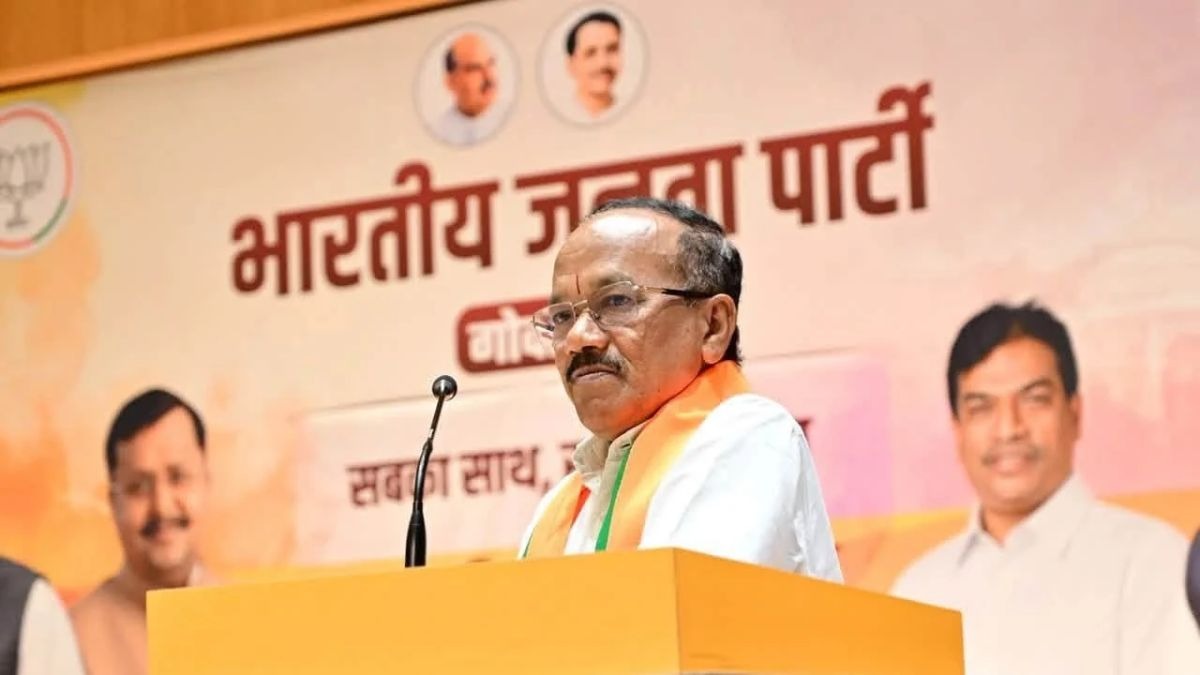
Four years after he rebelled against the party, former Goa chief minister and veteran Rashtriya Swayamsevak Sangh (RSS) hand Laxmikant Parsekar has rejoined the BJP. The re-induction comes at a time when the BJP is seen as trying to consolidate itself ideologically in the state after years of welcoming defectors, particularly from the Congress, the principal opposition force in Goa.Parsekar formally became part of the BJP in the presence of chief minister Dr Pramod Sawant, health minister Vishwajit Rane, BJP state president Damodar ‘Damu’ Naik and others.The BJP is caught in a tug of war with ally Maharashtrawadi Gomantak Party (MGP) over an alliance for the assembly elections due in early 2027. The MGP controls Mandrem, Parsekar’s traditional assembly seat in North Goa.After his return to the party, of which he was once a frontline leader, Parsekar claimed he had “not left the BJP but was [merely] out of it”. He stated he had not joined any other political party. Parsekar was Goa chief minister from 2014 to 2017. The three-term MLA had suffered a shock defeat at the hands of Dayanand Sopte of the Congress from Mandrem in the 2017 state elections.Sopte switched to the BJP and contested the by-election from Mandrem in 2019 as a BJP nominee despite reservations from the Parsekar camp. In 2022, an upset Parsekar left the BJP after the party decided to renominate Sopte from Mandrem for the assembly polls.Parsekar contested as an Independent and ended up at number three, but his presence in the fray is thought to have led to Sopte’s defeat at the hands of Jit Vinayak Arolkar of the MGP. Arolkar’s party was then in a pre-poll alliance with the Trinamool Congress (TMC). Parsekar had walked away with a section of the core BJP and Sangh Parivar vote, denting Sopte’s chances.The MGP has two MLAs in the 40-member Goa assembly—power minister Ramakrishna ‘Sudin’ Dhavalikar (Madkai) and Arolkar. Arolkar is said to have moved closer to chief minister Sawant and the BJP, and apparently even expressed willingness to take over as MGP chief from Dhavalikar’s brother and former minister Pandurang aka Deepak. A former police constable and volleyball player, Arolkar belongs to the OBC Bhandari community, the largest caste grouping in the state. While the MGP has said it is ready to ally with the BJP, it is eager to strike a hard bargain for more seats with its senior ally, which is facing growing anti-incumbency after three successive terms in power. It is likely that Dhavalikar may contest from Ponda instead of Madkai, which he has represented for six terms.Deepak may contest from Shiroda, which is held by Subhash Shirodkar of the BJP. Dhavalikar’s son Mithil is seen as the probable candidate from Madkai. In 2017, former chief minister Ravi Naik, who is the only member of the Bhandari community to become chief minister of the coastal state, defected to the BJP from the Congress and won from Ponda. The seat is vacant after his demise.“Laxmikant Parsekar’s return to the BJP is a signal that the party is seeking to close ranks and consolidate its ideological base, which saw heavy dilution over the years after the party welcomed and rewarded Congress turncoats with tickets while sidelining long-time leaders such as Parsekar,” said political analyst and journalist Gerard de Souza.“Parsekar’s inclusion adds heft to the BJP, which was short of a second-rung leadership after Manohar Parrikar’s passing, forcing the party to turn to Pramod Sawant, a relatively young and inexperienced face. Parsekar’s inclusion is also a signal to the BJP’s alliance partner that it is more than willing to play hardball over seat negotiations since Parsekar has set his sights on unseating the incumbent Jit Arolkar, who represents Mandrem assembly seat for the MGP,” he noted.Parsekar comes from a Kshatriya Maratha family affiliated to the MGP, which had a strong base in the Hindu Bahujan samaj, especially in the ‘New Conquests’ region of Goa. He first joined the RSS, and in 1989 was drafted to work for the BJP along with Rajendra Arlekar and Shripad Naik.At the time, Parsekar and Arlekar were the Pedne and Mormugao taluka karyawahs, respectively, of the RSS. Naik was the sanghachalak of the Tiswadi prant, covering Panaji. Around a year-and-half later, they were joined in by Parrikar, the first chief minister of Goa from the BJP.While Parsekar is a Maratha, Naik is a Bhandari and Arlekar a Dalit. Parrikar, who became the face of the Goa BJP, was a Saraswat. The Saraswats, who comprise both Hindus and Christians, are a small but influential community. These four leaders—an upper-caste Saraswat, Maratha, OBC and Dalit—were part of the social engineering of the BJP in the state. Naik is now a Union minister while Arlekar is the governor of Tamil Nadu.In 1994, the BJP allied with the MGP and four of its legislators were elected, marking its political opening in the state. The four included Parrikar and Naik. “During those times, working for the BJP was unheard of,” Parsekar had once told INDIA TODAY, adding that he had to leave his family home after joining the party. Although he would go home for festivals, he returned to his house only after being elected as MLA for the first term in 2002 by defeating MGP veteran Ramakant ‘Bhai’ Khalap, a former Union minister. Khalap is now with the Congress.Goa has a place of its own in India’s political history as the first state where a party came to power on a pro-Bahujan samaj plank. In elections held to the Goa, Diu and Daman assembly in 1963, two years after its liberation from Portuguese rule, the Congress, then a monolith in national politics, faced a massive drubbing at the hands of the MGP, at the time led by Dayanand ‘Bhausaheb’ Bandodkar, who became the chief minister. The Congress was being helmed by Purushottam Kakodkar, the father of later-day nuclear physicist Anil Kakodkar.The MGP had a strong base among Bahujans (or non-Brahmin Hindus) vis--vis the Congress, which was seen as an upper-caste formation. The MGP was opposed by the United Goans Party (UGP), which had support among the Roman Catholic Christians and sections of Hindu upper-castes. Bandodkar hailed from the miniscule but influential Gomantak Maratha samaj.Goa is also the only state where a referendum was conducted (1967) to decide on whether it should be merged into Maharashtra. The MGP was seeking Goa’s merger while the UGP wanted to maintain Goa’s statehood. Eventually, those against the merger prevailed.The MGP, which was later led by Bandodkar’s daughter Shashikala Kakodkar, and the UGP underwent a series of splits, and the Congress gradually gained ground. Today, the MGP is led by the Dhavalikar brothers, Brahmins who come from a family of priests at the Mahalaxmi temple at Bandivade. The MGP retains some of its base among the Bahujan Hindus (non-Saraswats and non-Brahmins in Goa), and in seats such as Madkai, Ponda, Shiroda, Priol, Mandrem and Pernem.Subscribe to India Today Magazine- Ends
How Goa ex-CM Laxmikant Parsekar's return to BJP is a signal for ally MGP
Full Article
Original Source
Read the full article at Indiatoday →KhanList aggregates and links to publicly available news content. We do not host full articles from third-party sources. Always verify important information with original sources.