
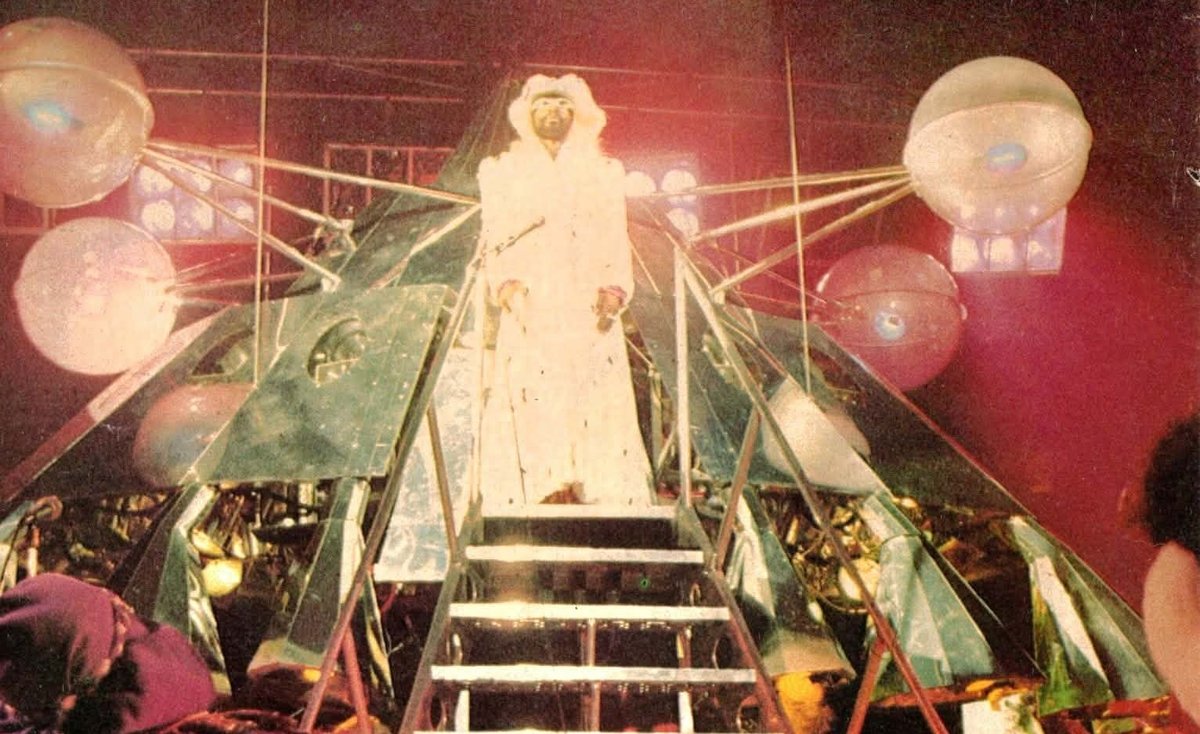
Daniel Bedrosian was just a teenager when the world’s funkiest spaceship blew his mind.It was the Boston-area stop of the 1997 Smokin’ Grooves tour, and the lineup had no shortage of stars: hip-hop group Cypress Hill, rapper Foxy Brown, singer Erykah Badu, and two young groups, Outkast and The Roots, that would soon become legends in their own right. But on this night, none of them could compete with George Clinton and the P-Funk All-Stars—or, more to the point, with Clinton’s ride.In front of thousands of fans, a lit-up, smoke- and firework-spewing flying saucer known as the Mothership—a 1,500-pound aluminum-and-glass craft featuring a 241-pound landing ladder—descended onto the stage and out popped Clinton. The crowd went nuts.On supporting science journalismIf you're enjoying this article, consider supporting our award-winning journalism by subscribing. By purchasing a subscription you are helping to ensure the future of impactful stories about the discoveries and ideas shaping our world today.“It was surreal,” says Bedrosian, who years later would become P-Funk’s keyboard player and author of the book Make My Funk the P-Funk. “It was absolutely like nothing I had ever experienced before.”October 27 marked the 50th anniversary of the Mothership’s first flight. Over that half century, the ship has risen from stage gimmick to cultural landmark, particularly in Black culture, and has earned a place in the Smithsonian’s National Museum of African American History and Culture (NMAAHC). It was also an audacious piece of engineering, arriving just as live music was beginning to look like the spectacle we now expect from arena headliners. Anyone who has gaped at the staging of a Taylor Swift, U2 or BTS concert has enjoyed the Mothership’s influence.“My understanding of the business in those days was that they were just starting to experiment with bigger, better, more exciting effects across the board,” says William Gorlin, a regional practice leader in the entertainment division of the engineering firm McLaren, an Affiliate of KCI. “Bigger set pieces, larger audio, better lighting.”Clinton had been performing since the late 1950s, but in the 1970s his career took off. By then he was leading two bands, Parliament and Funkadelic, known collectively as Parliament-Funkadelic, or P-Funk. Casablanca Records, Parliament’s label for much of the 1970s, was also home to the equally ostentatious KISS, and it gave Clinton the budget to put on the sci-fi shows playing in his head.“The number one inspiration was Star Trek,” says P-Funk archivist and historian Tim Kinley. “You have African Americans being put in conceptual situations where white people wouldn’t normally see them. You have, for example, African Americans all through all facets of government on the [Parliament] album Chocolate City. You had African Americans in space because, at that time, you saw on Star Trek Lieutenant Uhura.”The goal, says Kevin Strait, a curator at the NMAAHC, was to build a “vessel for the imagination” that could carry P-Funk’s “free your mind” ethos. The Mothership “offered audiences, particularly Black audiences, not only an epic visual spectacle but also a figurative means of transporting themselves beyond the hardships and constraints of everyday life,” he says.For the hardware, Clinton turned to two Tony Award–winning Broadway designers, Jules Fisher and Peter Larkin. With a production budget of around $275,000, equivalent to more than $1.5 million today, they created a roughly 20-foot-wide Mothership out of metal, plastic and glass. A much smaller model ship flew over the audience’s heads first, buying the crew time to ready the full-size Mothership for its landing.Keeping the ship flying night after night took around 100 roadies and stagehands, who had to disassemble it, load it up, haul it to the next city and reassemble it after every gig. “We’re talking about an army of tractor-trailers carrying various parts of the Mothership, as well as the other stage parts that went along with it,” Kinley says.The Mothership landed in dozens of venues, no two of them identical, and it had to work every time, whether it was descending from the roof of an arena in New York or one in Nebraska.The designers were also working with hardware that looks primitive by today’s standards.“Back in the day, most of the compact mechanical actuators”—the components that move stage machinery—“were hydraulic, and there was always fear of having hot oil over people,” Gorlin says. Today, he adds, electric linear actuators are opening up new possibilities for equipment that can hang over a crowd.There was no rule book, either. Modern productions must follow standardized safety codes, but in the 1970s, Gorlin says, there was “minimal regulation, if any, for touring sets,” whether the people at risk were onstage or in the audience. The ship never suffered a major mishap, but it did pick up some precautions along the way. After its first outing, Clinton got a handrail to hold onto because the crowd’s reaction had nearly knocked him off the platform. And the designers made the “smoke” with dry ice, frozen carbon dioxide, to ensure the band could still breathe as the ship came down.The original Mothership stayed on the road until 1981, then went into retirement and, eventually, a junkyard. When P-Funk’s popularity surged again in the 1990s, a replica brought back the landing, including at the show that blew Bedrosian’s mind. That ship later sat in storage at Clinton’s recording studio in Florida before making its final landing at the Smithsonian, where it’s on display today.An early sketch for the Mothership stage show offers a glimpse of the production’s wildly original design.Courtesy of Tim KinleyThe image of a white-suited Clinton popping out of the Mothership, outrageous in his appearance and his music, and in his vision of a future that was kinder to his people than the past had ever been, has outlived the original ship by more than four decades. It’s a legacy that “extends well beyond the world of funk,” Strait says. “It helped demonstrate that a live musical performance could be an immersive experience, bringing together sound, visual design and storytelling.”P-Funk still tours, and this year it has a new ride: a third Mothership, which made its debut in July at the Essence Festival of Culture in New Orleans. To prepare, Bedrosian and several bandmates joined Clinton at the Nashville warehouse where the new ship was kept, to rehearse the landing.“It’s all still very much a practical mothership,” Bedrosian says, meaning a real, physical machine. “As far as I can tell, it requires most of the same type of rigor” to land the ship as it did in the old days. It’s still a trip watching it descend all these years later—and now he has one of the best seats in the house.
How George Clinton’s Mothership landed onstage in 1976
Full Article
Original Source
Read the full article at Scientificamerican →KhanList aggregates and links to publicly available news content. We do not host full articles from third-party sources. Always verify important information with original sources.