
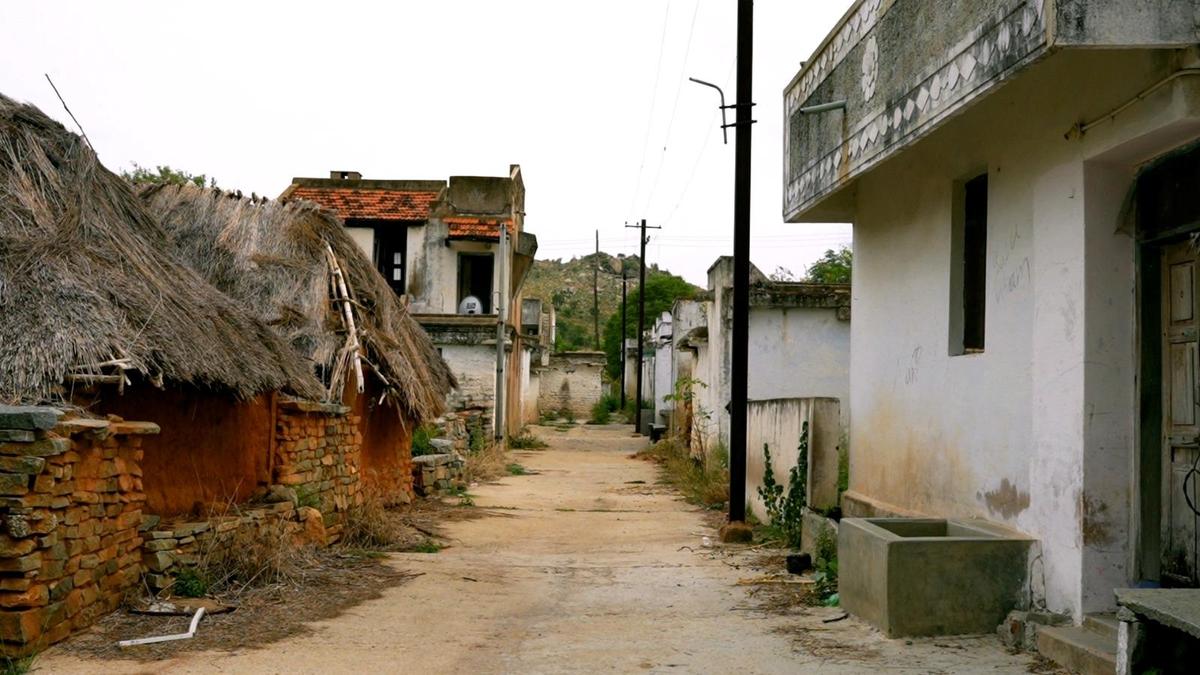
Seven hairpin bends above Kosuvaripalle panchayat of Tamballapalle mandal of Annamayya district, the tar road comes to an abrupt end. At the top of a 200-foot hillock is Gattumeedapalle village. It exists on paper, with streetlights that still burn every evening till dawn, a village temple, and an elementary school.Strange, not even a single resident is found. All sixty houses are empty, surrounded by an eerie silence, only to be disturbed by wind across the hillock.Once home to 60 joint families and around 500 people, this hamlet is now a textbook case of silent rural collapse.A cluster of strong stone-built houses, called ‘banda middelu’ in local parlance, constructed about six to eight decades ago, remains a testimony to the lapse of time, standing semi-dilapidated, engulfed by weeds and the walls turning old with neglect.Entering any imposing structure, one would find cold hearths, empty grain bins, and faded family photos on cracked walls. Even temple bells had reportedly been stolen long ago.In recent months, geologists, media, and nature lovers have turned their eyes to this phenomenon. What happened? Neither a flood nor a famine nor any ghastly past lies behind it.Gattumeedapalle was a groundnut village, known since pre-independence days. When the monsoons were favourable, each household harvested 200 bags. Farm labourers from as far as Punganur, Kolar and Palamaner camped here during the harvest season.People from surrounding villages were said to have frequented the hillock hamlet for loans. Ironically, today, its former residents eke out their livelihoods as farmhands downhill.“The trouble started in the 1980s. Rains failed monsoon after monsoon. Our people went for borewells in dozens, each 800 feet deep. All failed,” sighs Ramasubba Reddy, who left the village in early 2000.“Though we had drinking water, there was not a single drop for our crops. We came to realise that even our investments would not translate into return,” he says.With the gradual decline in cultivation, the village economy started dwindling. No transport, no jobs. The nearest provision shop was 2 km downhill on foot. Migration for livelihood gradually became a trend. At first, in the 1990s, one family climbed down the hillock and settled in Kosuvaripalle, the immediate downhill panchayat. Then another, then five, ten, and twenty and all. By the start of the new millennium, the entire hillock hamlet was empty.Many families migrated to Bengaluru, Kolar, Madanapalle and Tirupati in search of a livelihood and education for their children.Just before the 2024 elections, a fresh tar road was laid to the top of the hillock. “None of us asked any official for a road, which sounds like a big joke to us,” says a former resident, who now resides in Kosuvaripalle, requesting anonymity.“There is no scheme for scientific groundwater mapping in this hard-rock terrain. No official is bothered to look into the core of the village’s predicament,” he added.Rejecting the observations as a mere “blame game”, revenue officials try to silence the curiosity over it, saying “people might have left for better amenities and education.”Prof. T. Madhu, Professor and Head, Department of Geology, Sri Venkateswara University, told The Hindu that older generations settled atop the hillock, exploring groundwater sources through traditional methods of scanning with sticks and breaking coconuts, while hydrogeological surveys were unknown to them those days.“Basically, the entire hillock and the surrounding belt for several kilometres is a combined formation of quartzites, dolerites and dykes. With climate change and indiscriminate digging of borewells downhill and its surrounding areas, the hillock surface and the entire outcrop naturally went dry, with existing waters percolating down, ultimately suffering hydrological desertion,” he said.
How Gattumeedapalle in Andhra Pradesh turned into a ghost village
Full Article
Original Source
Read the full article at Thehindu →KhanList aggregates and links to publicly available news content. We do not host full articles from third-party sources. Always verify important information with original sources.