
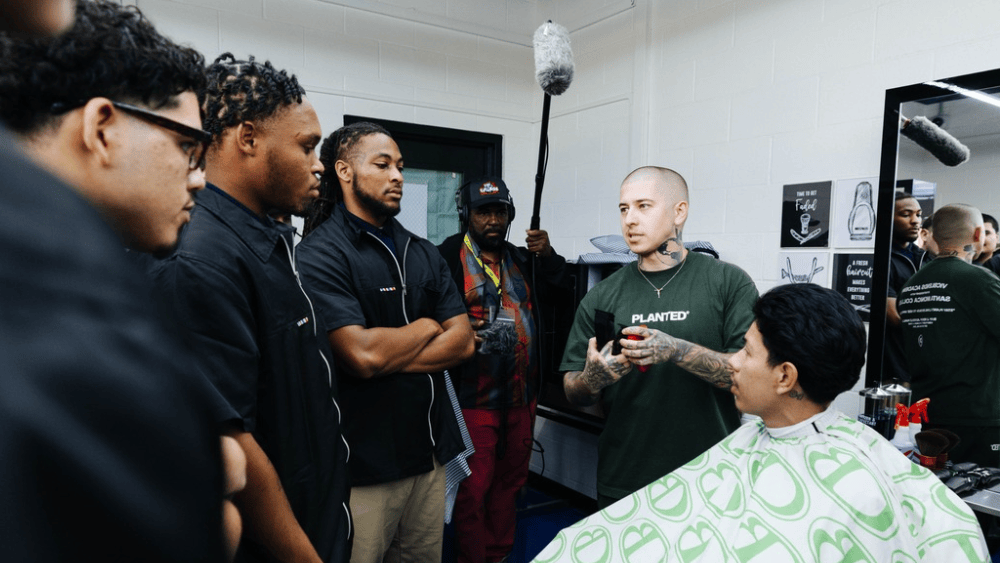
Film producer and Anti-Recidivism Coalition founder Scott Budnick has tapped a young, fresh face to help launch the latest vocational program in California state prisons: celebrity barber Victor Fontanez. Known on the internet as VicBlends, Fontanez has recently backed the first two barber programs in the history of the state’s prison system. After starting with Valley State Prison, the pair turned their attention to incarcerated youth. Last month, they unveiled a partnership with Santa Monica College to welcome 12 high school graduates currently housed at Barry J. Nidorf Juvenile Hall/Secure Youth Treatment Facility in Sylmar into a training program to prepare for California’s barber licensing examination. “I believe trade jobs are one of the most essential things in the world,” Fontanez, who has millions of followers across his social media platforms, tells Deadline. “Kids and people need an opportunity to see that there’s an extraordinary life full of purpose waiting for them without a college degree, without having to go through the regular textbook definition of what success is going to be like.” Watch on Deadline Budnick explains that he chose Fontanez for this partnership because he saw that the content creator already had the attention of many of the young people he worked with. It marks a long history of partnerships with celebrities and internet stars to bring attention to his work in anti-recidivism, which have also included work with Kim Kardashian and Common. Scott Budnick and Victor Fontanez at the Barry J. Nidorf Juvenile Hall/Secure Youth Treatment Facility Samuel Valdivia “I kept seeing a lot of the young people I work with in the jail and prison systems posting his motivational and inspirational content,” Budnick said. “I thought, ‘This guy is so cool, but he’s also so inspiring. I need to figure out how to reach him.'” In the interview below, the pair discuss more about how the partnership came together and what their plans are to expand barber programs — and other vocational programs — across the California state prison system. DEADLINE: Scott, could you tell me a little bit about how your partnership with Vic came together? How did you meet? SCOTT BUDNICK: Yeah, this was during Covid, so this was 2020. We were all online during that time, on Zoom and everything. I kept seeing a lot of the young people I work with in the jail and prison systems posting his motivational and inspirational content. I thought, ‘This guy is so cool, but he’s also so inspiring. I need to figure out how to reach him.’ I saw we had a mutual friend who worked in the NBA, so I reached out and said, ‘Hey, can you connect me to Vic?’ He connected me to Vic, and Vic thought the producer of The Hangover was reaching out to cast him in a role. Ultimately, I asked him if he’d consider visiting some prisons with me, because there were no licensed barber programs in the juvenile or adult systems. People were in there cutting hair, sometimes for years, but they couldn’t get licensed. They couldn’t turn it into a career until they were released. I thought, ‘What if we could get them through a year of barber school and get them licensed while they were still incarcerated, so they could come out to a real career?’ These are careers that can pay over $100,000 a year. I met Vic in 2021, [when] the Covid restrictions were relaxed, and we started visiting prisons. Vic, do you have anything to add to the story? VICTOR FONTANEZ: Yes, very accurate. I did think I was going to be a movie star. DEADLINE: There’s still time. FONTANEZ: I get this random call from Scott in the middle of the night. Our mutual friend had told me we would connect. I didn’t know what to expect, other than that this guy makes movies. When he told me these kids watch my videos, he asked if I’d ever be open to coming to see them. I really live through purpose, and I believe I have a purpose here to inspire. I don’t believe that looks one way or applies to only one group of people. Wherever I feel called to do so, whoever needs it, I’m willing to show up. So the immediate answer was yes. Two weeks later, I found myself in L.A. at a prison with Scott for the first time. That was my first time inside, so I got to see a couple of different vocational programs. I remember sitting there with Scott and being like, ‘Oh, where’s the barber program? Could we go see that?’ We learned right there that there had never been one in the history of incarceration in California. For 173 years, California has had prisons, and people there have never been able to become licensed barbers. There are tens of thousands of barbers, maybe even more, currently locked up across California who cut hair every day for all the inmates. Giving them a chance to obtain a license is life-changing. It gives them a second chance when they come home. It empowers them to use their pain and turn it into purpose, and to use their story and experience to help the people who sit in their chair become better for themselves. Scott and I have been linked since then and have grown a tremendous friendship. He’s one of the best guys in my life. That’s how we got started. It took us about five years to open the first one, and we recently opened our second, which is the first ever in a juvenile detention center. We did the first one ever in California, period, and then the first for juveniles. They’re two very different lays of the land. BUDNICK: And then in 2027, we’re doing one in the oldest prison in California, San Quentin. DEADLINE: What’s the process to actually get one of these programs off the ground and implemented? BUDNICK: It’s a lot of bureaucracy, because you’re dealing with state or county government. It’s a lot of bashing your head against the wall, trying to get them to move as quickly as we’re used to moving. For the one we just did in the juvenile facility, we had Santa Monica College as a partner, and they already have an incredible barber program. We love that these young kids can start the barber program inside juvenile hall and, when they’re released, continue on the campus of Santa Monica College, surrounded by supportive youth and faculty. I’d been working with juveniles locked up in that same juvenile hall for 22 years. I’ve been going there every week since 2004, so I had a very good relationship with the people running it. We were able to shortcut a few things, but both programs took three to four years to get up and running. These are things we could probably do in the private sector in six months. DEADLINE: To that point, Scott, you’ve been doing this a long time. Can you talk about how impactful it can be to have institutional support behind you, with Santa Monica College or other institutions willing to step in and put effort behind this? BUDNICK: I think it’s huge, because Vic and I aren’t required to find the instructors, figure out the curriculum and do all those things. It comes baked in. Vic and his brand, the VicBlends Academy, just make it cool. It makes the participants, whether they’re kids in juvenile hall or adults in state prison, really want to get involved and makes it a very cool career. All of it matters: the facility and, in the case of Valley State Prison, the warden being super supportive and saying, ‘I want to get this done immediately.’ Once he got involved and helped push, it moved really quickly. It was the same thing with some administrators in the juvenile facility. Once they really wanted it to happen and got involved, it happened. It’s all people. Some people are complicated, and you have to move those complicated people out of the way. Other people, when they really want to make something happen, make it happen. We were able to find the people who wanted to make it happen, and then we moved. DEADLINE: Vic, what has it been like for you to go into these prisons and see the impact of these vocational programs, and also see how impacted they are by you and your brand already? FONTANEZ: It’s very life-changing, seeing the transformation of some guys, especially youth offenders who have been in troubled neighborhoods, [who] haven’t had equal opportunity and have come from broken homes — not the foundation a lot of people have been blessed to grow up with — and then seeing the mistakes they made, but also seeing the new person they are years after rehabilitating themselves, is incredible. They’re not the people who walked in. If you asked everybody whether they wanted a safer neighborhood, everybody’s answer would be yes. It’s a unanimous decision. To do that, we just need opportunity and education. That’s the only way to really fight recidivism and make an impact: giving equal opportunity to everybody. Being in there, hearing their stories and hearing them be human — when we opened the first school, someone mentioned to me, ‘This is the first time that they felt human in a long time when they walked through these doors.’ That always stuck with me. A lot of these guys are just waiting for an opportunity to prove themselves. Scott said the other day that two things really help people change their lives: family support and an opportunity to change. The pride we’ve seen our students have stepping into the school has been incredible. They’re so proud to become barbers. They’re so proud to have a brotherhood in there, a goal and something to work toward every single day. DEADLINE: Your first cohort through Santa Monica College will graduate next fall, or they’re expected to. What are you looking forward to about seeing that first cohort graduate? FONTANEZ: I’m excited to see results. We’re excited to see a changed person from day one of the program to the last day. We’re excited to see these guys come home and have this opportunity to give back to the community. I’m excited to watch the transformation. Scott’s been doing this a long time, so he’s seen people over the last 25 years, from day one until today. I’ve seen a lot of the guys Scott has known, so I get this opportunity to have that same experience of watching the growth happen in real time. I’m really looking forward to these guys coming home and crushing it as barbers, and to giving them all the support they could want or ask for when they do come home. It’s going to be incredible. DEADLINE: Scott, how are you planning on expanding this even further? What’s your next step here? BUDNICK: We’re definitely going to do San Quentin next, which is exciting. But there are all types of other programs I’m interested in. San Quentin has an incredible film program, and I’ve been supporting the filmmakers inside San Quentin. I want to bring that down to the juvenile facility, too. In the same facility where Vic just started the barber school, the juvenile hall, Common, the rapper and actor, just started an audio engineering and music production program that we’d like to expand. I feel like giving young people hope and opportunity, along with real training and a real career, not only changes their lives and their families’ lives, but is also great for public safety. I’m all in for all of it. DEADLINE: You’ve mentioned a lot of fields, whether it be barbering or audio engineering or film production, that are very hands on and allow people to create something of their own. How do you see that impact them? FONTANEZ: I believe trade jobs are one of the most essential things in the world. Kids and people need an opportunity to see that there’s an extraordinary life full of purpose waiting for them without a college degree, without having to go through the regular textbook definition of what success is going to be like. We need barbers. I think all of us saw that during Covid, when none of us could get haircuts, the power of a haircut, [and] what it feels like to have a mentor, a friend, a barber. Trade jobs are extremely important — not just barbering, but also filmmaking, editing, making music, plumbing and electrical work. At Valley State Prison, where we have our first program, we’re on a road toward 10 vocational programs, showing these guys how to repair bikes, do masonry, code and do all types of different trade jobs that don’t require a college degree. I believe one of the most important things is for kids to know there’s another chance at success and a life full of purpose outside of just the traditional path of going to college. DEADLINE: Was there anything you think I missed, or anything else you wanted to add about this program or any of your programs? BUDNICK: No. You’ve got to come in person to San Quentin. FONTANEZ: Just in conclusion, Scott and I started this initiative years ago, but it wasn’t possible without all of our partners. Scott and I are a small piece of a large team, and this school and all the schools we’re going to open should be a representation of second chances, hope and what a team can do. This isn’t possible with just the two of us. We want to credit Barry J. Nidorf, Santa Monica College, L.A. Probation and BabylissPRO for being our sponsors for both programs. J.P. Resin is important. They laid the floor and did a lot of the grunt work to make the concrete look pretty again. This is collectively a massive team effort. Scott and I look forward to working with San Quentin on our next venture and doing the same thing as many times as we can throughout the state.
How Film Producer Scott Budnick & Celebrity Barber VicBlends Teamed For A New Training Program In California Prisons
Full Article
Original Source
Read the full article at Deadline →KhanList aggregates and links to publicly available news content. We do not host full articles from third-party sources. Always verify important information with original sources.