
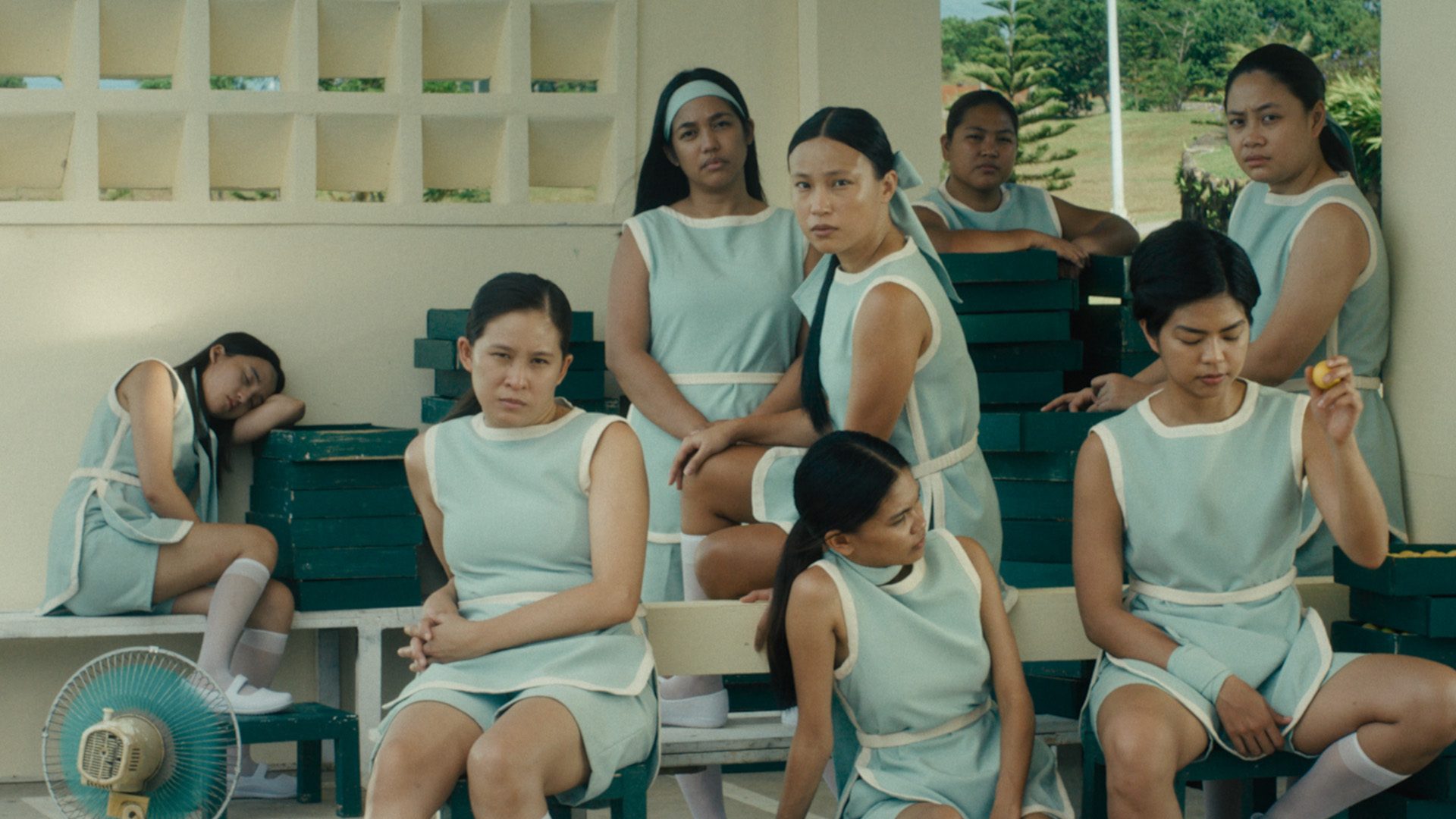
Filipinos face a complex relationship with extreme heat, which has significant social and economic impacts, as highlighted in the film 'Filipiñana'. The film explores themes of class disparity and personal fulfillment through the story of Isabel, a young tee girl at an exclusive country club, juxtaposing her experiences with those of residents in a water-scarce neighborhood. Despite critiques of its slow pace, 'Filipiñana' is praised for its visual storytelling and deeper commentary on Philippine society, colonialism, and the quest for identity. This is AI-generated. Read the article for full context. Report any errors. Content warning: Minor spoilers ahead. Filipinos have a complex relationship with the tropical heat. We’re used to getting sweaty all our lives, even during the times we don’t even move that much: sitting in random establishments, wandering idly in our homes, or standing in line, waiting for something (an activity Filipinos have been well accustomed to, because everything feels ironically slow in our fast-paced society). But as mundane as it may seem, the extreme temperature isn’t to be underestimated. A Greenpeace report shows that heat stress is pushing Filipinos into a “climate poverty trap.” Heat has lingered in our lives so much that it has caused class suspensions and economical disruptions, among other things. In the Filipino film Filipiñana, though, heat isn’t only a villain; it’s a catalyst to expose bigger evils. The satirical debut feature of Rafael Manuel — who also wrote and edited the film — follows Isabel (played by Jorrybell Agoto), a 17-year-old “tee girl” who’s new to the job in an exclusive country club. Her responsibilities include assisting golfers in setting up golf balls at the hitting bay. One of them is Dr. Palanca (Teroy Guzman), the club’s president, whom Isabel gets strangely drawn to. Jorrybell Agoto stars as a 17-year-old tee girl. Filipiñana film still Before hitting the local cinemas, Filipiñana graced the international festival circuit through the Sundance Film Festival — where it took home the Special Jury Award for Creative Vision — and the 76th Berlinale. Bianca Balbuena, one of the film’s producers and CEO of Epicmedia Productions Inc., shared in an interview with Rappler: “This is the project where I got to deal with big studios mostly doing English-speaking films, the complicated but rewarding UK system of legal, financing, and closing.” “We also have a UK distributor, BFI [Distribution], so I am excited to discover a wider UK audience. I am also learning a lot from our Oscar-winning distributor Kino Lorber and our PR companies in North America, Divergent and Cinetic, on how to push and market our local films to the Western market.” The paradox of water Filipiñana happens over the course of one day. It starts off strong with its juxtaposition of two contrasting scenes, showing class disparity. There’s a cramped Manila neighborhood where residents scurry to fill their jugs with water, a scarce resource. Their chaotic state gets even more rattling when they almost get hit by a tourist van, ridden by the country club visitors, who are protected from the drought thanks to their air conditioning. Meanwhile, the golf course catering to high society has an abundance of water — sprinklers and water fountains are for everyone’s convenience, even to the rich who can’t seem to stop complaining: “Grabe, ang init, parang galit na galit ang Diyos sa atin (Wow, it’s so hot, it’s like God is so angry at us).” Thirst is a strong emotion in the film, and is experienced by almost everyone — whether it’s for a new discovery, self-expression, or personal fulfillment. Everyone can’t seem to feel satisfied with what they have now, and are always left wanting more. But you’ll have more empathy for the tee girls who’d put themselves in discomfort, just to catch some cold air conditioning because their electric fans won’t cut it in the sweltering heat. For a relatively quiet film, it told a lot. A reasonable slow burn Filipiñana had its Cinemalaya 2026 run as the festival’s closing film, its Philippine premiere, with some critics pointing out how it’s awfully slow, that you could easily fall asleep before the credits roll. While its slow pace is heavily felt, it’s intelligently done, as it lies in intention. Its slowness probably means lethargy — how the extreme heat pushes you to take things in slowly, or discourages you to take action. “As our great cinema icon Lav Diaz says: ‘It’s just cinema.’ We feel that to group a film into a category just based on the pace of the film would do a great disservice to the audience,” Balbuena said. “There are so many kinds of films to explore and discover. We would say don’t be fooled by the term ‘slow cinema’. It can move you with incredible emotion and even overwhelming violence. Pacing and technique are just ways to tell a story,” she added. “Filipiñana is different from most films we’re used to as [a] general audience, because the film is more formalist than narrative. It takes a certain kind of openness to accept that. And that is, in fact, counterflow cinema.” Since the POV we’re following is Isabel’s, the slow burn also makes sense. It’s her first day on the job, and for someone so young in that disposition, it would take some time to absorb (and revisit) some horrors. “For us, it’s always been about the portrayal of innocence — about innocence lost but ultimately, humanity gained,” Balbuena stated. “The film is a coming-of-age. Her growing up has a lot to do with her turning inward into memories, which she has suppressed or forgotten. This is a representative of a malaise plaguing our country — we have a short collective memory as people.” Picturesque eeriness Even if the film’s audience is torn between liking or disliking its pace, what they can probably agree on is that it’s the epitome of picturesque. Every frame packs striking color palettes, flawless blocking, and overall jaw dropping production design. This reflects the team’s ambitious creative choices. “I’ve also learned that when we have big support, we can do production the proper way. We shot for over 50 days in eight golf courses and took care of the well-being of the staff and cast. We do rehearsals in the morning and shoot in the afternoon. It was a breath of fresh air — how this production was run,” said Balbuena. Does this make perfectionism a healthy trait to cultivate in filmmaking? “[It] depends on the goal and purpose. If it’s perfectionism with the goal of doing things the right way based on a moral stance, then yes. But we also believe perfectionism is the enemy of creativity,” argued Balbuena. Perfectionism also spilled over to the movie. There’s an eerie kind of synchronization in the actions made by the swimming pool cleaners to the staffers fixing the chairs and tables. Everything is well-choreographed, as if to cover something dark and twisted. Ilocos as an anchor As both Isabel and Dr. Palanca hail from Ilocos, you’d initially think that this becomes a sacred similarity. However, this profound (one-sided) connection also becomes Isabel’s portal to a wakeup call, as exhibited to the timing of when “Manang Biday,” a traditional Ilocano folk song, plays in the film. “Ilocos, as you already know, is a rural northern region in the Philippines that is of immense political significance — it’s where infamous dictator Ferdinand Marcos hails from,” explained Balbuena. “And now, less than 40 years after he was ousted from power, his son is the current president of the Philippines. Ilocos is also where Jorrybell Agoto, who plays Isabel, was born. So it was a very natural choice.” A post-colonialism portrait Ultimately, Filipiñana portrays Philippine society rooted in American colonialism. And it’s a clever creative choice to inject it right in the title. “When you look up ‘Filipiñana’ in a dictionary, it’s defined as anything that relates to Filipino culture and I liked the juxtaposition of matching that with the image of a golf course,” Manuel tells Rappler. “Because although it’s not the first thing that comes to mind when one thinks of the Philippines, I think a golf course encapsulates our country quite well. I also think of it as a play on Americana but with an “ñ” (which is used in Spanish) so with one word — “Filipiñana” — you allude to both our colonial histories.” But zooming into the film, you’ll feel that this isn’t where it all ends. When a default Mandarin greeting gets repeatedly taught to the tee girls to welcome Chinese tourists — to the point that it almost feels robotic — you could sense how Isabel suddenly wants to take control of what she can, even in ways you can’t explain. So, you almost completely get it when she hits a mango with a golf club, or jumps into unknown waters, just to feel something. – Rappler.com
How ‘Filipiñana’s’ slow burn exposes the Philippines’ class divide
Full Article
Original Source
Read the full article at Rappler →KhanList aggregates and links to publicly available news content. We do not host full articles from third-party sources. Always verify important information with original sources.