
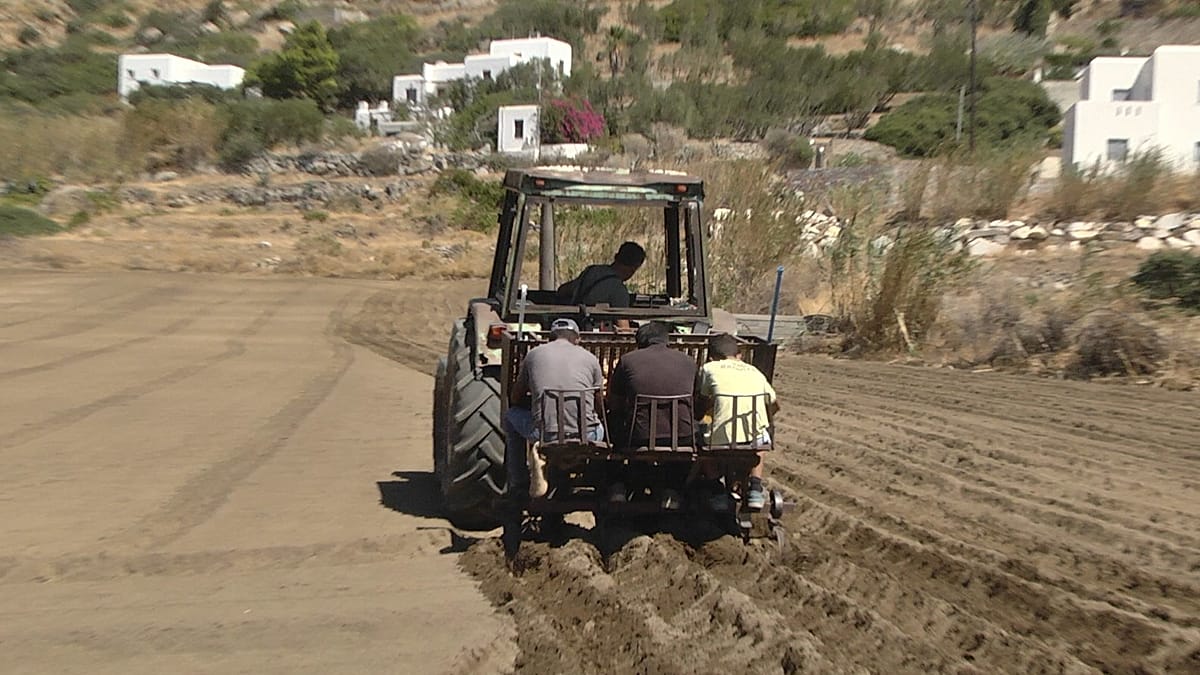
Naxos is the largest island in the Cyclades and its eponymous variety of potatoes has been grown here since the late 18th century. Sold all over Europe, the crop is an important part of the local economy. Sowing and harvesting takes place twice a year with the second time happening every September. Euronews went to meet Naxos potato farmers and learn more about a crop under threat. ADVERTISEMENT ADVERTISEMENT We meet Stelios Vathrakokoilis, one of the biggest potato growers on Naxos and President of the Galanado Agricultural Cooperative, and ask him what makes the island’s potatoes so special. "First of all, we have abundant sunshine almost all year round," he says. "Second, we have the sea all around us, at a distance of three to four kilometres. Third, we use cow manure on our fields, as much as we judge necessary, and the fourth and most important factor is that our subsoil lacks certain elements. That element is calcium. If, in these areas, you grow tomatoes or vegetables without adding fertilisers, they will start rotting on the back side of the fruit. That means a lack of calcium. Potatoes are not bothered by this. So it is the absence of calcium from our soils that gives the potato about 80 per cent of its distinctive flavour." Young people don't want to farm potatoes anymore In the 1980s, annual production of Naxos potatoes reached 15,000 tonnes. Every member of a family worked on the crop. Families today are smaller and children follow other career paths. Some 300 families on the Cycladic island are involved in potato farming today and production has dropped to a mere 5,000 tonnes. What is a fake Naxos potato? In 2010, the Naxos potato was granted protected status. This means that potatoes must be given the seal of approval before being able to be sold under the Naxos potato label. Farmer Stelios Vathrakokoilis explains that some package up potatoes as Naxos when they are, in fact, inferior varieties. "We started marketing Naxos potatoes first through the AB Vassilopoulos supermarket chain. A year later, Sklavenitis came in very strongly, followed by all the chains, so that all this product was going straight onto supermarket shelves." "But even there, some fraud takes place. I don’t know who, but certain people buy potatoes from other regions, even other continents, especially Egypt. They take them into their packing plants, package them and sell them as Naxos potatoes." "This happens even more in the street markets. If you walk into a market with 20 or 30 stalls, you will see all of them claiming to sell Naxos potatoes. They are not from Naxos. Out of forty stalls, perhaps one or two sell the real thing. Everyone calls their potatoes Naxos because the price is higher and the taste better. The upshot is that consumers can find genuine Naxos potatoes in 99 per cent of cases only on supermarket shelves. Only there will they find them." Water and labour shortages threaten the future of Naxos potatoes The shortage of labour has become acute in recent years and is a serious concern for farmers - it is very difficult to find workers with the legal right to work. Water shortages are also an issue. More residents and tourists on the island along with prolonged drought means water resources are spread much more thin. Farmers have to buy expensive water from the municipality, supplied from desalination plants. Farmer Stelios Vathrakokoilis is sounding the alarm for the future, seeing production shrink and problems multiply: "The basic precondition for having production is manpower. A second point, and what I see when I look ahead over the next five to ten years, is that we will be searching with binoculars to find a farmer, not only on Naxos but across Greece." "It makes no sense for one 'stremma' of land to leave €1,500 in a Dutch farmer’s pocket, €1,200 for an Israeli farmer and €50 for a Greek farmer. It can not go on like this! Clearly we are doing something wrong. We are still using traditional methods, techniques from decades ago, and we are not moving towards something different, such as hydroponics or similar systems, with smaller areas, better working conditions and more income." "What I see is that in 5–10 years there will be no Greek farmers left anywhere in the country. And I think this is broadly a European issue as well, as we can see from the protests farmers are staging in France and Germany." "It is not sustainable to pay €2.5 per litre for diesel fuel, to have fertiliser prices through the roof, seed prices through the roof and monthly wages of around €2,500. If you try to farm under these conditions, you will end up completely in the red," stresses Stelios Vathrakokoilis. The local farmers union is trying to help This year the Union of Agricultural Cooperatives of Naxos marks a century of activity. It stands by the producers and works to solve the many challenges facing the island’s agricultural and livestock sectors. The Union’s goal is to support both the product and the people who grow it: "Naxos potatoes are not just another product. They are the history of the place, its production, its economy. They are the wealth of the farmer and the livestock breeder," Dimitris Kapounis, President of the Union of Agricultural Cooperatives of Naxos, tells Euronews. "Potatoes arrived on Naxos before the time of Kapodistrias, so you can see the passion, the love, the genuine cultivation of the land in this chapter we call Naxos potatoes," he says. Every year the island hosts a major festival celebrating the potato. The 17th Potato Festival was held on 12 September at the port of Naxos. The centenary of the founding of the Union of Agricultural Cooperatives of Naxos was celebrated at the same time. More than 3,000 people took part in the event in Nikiforos Mandilaras Square, alongside local organisations and representatives of the farming community. Residents and visitors sampled different recipes in which Naxos potatoes took centre stage, and enjoyed performances by musicians and dance groups.
How fake Naxos potatoes and modern ambitions are threatening the future of a world-renowned crop
Full Article
Original Source
Read the full article at Euronews →KhanList aggregates and links to publicly available news content. We do not host full articles from third-party sources. Always verify important information with original sources.