
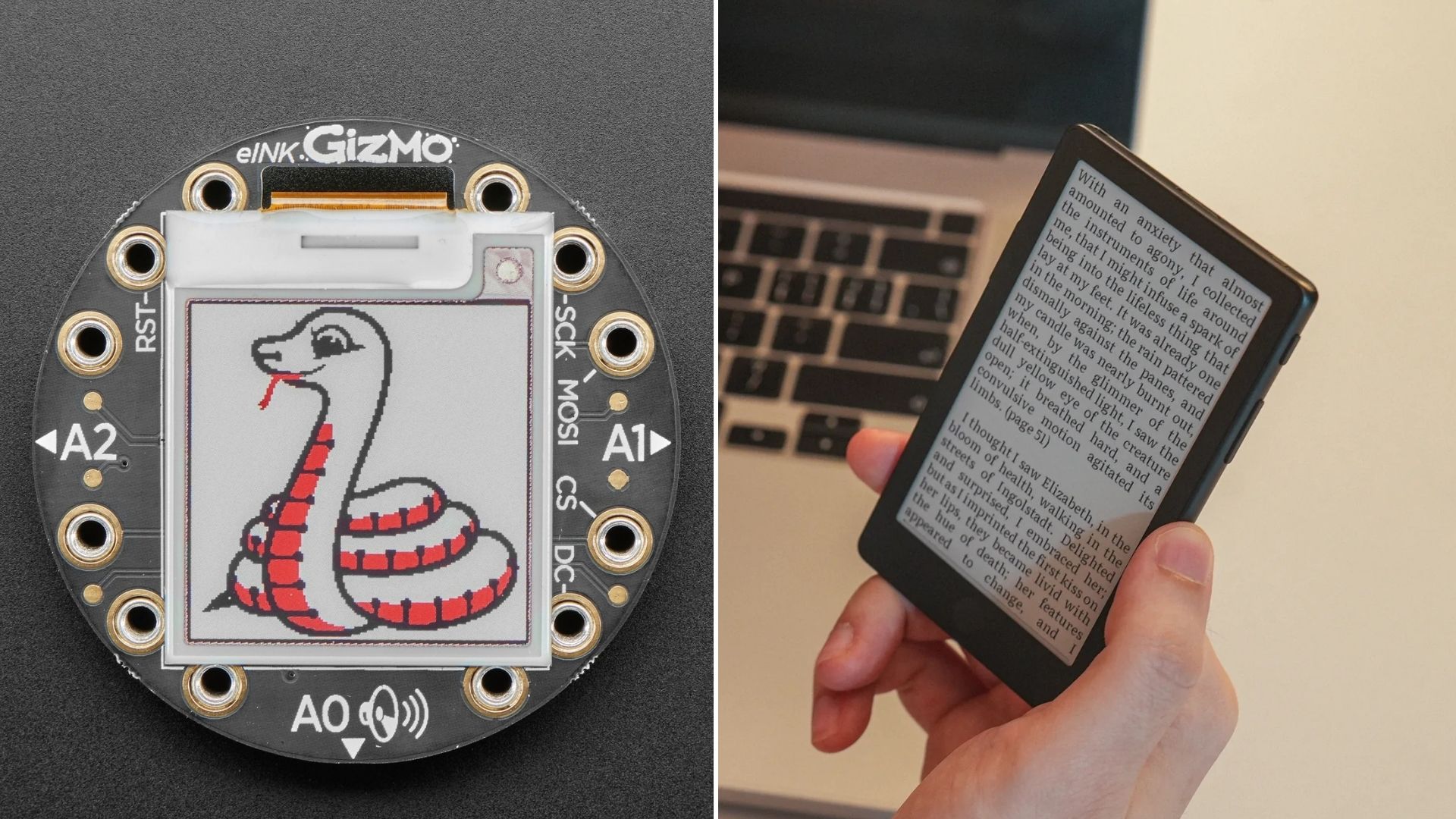
E-ink displays can look almost suspiciously like paper. They don’t glow like a phone screen, remain readable under bright sunlight, and can display the same page for days without constantly drawing power. Yet beneath that paper-like surface is a surprisingly simple bit of physics. Millions of tiny charged particles move around in microscopic containers. The technology is officially known as an electrophoretic display, or EPD. It is used in e-readers, electronic shelf labels, digital signage and an expanding range of low-power devices. Tiny capsules full of moving ink At the heart of a conventional black-and-white e-ink display are millions of microscopic capsules. Each is roughly the diameter of a human hair and contains a clear fluid with electrically charged pigment particles suspended inside it. In a common two-particle system, the particles are black and white and carry opposite electrical charges. The capsules sit above an electronic layer that can apply a controlled electric field to individual areas of the display. Apply one polarity and the white particles move toward the top of a capsule. Reverse the field and the black particles move upward instead. What the viewer sees therefore depends on which particles are positioned at the surface. This movement is called electrophoresis. Charged particles move through a fluid in response to an electric field. The same basic principle was demonstrated in early electronic-paper research, including the microencapsulated electrophoretic ink described by researchers at the MIT Media Lab in a 1998 Nature paper. There is no backlight This is where e-ink takes a very different route from an LCD or OLED display. A phone or laptop screen produces or controls light that travels toward your eyes. Traditional LCDs use a backlight, while OLED pixels generate their own light. E-ink is reflective. Instead of producing the light you see, it uses ambient light, reflecting it from the pigment particles at the surface much like ink on a printed page. The brighter the surroundings, the easier the screen can be to see. That is why an e-reader can be remarkably comfortable to use outdoors on a sunny day while a conventional display may become harder to see. E-readers can still have a light for reading in darkness, but it is generally a front light that illuminates the surface rather than a conventional display backlight shining through the screen. The clever trick: the picture stays put One of the most important properties of electrophoretic displays is bistability. Once the pigment particles move into position, they can stay there without continuously applying power. The electronics need electricity to change the image, but not simply to keep an existing image on screen. That means an e-reader can display a page for hours while consuming essentially no display power between updates. E Ink says its displays consume power only when the image changes, with the energy required for an update depending on the display and operating mode. It is one reason e-ink devices can achieve battery life measured in weeks rather than hours. So why does e-ink refresh so slowly? There is a tradeoff for all that efficiency. LCD and OLED pixels can change extremely quickly because they control light electronically. E-ink has to physically move pigment particles through fluid. That makes its refresh behavior fundamentally different. Modern E Ink displays have multiple refresh modes, and the company says some can update a full display in as little as 120 milliseconds. The technology is still generally slower and can produce visible flashing or ghosting during certain transitions, which is perfectly acceptable for turning pages or reading a document. But it is considerably less ideal for fast video or action-heavy games. What about color? Color e-ink works by adding more types of charged pigment particles or using different display structures. E Ink’s color technologies include systems using black, white, red, and yellow particles, while other approaches can produce a broader color range. Its Advanced Color ePaper technology, for example, uses colored particles rather than relying on a conventional LCD-style color filter array. Color e-ink therefore remains reflective and low-power, but there is another tradeoff: color electrophoretic displays generally cannot match the brightness, saturation, and refresh performance of modern OLED or LCD screens. Why e-ink still matters E-ink is not trying to replace your smartphone display. Its advantage comes from doing less. It reflects rather than emits light, holds an image without continuously consuming display power, and can remain readable in bright environments. That makes it especially useful when the priority is information rather than animation: books, labels, signs, notes, and other content that doesn’t need to change every millisecond. In a world increasingly filled with glowing screens, e-ink’s cleverest trick may simply be knowing when not to glow. Get the latest in engineering, tech, space & science - delivered daily to your inbox.Kaif Shaikh is a journalist and writer passionate about turning complex information into clear, impactful stories. His writing covers technology, sustainability, geopolitics, and occasionally fiction. A graduate in Journalism and Mass Communication, his work has appeared in the Times of India and beyond. After a near-fatal experience, Kaif began seeing both stories and silences differently. Outside work, he juggles far too many projects and passions, but always makes time to read, reflect, and hold onto the thread of wonder.
How electrophoretic e-ink displays create images without a backlight
Full Article
Original Source
Read the full article at Interestingengineering →KhanList aggregates and links to publicly available news content. We do not host full articles from third-party sources. Always verify important information with original sources.