
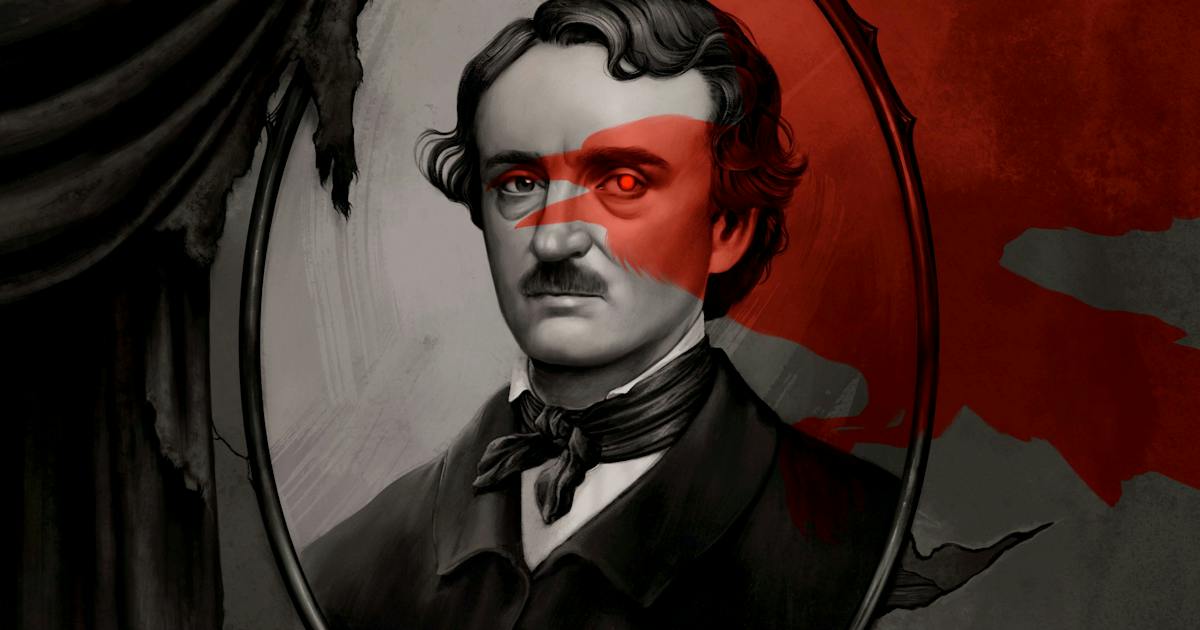
Edgar Allan Poe can be difficult to take seriously. His contemporaries condescended to him, regarding him as talented but childish and undisciplined. “If we imagine an extremely sensitive boy, full of fun and harmless mischief, suddenly chilled into a metaphysician, but with his early state still clinging to him, we … have Poe precisely,” the critic George Washington Peck wrote in 1850, a year after the author’s death. Walt Whitman appreciated Poe’s “intense faculty for technical and abstract beauty,” but judged that he “probably belong[ed] among the electric lights of imaginative literature, brilliant and dazzling, but with no heat.” Writing nearly a century later, T.S. Eliot was even more dismissive: “That Poe had a powerful intellect is undeniable: but it seems to me the intellect of a highly gifted young person before puberty.”Emily Ogden, near the start of her probing, and sometimes puzzling, new book, Darkness Becomes Bright: On the Brief Life and Immortal Art of Edgar Allan Poe, admits that she, too, “didn’t like Poe at first”: “I found him lurid and puerile. Obsessed with death and frightened of sex, he was, at the same time, a vulgar showman.” She came around only after teaching a course on his work at the University of Virginia, Poe’s alma mater, where Ogden is a professor of literature. In Darkness Becomes Bright, she takes Poe seriously indeed, staking a claim not only for his literary value but for the therapeutic resources his writings offer. Her Poe is not a concocter of hokey ghost stories: He is an excavator of repressed emotion, an explorer of existential poles, even a sacrificial figure who suffers in the reader’s place.Darkness Becomes Bright: On the Brief Life and Immortal Art of Edgar Allan Poe Viking, 240 pp., $30.00 Poe was born in Boston in 1809 to a pair of professional actors. Orphaned by the age of three, he was taken in—though never formally adopted—by the Allans, a family of tobacco merchants in Richmond, Virginia. He excelled at Latin and at swimming: At the age of 15, he swam six miles in the James River against a strong current. Ogden sees this feat as an early sign of Poe’s lifelong propensity for the extreme. She tells us that he “used to encourage [his schoolmates] to punch him in the chest to show that he could stand the pain.”He attended the University of Virginia for a single year, which was enough time to pick up the dissolute habits that would persist throughout his life. By the time Poe left UVA, he owed about two thousand dollars in gambling debts and was well on the road to chronic alcoholism. He commenced his literary career by publishing three little-noticed books of verse before taking up short fiction, which paid better. (Though the Allans were wealthy, they were stingy with their foster son, and he was perpetually short of funds.) As Ogden notes, the idea of making a living as a professional fiction writer was still a novel one in the 1830s, when Poe started out. A wave of new literary periodicals were hungry for fiction, as well as articles and reviews (which Poe also supplied en masse). Though he always regarded himself as a poet first and foremost—he even signed himself “Edgar A. Poe-t” on occasion—short stories written for the flourishing magazine market were how he made his livelihood, and it’s on those stories that his reputation rests.Poe wrote in a variety of popular genres, from satire to science fiction, but he came to specialize in tales of the macabre. These were influenced by the Gothic horror of E.T.A. Hoffmann—Poe was always Eurocentric in his tastes—but infused with their own peculiarly American intensity. His stories usually deal with murder or the supernatural (or both) and are almost invariably written in the first person; his narrators are frantic wretches on the verge of insanity. They tend to be highly educated aristocrats, with fancy Latinate vocabularies and a penchant for speechifying. “Oh, outcast of all outcasts most abandoned! to the earth art thou not for ever dead? to its honors, to its flowers, to its golden aspirations?” the protagonist of “William Wilson” (one of Poe’s best stories, and one of the earliest doppelgänger narratives) cries out. As Ogden points out, Poe’s default rhetorical mode is the confession: “More than murder itself, what obsesses Poe is how to talk about murder … Can we bear to speak, and can anyone bear to listen?” His tormented men, talking to no one and everyone, presage Dostoevsky’s Underground Man and Nabokov’s Humbert Humbert (Lolita is rife with allusions to Poe). The psychological suffering of his narrators is arguably what’s most compelling about Poe’s stories, more so than their somewhat pat plots.And Poe was certainly familiar with suffering. In 1835 he married his first cousin, Virginia Clemm, when he was 27 years old and she 13. (As Ogden points out, cousin marriage and marriage to minors were both common practices in Poe’s day, though “[it] must be said that he leaned into the incestuousness of their bond. Edgar called her Sissy, almost as if he wished that the blood relationships had been closer.”) Virginia’s health was fragile: She spent half their marriage slowly dying from tuberculosis, the same disease that killed Poe’s mother. At the age of 19, she had her first pulmonary hemorrhage, a scene Ogden permits herself to imagine in visceral detail: “The arterial blood would have been vermilion, likely a few mouthfuls or a teacupful, although some people coughed up a good deal more than that.” Poe started grieving Virginia even while she lived: “Her life was despaired of,” he wrote to a friend (a rather chilling use of the passive voice). “I took leave of her forever & underwent all the agonies of her death.” She recovered from this initial bout, but the disease continued to progress unevenly over the course of five years, condemning Poe to a “horrible never-ending oscillation between hope & despair” before she finally died in 1847, at the age of 24.It was during the period of Virginia’s protracted illness that Poe wrote and published many of the works we remember him by today, including “The Pit and the Pendulum,” “The Masque of the Red Death,” “The Tell-Tale Heart,” and “The Raven.” All of them fixate on death, guilt, and decay, and it seems impossible that their author’s grim circumstances played no part in their creation. Of the composition of “The Raven,” Ogden notes: “Lenore, the lost beloved in the poem, is already gone, but Virginia is still alive. Some of [Poe’s] readers have registered the ghoulishness of his picturing the death of a dear woman while his own wife lay dying.” Yet Poe insisted, in his 1846 essay “The Philosophy of Composition,” that “The Raven” (like all his writings) had been written according to a predetermined aesthetic formula, in order to produce a calculated effect on his readers. The word “Nevermore” was selected as a refrain because “the long o [is] the most sonorous vowel,” and he chose the subject matter because “the death … of a beautiful woman is unquestionably the most poetical topic in the world.”Ogden, like many a scholar before her, is skeptical of this explanation. “Here is what Poe asks us to believe,” she comments. “He wrote a poem about mourning a dead lover. His own wife was dying at the time. But he didn’t write to release an upwelling of despair.” When he says he regards the death of a beautiful woman as a mere trope, “he sounds heartless and creepy”:He sounds like he thinks a woman’s death is a plaything, a mere abstraction. But I don’t believe he thought that. He wrote as a man to whom death was too real, not as one to whom it was not real enough. He was doing what some of us do to manage the unthinkable: making it into an intellectual problem to be solved.Indeed, Poe seems to have dealt with the extremity of his circumstances by escaping into fantasies of still more extreme circumstances. And also, notably, into scenarios where the worst had already occurred: Poe’s narrators, for all their anguish, are recounting past traumas, not experiencing ongoing ones. It must have been a relief, of sorts.By the mid-1840s, the Poe family’s financial situation was truly desperate. “Many of the best stories of Poe’s career are the pressurized result of his attempt to face life’s demands and death’s ultimatum at once,” Ogden says. “He wrote for crowds—he wrote so that what he wrote would sell—but he wrote in the shadow of the death that hounded him.” This duality seems to be part of why Ogden is so fascinated by Poe: He sublimated his misery into popular entertainment. If a part of Poe was a half-insane romantic, another part was a canny literary operator—one smart enough to understand the market value of a half-insane romantic. “To combine madness and strategy was his way,” Ogden observes. “A part of him plumbed the depths of human experience while another part worked angles.”While Poe could be pragmatic, he could also be self-destructive. His inveterate drinking and gambling only exacerbated his financial burden, and he enjoyed picking pointless fights with other writers in public. In 1845, he started a feud with Henry Wadsworth Longfellow, the beloved author of The Song of Hiawatha; Poe accused Longfellow, baselessly, of plagiarism, and also, per Ogden, “implied that the other poet’s nose was too large.” One of his defining traits was what he himself called “the spirit of perverseness.” In Poe’s story “The Black Cat,” the narrator — who gouges out the eye of his pet cat for no apparent reason, and later hangs the animal from a homemade gallows—asks: “Who has not, a hundred times, found himself committing a vile or a silly action, for no other reason than because he knows he should not?” Perverseness—“the unfathomable longing of the soul to vex itself”—drove Poe, as it drives his protagonists, to ruin, or the brink of it, again and again. But it was also the source of his inspiration and, Ogden argues, his enduring relevance for us today.By any measure, Poe has had an extraordinary influence. He’s a crucial figure in the American horror canon, of course—a forerunner to the likes of H.P. Lovecraft and Stephen King—and is often cited as the inventor of detective fiction on the basis of the three “tales of ratiocination” he wrote featuring the amateur investigator C. Auguste Dupin, who became a model for Sherlock Holmes. Poe has also been important to modernist and avant-garde literature, thanks largely to his effect on the poet Charles Baudelaire, who translated much of his work into French and was greatly impressed by what Ogden calls “Poe’s insistence that morality and beauty had to be kept rigorously separate.” Baudelaire’s admiration raised Poe’s profile in France, and for decades his fame on the Continent dwarfed his American reputation. Ogden devotes a detailed chapter to Baudelaire and another to the Argentine novelist Julio Cortázar, another Poe aficionado, who translated Poe’s prose works into Spanish in the 1950s.She also tracks Poe’s surprising influence on psychoanalysis. There is a strong resemblance, Ogden suggests, between Poe’s “spirit of perverseness” and Sigmund Freud’s notion of the death drive: “The two concepts circle around the same mystery: why do we frustrate ourselves?” But a more direct line of descent runs through Marie Bonaparte, a great-grandniece of Napoleon and close associate of Freud. Poe’s stories had terrified Bonaparte as a child, and when she was analyzed by Freud in the mid-1920s, she decided to deliberately induce anxiety by revisiting them. Thus, “she read Poe’s stories in the evenings, dreamed about them overnight, and recounted both the stories and the dreams to Freud in the morning.” Freud went along with the plan, though he himself was not a fan of Poe’s writing: “I was so close to throwing Poe out the door, he is too ridiculous,” he wrote to Bonaparte. A year into the treatment, he was urging her to switch to Nathaniel Hawthorne: “Don’t you think Hawthorne is refreshing, compared to such a psychopath?”But Bonaparte, who went on to become a practicing analyst herself, remained transfixed by Poe, so much so that she published a two-volume psychoanalytic biography of him (or, as she preferred to call it, an “analysis of the dead”) in 1934. According to Bonaparte, Poe’s life and work were both determined by the early death of his mother, which “deprived [him] of the possibility of detaching from her slowly.” “In love with her and deprived of her,” Ogden summarizes, “he felt a sexual desire for dead women. He then repressed this forbidden wish and avoided sex altogether.” (Bonaparte conjectured that Poe’s marriage to Virginia was never consummated.) A central text for Bonaparte was Poe’s story “Ligeia,” in which a man’s beloved first wife dies prematurely, only to resurrect herself by possessing the corpse of his second wife. To Bonaparte, this represented the revenge of the dead mother on the son who attempts to replace her.Ogden’s readings of Poe are psychoanalytically inflected, too, though at times her book feels less like an “analysis of the dead” than a self-analysis, or even a therapy session. Her personal investment in Poe evidently goes far beyond what is typical in literary criticism (or, at least, far beyond what most literary critics will admit to). She quotes Marie Bonaparte: “We like to feel, through space and through time, the beating of hearts that seem to keep time with our own,” and adds that when Bonaparte “wrote about Poe, she knew that she was also writing about herself.”Ogden seems to be up to something similar. Darkness Becomes Bright isn’t a traditional biography: It’s organized essayistically rather than chronologically, and it’s dotted with anecdotes from Ogden’s own life that are often only tangentially related to the subject of Poe. She tells us about narrowly avoiding a car accident on the highway around the same time she learned she had been passed over for a literary prize. (“I dwelled on that loss almost more than I did on the near accident. I told my husband that it was odd how little it felt like a prize, not dying.”) She describes the houses she designed in her head as a child when she was struggling to fall asleep. A surprising number of these stories concern animals: a dream about a hawk, raccoons slaughtering her backyard chickens, the prolonged terminal illness of her dog Howie.The animal motif is a bit perplexing, and one begins to suspect that these stories are standing in for others, stories Ogden is unable or unwilling to tell. They circle around themes of death and domesticity, highlighting the uncanniness of living alongside other beings, and how loving others exposes us at every moment to the threat of irreparable loss. And yet we don’t, for the most part, dwell on this: “we distract ourselves; we look on the bright side; we bury ourselves in work; we dance or buy something; we read self-help.” Sometimes we write stories, or read them, that dramatize what we can’t bear to face. At one point, Ogden imagines Poe composing “The Black Cat”: “Poe did not kill his wife or his cat. But he wrote in the first person about someone who did, probably while his own wife and cat were in the next room. Catterina, Poe’s cat, could have walked across the writing table. Virginia could have been coughing.”One of the most compelling things about Darkness Becomes Bright is that, while Ogden’s reasons for writing about Poe seem deeply felt, she never quite clarifies them: It’s possible that she doesn’t fully understand them herself. “Why write about Poe?” she wonders aloud at one point. “Sometimes I have no reason; other times I do, just as one is not at every moment in love with the people one loves.” (This is one of many plangent aphorisms Ogden scatters throughout her book.) One gets a sense that reading Poe has helped her through some intense emotional pain—she says, in the book’s final sentence, that she has “nominated him to handle death on her behalf”—though she is reticent about confessing the particulars. That, apparently, is Poe’s job.Though Ogden makes a spirited case, I come away from Darkness Becomes Bright not quite convinced of Poe’s greatness. (Or rather, I was convinced until I reread some Poe stories myself and got bogged down in the purple prose and rampant melodrama.) But her book is moving anyway, as a meditation on how literature can transmute the worst experiences—author’s and reader’s alike—into something bearable, or even beautiful.
How Edgar Allan Poe Mined His Own Misery
Full Article
Original Source
Read the full article at Newrepublic →KhanList aggregates and links to publicly available news content. We do not host full articles from third-party sources. Always verify important information with original sources.